
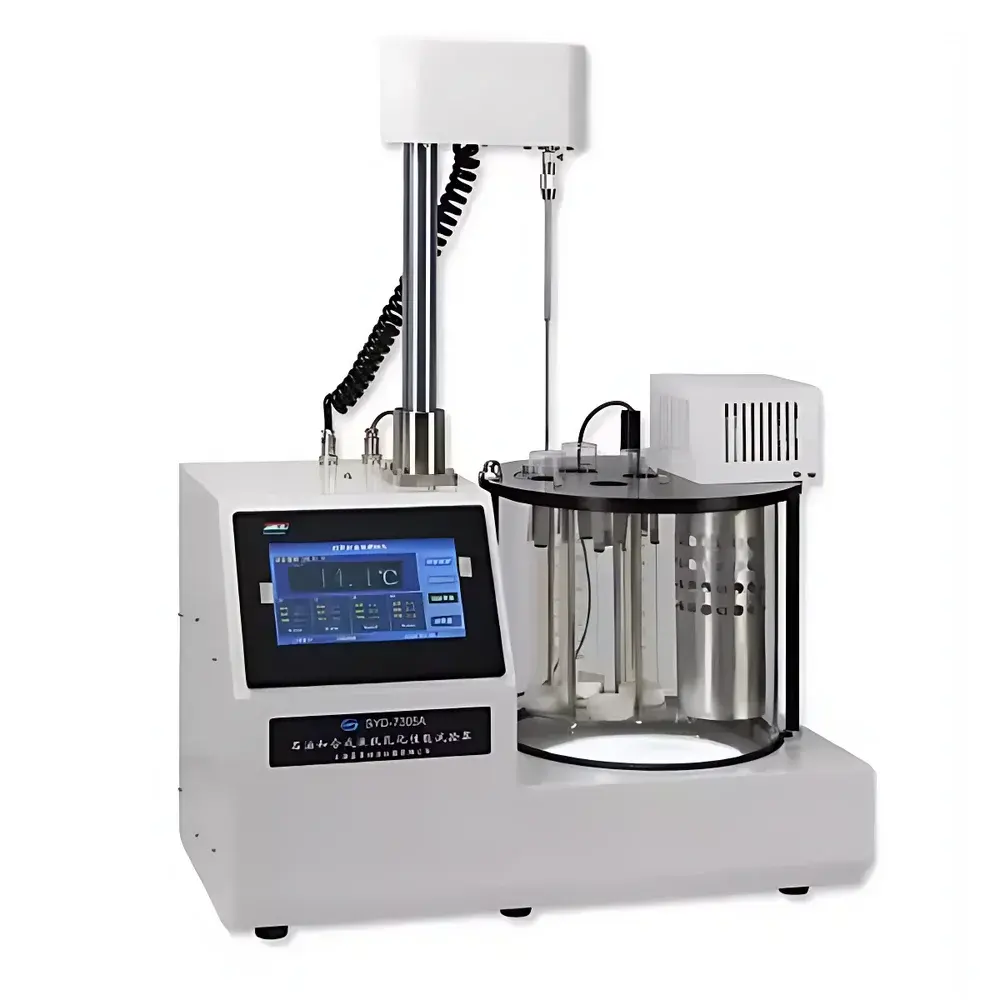
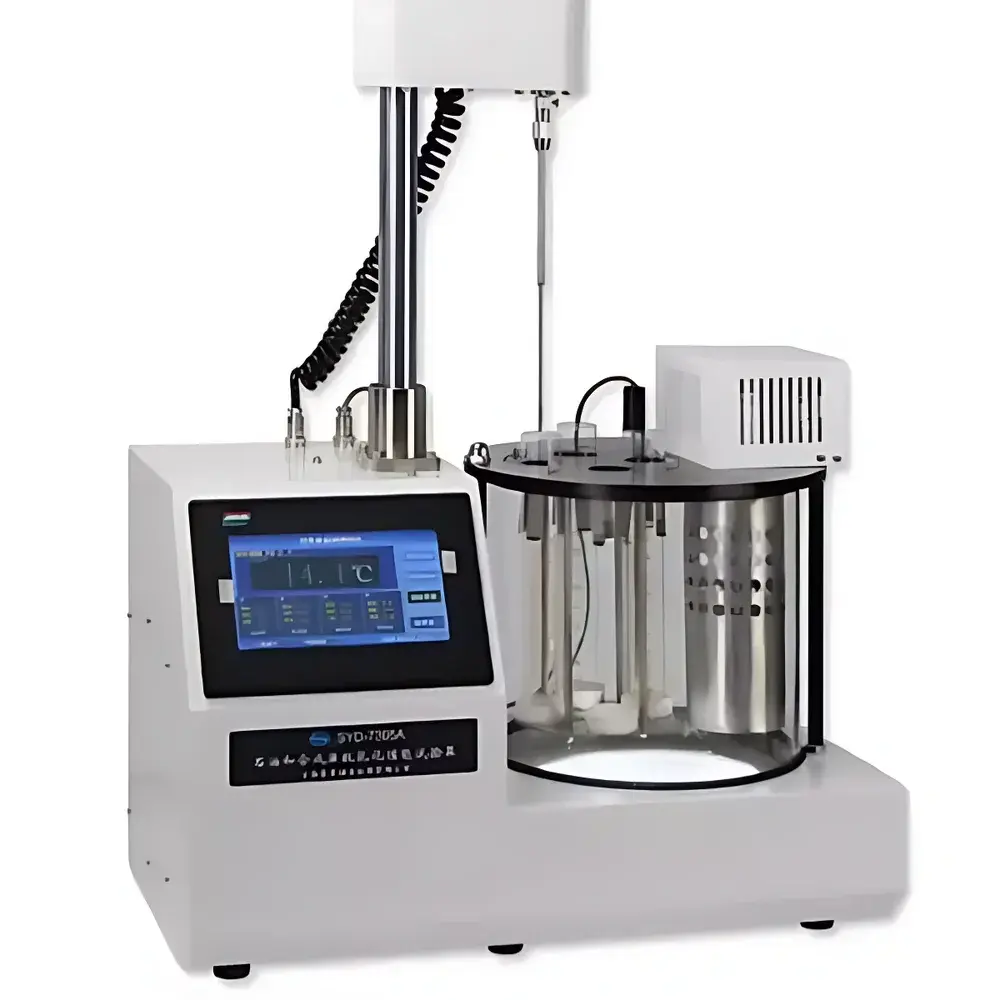
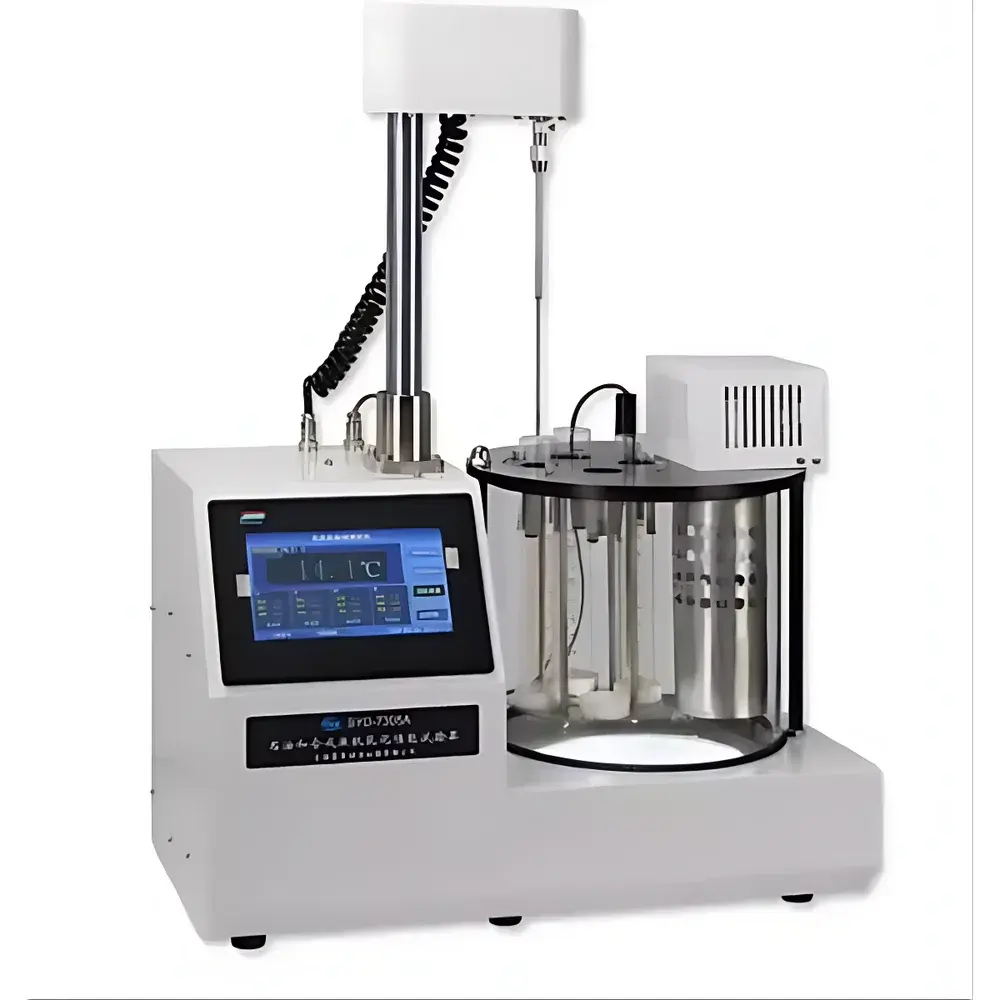
Changji Instruments SYD-7305A Emulsibility Tester
| Brand | Changji Instruments |
|---|---|
| Origin | Shanghai, China |
| Manufacturer Type | Authorized Distributor |
| Country of Origin | China |
| Model | SYD-7305A |
| Pricing | Available Upon Request |
| Temperature Control Range | Room Temperature to 100 °C |
| Temperature Stability | ±0.1 °C |
| Stirring Time Range | 0–100 minutes |
| Timing Range | 0–99.9 hours |
| Sample Capacity | 4 test positions |
| Data Storage Capacity | 350 test records |
| Power Supply | AC 220 V ±10%, 50 Hz ±10% |
| Max. Power Consumption | 1500 W |
| Operating Environment | 5–40 °C, RH <85% |
| Dimensions (L×W×H) | 520 × 330 × 550 mm |
| Net Weight | 23 kg |
Overview
The Changji Instruments SYD-7305A Emulsibility Tester is a precision-engineered laboratory instrument designed for the quantitative assessment of emulsion separation behavior in petroleum-based and synthetic lubricants, as well as in-service turbine oils. It operates in strict accordance with two key national standards of the People’s Republic of China: GB/T 7305 (“Test Method for Determining Water Separability of Petroleum and Synthetic Fluids”) and GB/T 7605 (“Test Method for Determining Demulsibility of In-Service Turbine Oils”). These standards align closely with internationally recognized methodologies—including ASTM D1401 (Standard Test Method for Emulsibility of Turbine Oils) and ISO 6614 (Petroleum Products — Determination of Emulsibility)—ensuring cross-compatibility for global quality control laboratories conducting routine oil condition monitoring and formulation validation.
Key Features
- 7-inch industrial-grade color touchscreen interface with real-time graphical display of temperature, stirring status, elapsed time, and phase separation progress—enabling intuitive visual tracking of each test cycle.
- Menu-driven human-machine interaction architecture with structured parameter input, error-resistant entry logic, and on-screen guidance—reducing operator training requirements and minimizing procedural deviation.
- Motorized vertical actuation system for sample stirring rods, delivering precise positional repeatability and minimal mechanical vibration during immersion and withdrawal—critical for maintaining consistent shear history across replicate tests.
- Optimized water bath circulation design featuring low-noise impeller agitation and high-efficiency thermal distribution—achieving uniform temperature across all four test wells within ±0.1 °C stability over extended durations (up to 99.9 hours).
- Integrated microprocessor-based timing and temperature regulation with dual-sensor feedback loops—supporting programmable ramp-and-hold profiles and automatic shutdown upon test completion or thermal fault detection.
Sample Compatibility & Compliance
The SYD-7305A accommodates standard 40-mL glass test tubes (as specified in GB/T 7305 and ASTM D1401), supporting both neat base oils and formulated lubricants containing additives such as anti-wear agents, rust inhibitors, and demulsifiers. Its four-position configuration enables parallel testing of multiple samples or replicates under identical thermal and mechanical conditions—enhancing statistical robustness for QC release or R&D screening. The instrument complies with fundamental GLP principles: all test parameters are digitally logged with timestamps, and stored data includes ambient conditions, setpoints, actual measured temperatures, and user-assigned identifiers. While not inherently 21 CFR Part 11 compliant out-of-the-box, its audit-ready data export (via USB) supports integration into validated LIMS environments where electronic record integrity and operator accountability are mandated.
Software & Data Management
Data acquisition and storage are handled internally by an embedded ARM-based controller. Each test record contains: date/time stamp, target and actual bath temperature, stirring duration, total demulsification time, operator ID (manually entered), and pass/fail flag based on visual phase separation criteria per GB/T 7605. Up to 350 complete test logs are retained in non-volatile memory and can be exported in CSV format via USB 2.0 port for downstream analysis in Excel or statistical software (e.g., JMP, Minitab). No proprietary software installation is required—raw files are human-readable and compatible with automated parsing scripts used in centralized lab informatics systems.
Applications
- Quality assurance of new turbine oils prior to commissioning in power generation facilities.
- Monitoring emulsibility degradation in in-service steam and gas turbine oils during scheduled maintenance intervals.
- Evaluating the impact of oxidation, hydrolysis, or additive depletion on water separation performance.
- Comparative screening of demulsifier package efficacy during lubricant reformulation.
- Supporting root-cause analysis of water-related bearing failures or control system valve sticking attributed to poor oil-water separation.
- Training laboratories and technical service centers in standardized demulsibility methodology per ISO/IEC 17025 competency requirements.
FAQ
What standards does the SYD-7305A comply with?
It is fully aligned with GB/T 7305 and GB/T 7605, and functionally equivalent to ASTM D1401 and ISO 6614 for emulsibility measurement.
Can the instrument be used for non-turbine oils?
Yes—it is validated for petroleum-based hydraulic fluids, gear oils, and synthetic ester- or polyalphaolefin (PAO)-based lubricants, provided they meet viscosity and density ranges specified in the referenced standards.
Is external calibration required?
The unit includes factory-calibrated PT100 temperature sensors; annual verification against NIST-traceable references is recommended per ISO/IEC 17025 internal calibration procedures.
Does it support automated reporting?
No built-in report generator exists, but exported CSV files contain all fields necessary for custom report templates or integration with enterprise lab management platforms.
What maintenance is needed for long-term reliability?
Routine cleaning of the water bath and stirring assemblies, periodic inspection of silicone seals, and verification of stir motor torque output every 500 operating hours ensure sustained repeatability and compliance with method-defined mechanical agitation specifications.



