
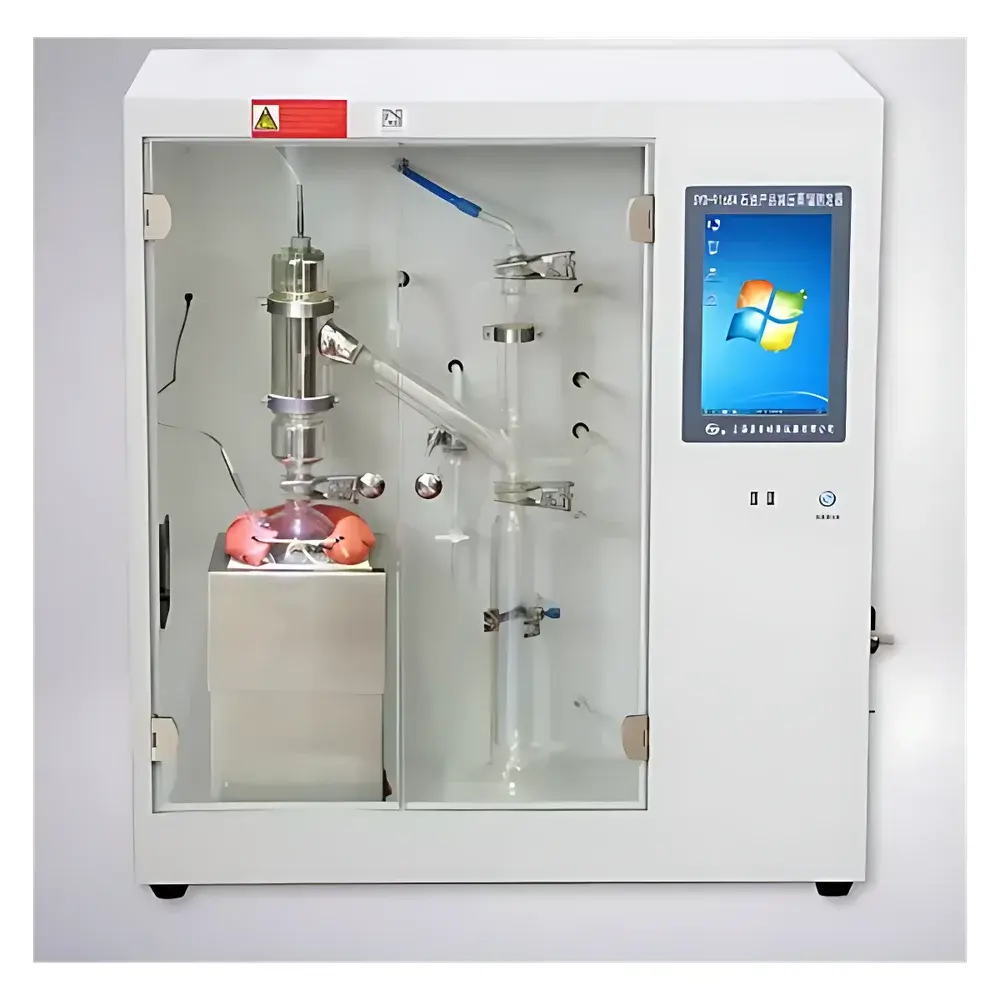
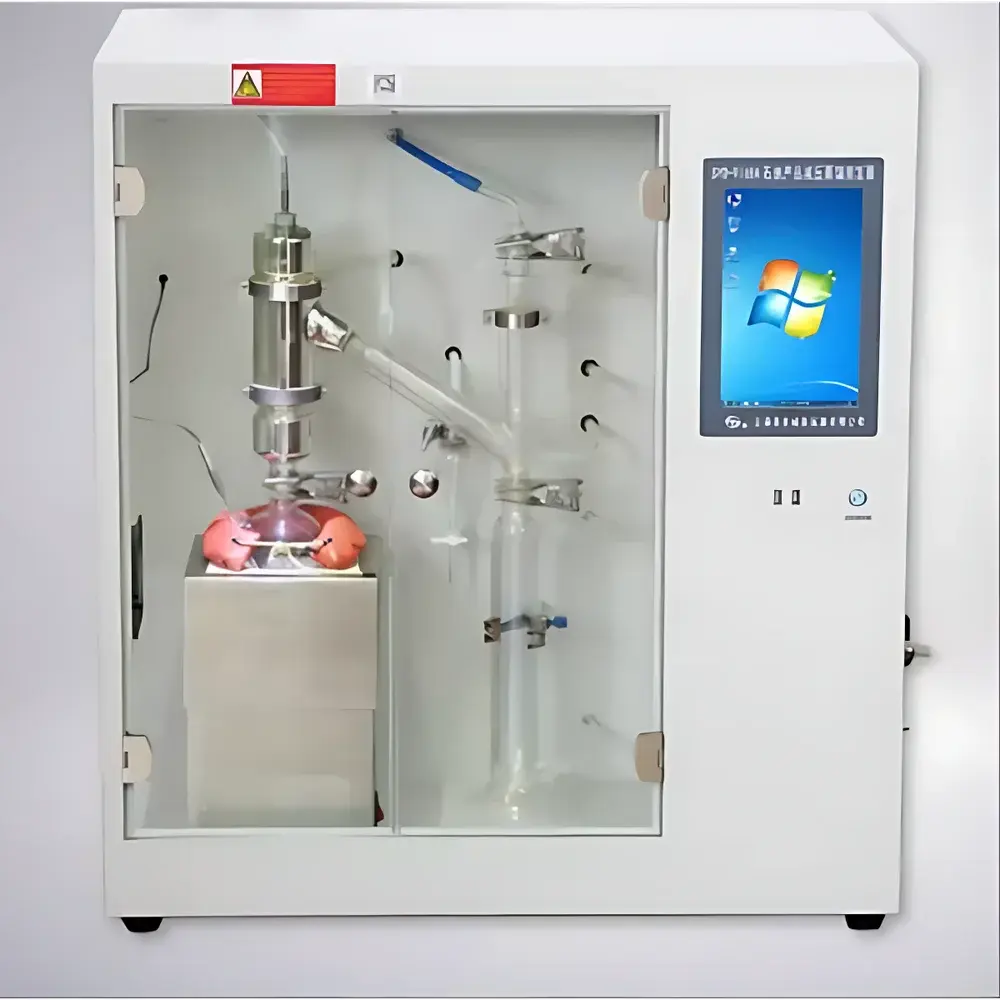
Changji Instruments SYD-9168A Vacuum Distillation Apparatus for Petroleum Products
| Brand | Changji Instruments |
|---|---|
| Origin | Shanghai, China |
| Model | SYD-9168A |
| Test Mode | Vacuum (Reduced Pressure) |
| Temperature Range | 30 °C to 80 °C ±3 °C (for condenser cooling bath) |
| Temperature Accuracy | ±0.5 °C |
| Absolute Pressure Control Range | 2, 5, 10, 20, 50 mmHg |
| Pressure Measurement Range | 2.00–170.00 mmHg ±0.01 mmHg |
| Pressure Control Precision | <0.01 mmHg (at residual pressure <7.5 mmHg) |
| Cold Trap Temperature | ≤−40 °C (Peltier-cooled) |
| Heating Power | 0–500 W adjustable |
| Total Power Consumption | ≤1800 W |
| Compliance | GB/T 9168 |
Overview
The Changji Instruments SYD-9168A Vacuum Distillation Apparatus is a fully integrated, microprocessor-controlled system engineered for precise determination of boiling point distributions of petroleum products under reduced pressure, in strict accordance with the Chinese national standard GB/T 9168—Test Method for Reduced-Pressure Distillation of Petroleum Products. This instrument enables accurate fractional distillation of volatile and semi-volatile hydrocarbon fractions—including naphthas, kerosenes, gas oils, and vacuum distillates—within a maximum observed distillation temperature of 400 °C at controlled sub-atmospheric pressures. The apparatus operates on the fundamental principle of vacuum-assisted vapor–liquid equilibrium separation: by lowering system pressure, the boiling points of high-boiling components are depressed, allowing thermal separation without thermal decomposition. Its design emphasizes repeatability, operator safety, and regulatory traceability—making it suitable for QC laboratories in refineries, independent testing labs, and R&D facilities engaged in crude assay, cut point analysis, and distillation curve validation.
Key Features
- Integrated industrial-grade control unit with 10.1-inch capacitive touchscreen interface for intuitive parameter setup, real-time monitoring, and step-by-step procedural guidance.
- Automated vacuum regulation system featuring closed-loop PID control of absolute pressure across six preset setpoints (2, 5, 10, 20, and 50 mmHg), with continuous digital pressure feedback and <0.01 mmHg resolution.
- Peltier-based cold trap operating at ≤−40 °C, eliminating cryogenic consumables while ensuring efficient condensation and capture of high-molecular-weight vapors and non-condensables.
- Motorized vertical lift stage with programmable height limits and soft-stop logic—designed to safely position ASTM D1160-compliant glassware (e.g., 125-mL flask, 600-mm condenser) without manual handling.
- Auto-recovery condensate management: condensed distillate collected in the cold trap is thermally released and gravity-fed into a calibrated recovery vessel upon completion of the test cycle.
- Nitrogen purge interlock: system prompts user to initiate inert gas backfilling prior to venting, preventing oxidative degradation of residues and mitigating explosion hazards associated with air ingress into hot, hydrocarbon-laden vacuum chambers.
- Real-time atmospheric-equivalent temperature conversion: onboard algorithm applies ASTM D1160 Annex A correction factors to raw distillation temperatures based on instantaneous measured pressure—eliminating manual lookup tables and reducing human error.
Sample Compatibility & Compliance
The SYD-9168A accommodates standard ASTM/GB glassware configurations for reduced-pressure distillation, including 125-mL round-bottom flasks, 600-mm air condensers, and graduated receiving cylinders. It supports sample volumes from 100 mL to 200 mL and is validated for use with crude oils, straight-run distillates, hydrotreated fractions, and synthetic feedstocks exhibiting initial boiling points >30 °C and final boiling points up to 400 °C under vacuum. The system conforms to GB/T 9168 requirements for pressure stability (<±0.5 mmHg over 10 min), temperature uniformity (±0.5 °C), and reproducibility (≤1.0 °C for duplicate runs). While not certified to ISO/IEC 17025 out-of-the-box, its audit-ready data logging architecture—including timestamped raw sensor values, user actions, and system events—supports laboratory accreditation under GLP or refinery-specific QA protocols.
Software & Data Management
All operational parameters, sensor readings (pressure, bath temperature, flask surface temperature), and distillate volume/time profiles are logged automatically at 1-second intervals. Data files are stored internally in CSV format with embedded metadata (operator ID, sample ID, method version, calibration status). Export is supported via USB 2.0 port to external drives or direct printing via USB-connected thermal or inkjet printers. The firmware includes configurable report templates compliant with internal QA templates and aligns with foundational elements of FDA 21 CFR Part 11—such as electronic signatures (via password-protected login), audit trails, and immutable data archives—though full Part 11 compliance requires supplementary procedural controls and IT validation by the end user.
Applications
- Determination of T10, T50, T90 cut points for jet fuel (ASTM D1655) and diesel (ASTM D975) specifications.
- Crude assay support: characterization of vacuum gas oil (VGO) yield and quality for FCC or hydrocracking feed evaluation.
- Monitoring thermal stability of lubricant base stocks during vacuum stripping operations.
- Verification of solvent recovery efficiency in petrochemical extraction units.
- Research-scale fractionation of bio-oils and pyrolysis liquids where low-residence-time distillation minimizes secondary cracking.
FAQ
What vacuum levels does the SYD-9168A support, and how is pressure stabilized?
The instrument provides five discrete absolute pressure setpoints: 2, 5, 10, 20, and 50 mmHg. Pressure is actively regulated using a digitally controlled vacuum pump and proportional solenoid valve, maintaining stability within ±0.01 mmHg below 7.5 mmHg and ±1% of setpoint above that threshold.
Is the system compatible with ASTM D1160 test procedures?
Yes—the mechanical configuration, glassware geometry, heating profile, and pressure control range comply with the physical requirements of ASTM D1160. Users must validate method equivalence per their internal SOPs, particularly regarding cold trap placement and distillate collection timing.
Does the apparatus include built-in calibration verification tools?
It features self-diagnostics for pressure transducer zero drift and temperature sensor continuity checks. NIST-traceable calibration of the pressure sensor and PT100 bath probe is recommended annually and must be performed externally using certified standards.
Can the SYD-9168A operate unattended through an entire distillation cycle?
Yes—once initiated, the system autonomously manages heating ramp, vacuum stabilization, distillate collection, cold trap warming, nitrogen purging, and data archiving. However, operator presence is required for glassware loading/unloading and post-test residue inspection per GB/T 9168 Section 7.
What maintenance is required for the Peltier cold trap?
No consumables or refrigerants are needed. Routine maintenance consists of periodic cleaning of the cold plate surface and inspection of thermal interface paste integrity every 6 months under continuous operation.





