
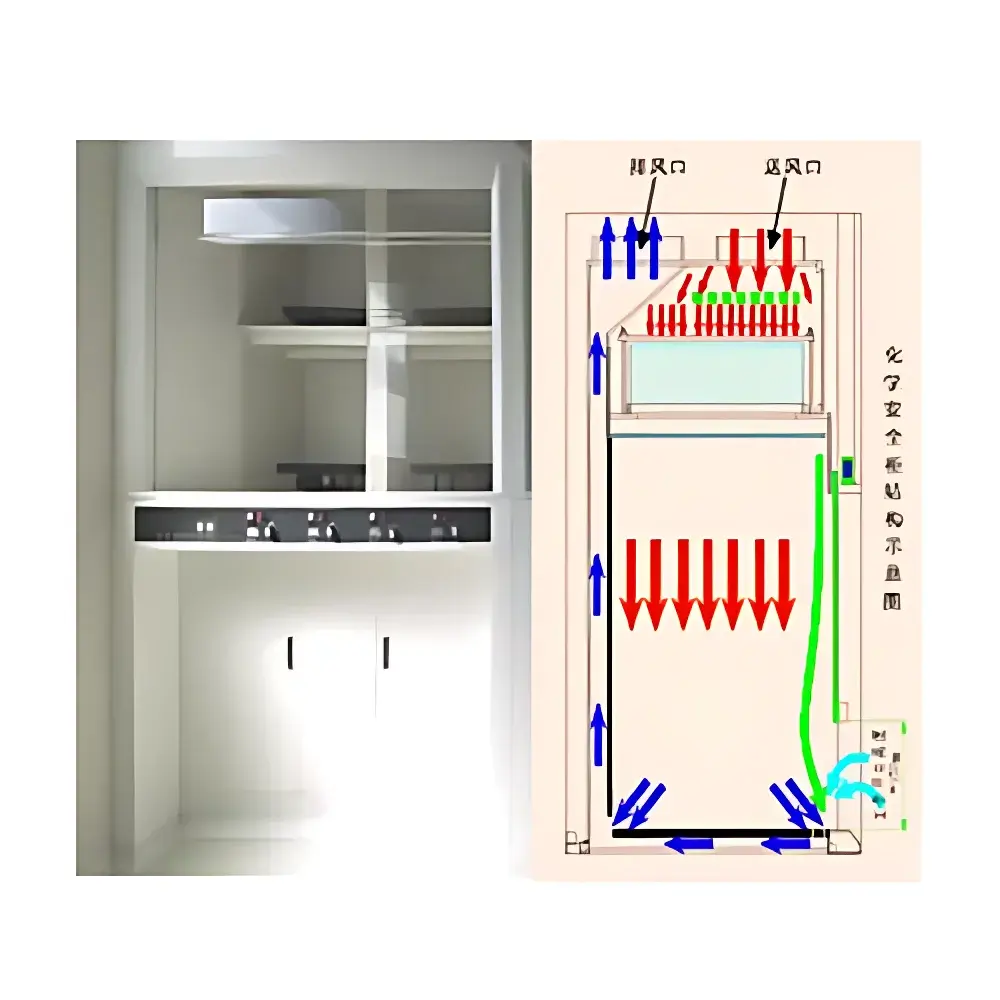
Chemical Safety Cabinet (LabTech LT Series Fume Hood)
| Brand | LabTech |
|---|---|
| Origin | Beijing, China |
| Manufacturer Type | Direct Manufacturer |
| Country of Origin | China |
| Model | LT |
| Construction Material | All-Steel Enclosure |
| Configuration | Single-Face Operation Fume Hood |
| Airflow System Options | Top Supply/Top Exhaust, Top Supply/Bottom Exhaust, Bottom Supply/Top Exhaust, Recirculating Mode, FFU-Equipped |
| Internal Cleanroom Class | ISO Class 5 (100-Particle Count) or ISO Class 4 (10-Particle Count) Available |
| Cabinet Liner Material | Lead-Free Flame-Retardant PVC Welded Panels |
| Customization | Yes — including Class 100 Cleaning Cabinets, Central Sampling Cabinets, and Class 100 Drying Cabinets |
Overview
The LabTech LT Series Chemical Safety Cabinet is an engineered containment solution designed for ultra-trace and sub-trace analytical sample preparation in environmental, pharmaceutical, clinical, and materials laboratories. Unlike conventional fume hoods that prioritize vapor removal, this cabinet integrates controlled laminar airflow with stringent particulate and chemical contamination control—functioning as a hybrid between a Class 100 (ISO 5) clean bench and a chemically resistant fume hood. It operates on the principle of unidirectional vertical or horizontal laminar flow, generated by high-efficiency particulate air (HEPA) or ultra-low penetration air (ULPA) filters, combined with precisely balanced supply and exhaust dynamics to maintain negative pressure differentials and prevent cross-contamination. The cabinet is intended for use in pre-analytical workflows where background interference from airborne metals, organics, or aerosols must be reduced to parts-per-quadrillion (ppq) levels—critical for ICP-MS, HR-GC-MS, and low-level radiochemical analysis.
Key Features
- Structural integrity: Fully welded all-steel enclosure with reinforced frame and corrosion-resistant epoxy-powder-coated finish for long-term durability in aggressive chemical environments.
- Contamination control: Internally configurable to meet ISO 14644-1 Class 4 (10 particles ≥0.1 µm per cubic foot) or Class 5 (100 particles ≥0.5 µm per cubic foot), validated via particle counter protocols compliant with ISO 21501-4.
- Material safety: Interior liner fabricated from lead-free, UL94-V0 rated flame-retardant PVC, certified for resistance to acids (e.g., HNO₃, HF), bases (e.g., NaOH), and organic solvents without outgassing or degradation.
- Modular airflow architecture: Supports multiple ventilation configurations—including top-supply/top-exhaust (standard), top-supply/bottom-exhaust (for volatile density stratification), bottom-supply/top-exhaust (for heat-generating processes), recirculating mode with dual-stage carbon + HEPA filtration (for solvent recovery applications), and FFU-integrated vertical laminar flow modules.
- Operator protection: Face velocity maintained at 0.4–0.6 m/s across the sash plane per ANSI/ASHRAE 110 and EN 14175 standards; integrated sash position sensor and airflow alarm system provide real-time monitoring and fail-safe shutdown capability.
Sample Compatibility & Compliance
The LT Series accommodates a broad spectrum of sample types—including aqueous digests, acid-washed filters, polymer matrices, biological tissues, and semiconductor wafers—without introducing detectable background contributions. Its design conforms to key international safety and quality frameworks: structural compliance with EN 14175-3 (fume hood performance), electrical safety per IEC 61010-1, and material biocompatibility aligned with USP Class VI testing requirements. For regulated environments, optional audit-trail-enabled controllers support 21 CFR Part 11-compliant data logging (user access, airflow setpoints, filter life, alarm events), facilitating GLP and GMP documentation workflows.
Software & Data Management
Equipped with LabTech’s proprietary Cabinet Control Interface (CCI v3.2), the system provides local touchscreen operation and remote Ethernet/IP connectivity. CCI records time-stamped operational parameters—including static pressure differential (±0.1 Pa resolution), filter saturation status, cumulative runtime, and sash height—with export capability to CSV or LIMS-compatible XML schema. Optional integration with laboratory infrastructure management platforms enables centralized monitoring across multi-cabinet installations and automated calibration scheduling aligned with ISO/IEC 17025 clause 6.4.2.
Applications
- Ultra-clean sample digestion for trace metal analysis (e.g., EPA Method 200.8, ISO 17294-2)
- Preparation of reference materials and calibration standards under low-background conditions
- Handling of isotopically enriched compounds and radiological samples (in conjunction with appropriate shielding)
- Acid leaching and flux-based dissolution of geological and metallurgical specimens
- Assembly and packaging of high-purity reagents and certified reference materials (CRMs)
- Controlled drying and storage of pre-cleaned quartzware, PFA vials, and membrane filters
FAQ
What cleanroom classification does the LT cabinet achieve?
It is factory-configurable to ISO Class 4 (10 particles/ft³ @ 0.1 µm) or ISO Class 5 (100 particles/ft³ @ 0.5 µm), verified using calibrated light-scattering particle counters.
Can the cabinet be integrated into an existing lab HVAC system?
Yes—ductless (recirculating) and ducted (exhaust) modes are supported; static pressure compatibility and exhaust interface dimensions are provided in the installation manual.
Is validation documentation available for IQ/OQ/PQ protocols?
LabTech supplies a full validation toolkit—including test templates, acceptance criteria aligned with ISO 14644 and EN 14175, and raw data logs—for user-executed or third-party-conducted qualification.
Does the cabinet support hazardous gas monitoring integration?
Optional ports and Modbus RTU interface enable connection to external toxic gas sensors (e.g., HF, Cl₂, H₂S) with programmable alarm thresholds and interlocked sash closure.
What maintenance intervals are recommended for filters and airflow verification?
HEPA/ULPA filters require integrity testing every 6 months (DOP/PAO scan); carbon filters in recirculating mode should be replaced every 12 months or after 1,000 hours of solvent exposure, whichever occurs first.



