
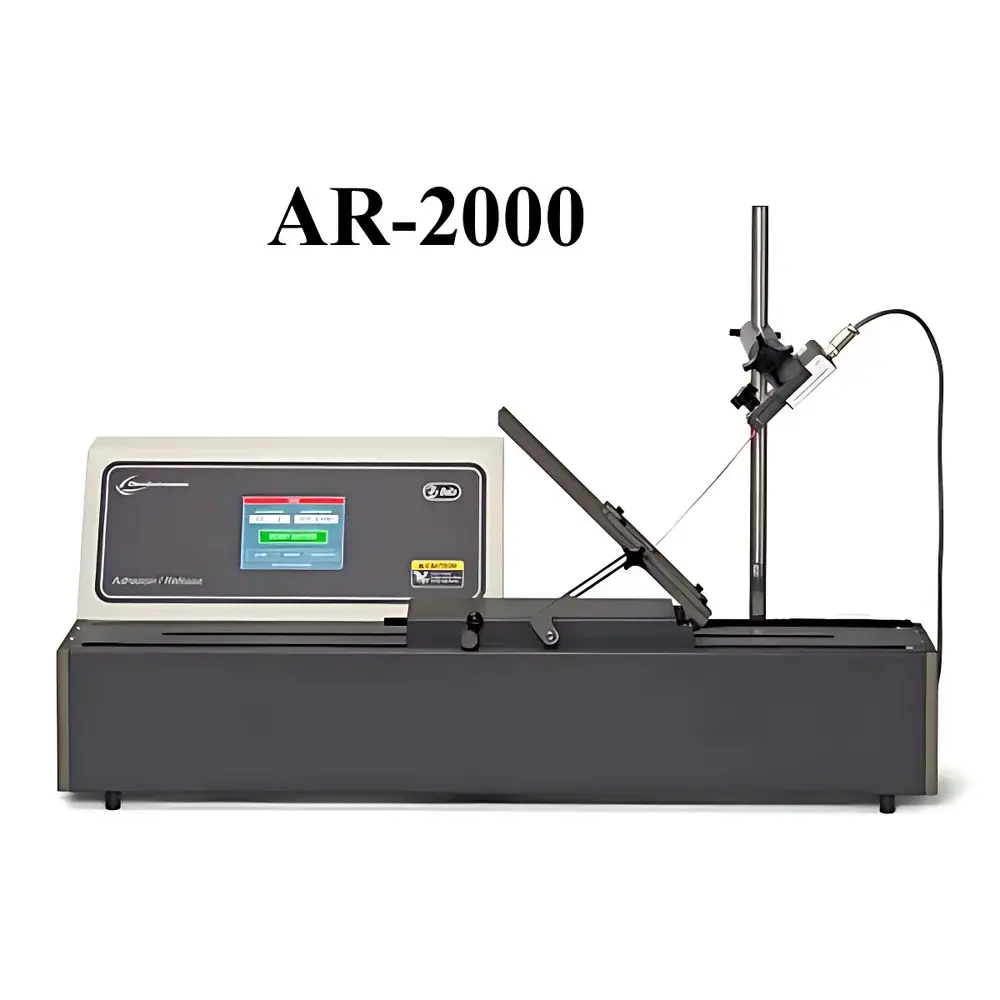
ChemInstruments AR-2000 Advanced Adhesion & Peel Testing System
| Origin | USA |
|---|---|
| Manufacturer Type | Authorized Distributor |
| Origin Category | Imported Instrument |
| Model | AR-2000 |
| Pricing | Available Upon Request |
| Display | 5.7-inch color touchscreen |
| Speed Range | 1–1200 ipm (3–3048 cpm) |
| Peel Angle Selection | 90° to 180° |
| Load Cell Options | 2, 5, 10, or 25 lbf |
| Sample Length Range | 0.5″–12″ (12.7–305 mm) |
| Operating Temperature | 0–70 °C (32–150 °F) |
| Accuracy | ±0.1% of full-scale load cell |
| Power Input | 220 VAC, 50/60 Hz |
| Dimensions (H×W×D) | 61 × 91 × 33 cm |
| Weight | 42 kg |
| Compliance Standards | PSTC-101 (A–F), PSTC-4, PSTC-15, PSTC-55, ASTM D3330, TLMI L-IA1/L-IA2/L-IA3, AFERA 4001 R11, FINAT FTM 1–6, 10, 11 |
| Data Interface | USB 2.0 |
| Software Integration | EZ-Date™ for data export and report generation |
Overview
The ChemInstruments AR-2000 Advanced Adhesion & Peel Testing System is a precision-engineered benchtop instrument designed for quantitative measurement of peel adhesion, tack, and shear resistance in pressure-sensitive tapes, labels, films, laminates, and functional coatings. Built upon the proven architecture of the AR-1000 platform, the AR-2000 incorporates enhanced mechanical stability, real-time digital speed control via encoder feedback, and intuitive touchscreen operation—enabling consistent, repeatable force measurements under standardized test geometries. Its operating principle follows controlled tensile separation at defined angles (90° or 180°), where a fixed-rate peeling motion induces interfacial stress between substrate and adhesive layer. Force transduction is performed via high-stability load cells (2–25 lbf), calibrated to ±0.1% of full scale, ensuring traceability to NIST-traceable standards. The system is purpose-built for laboratories and QC environments requiring compliance with internationally recognized test protocols across packaging, medical device labeling, electronics assembly, and automotive bonding applications.
Key Features
- 5.7-inch high-resolution color touchscreen interface enabling fully standalone operation—no external PC required for basic test execution or parameter configuration
- Rugged aluminum-and-steel frame engineered for long-term durability in industrial production-floor environments, including resistance to vibration and ambient temperature fluctuations
- Digital servo-controlled drive system with optical encoder feedback ensures precise, non-drifting speed regulation across the full 1–1200 ipm range (3–3048 cpm)
- Modular load cell selection (2, 5, 10, or 25 lbf) allows optimization of resolution and dynamic range for low-tack films or high-strength structural adhesives
- Adjustable peel angle mechanism supporting both 90° and 180° configurations per PSTC, ASTM, and FINAT specifications
- Integrated USB 2.0 port for direct data transfer to Windows-based systems running EZ-Date™ software—supporting CSV export, statistical summary, and customizable report templates
Sample Compatibility & Compliance
The AR-2000 accommodates specimens from 0.5″ to 12″ in length (12.7–305 mm), with standard fixture geometry optimized for flat, flexible substrates including PET, PP, paper, foil, and silicone-coated release liners. Its mechanical design conforms to dimensional and procedural requirements outlined in PSTC-101 (Methods A–F), ASTM D3330 (Standard Test Method for Peel Adhesion of Pressure-Sensitive Tape), TLMI L-IA1 through L-IA3 (for label performance), AFERA 4001 R11 (European peel test protocol), and FINAT FTM 1–6, 10, and 11 (functional testing methods for self-adhesive materials). All hardware and firmware are validated for GLP-compliant data integrity; audit trails, user access logs, and electronic signatures can be enabled within EZ-Date™ to meet FDA 21 CFR Part 11 readiness requirements when deployed in regulated manufacturing settings.
Software & Data Management
EZ-Date™ software provides comprehensive post-test analysis capabilities, including real-time graphing of force vs. distance, automatic peak detection, average peel force calculation, and coefficient-of-variation reporting. Raw data files retain timestamped metadata (operator ID, test method, load cell serial number, environmental conditions) for full traceability. Export options include CSV, PDF, and Excel-compatible formats suitable for integration into LIMS or ERP platforms. The software supports multi-user permission levels, configurable pass/fail limits, and batch-level statistical process control (SPC) charting—facilitating routine quality assurance workflows in ISO 9001-certified facilities.
Applications
- Quantitative validation of pressure-sensitive adhesive performance during raw material qualification and incoming inspection
- Process development and optimization of coating line parameters (e.g., drying temperature, cure energy, dwell time)
- Stability assessment of adhesive bonds under accelerated aging conditions (thermal, humidity, UV exposure)
- Comparative evaluation of competitive tape formulations against internal specification limits
- Supporting technical documentation for regulatory submissions in medical device packaging (ISO 11607) and pharmaceutical labeling (USP )
FAQ
Does the AR-2000 support automated test sequencing for unattended operation?
Yes—EZ-Date™ enables programmable multi-step test sequences with pre-defined dwell times, speed ramps, and pass/fail logic, allowing overnight batch testing with minimal operator intervention.
Can the system be calibrated in-house using standard weights?
While field verification with certified deadweights is possible, full calibration requires traceable reference standards and must be performed by authorized service personnel to maintain compliance with ISO/IEC 17025 and ASTM E4 guidelines.
Is the AR-2000 compatible with third-party LIMS or MES platforms?
Yes—via CSV export or optional OPC UA connectivity (available as a firmware upgrade), enabling bidirectional data exchange with enterprise laboratory and manufacturing execution systems.
What maintenance intervals are recommended for sustained accuracy?
Load cell zero-point verification is advised before each test session; full mechanical inspection and encoder alignment verification are recommended every 6 months or after 5000 test cycles, whichever occurs first.



