
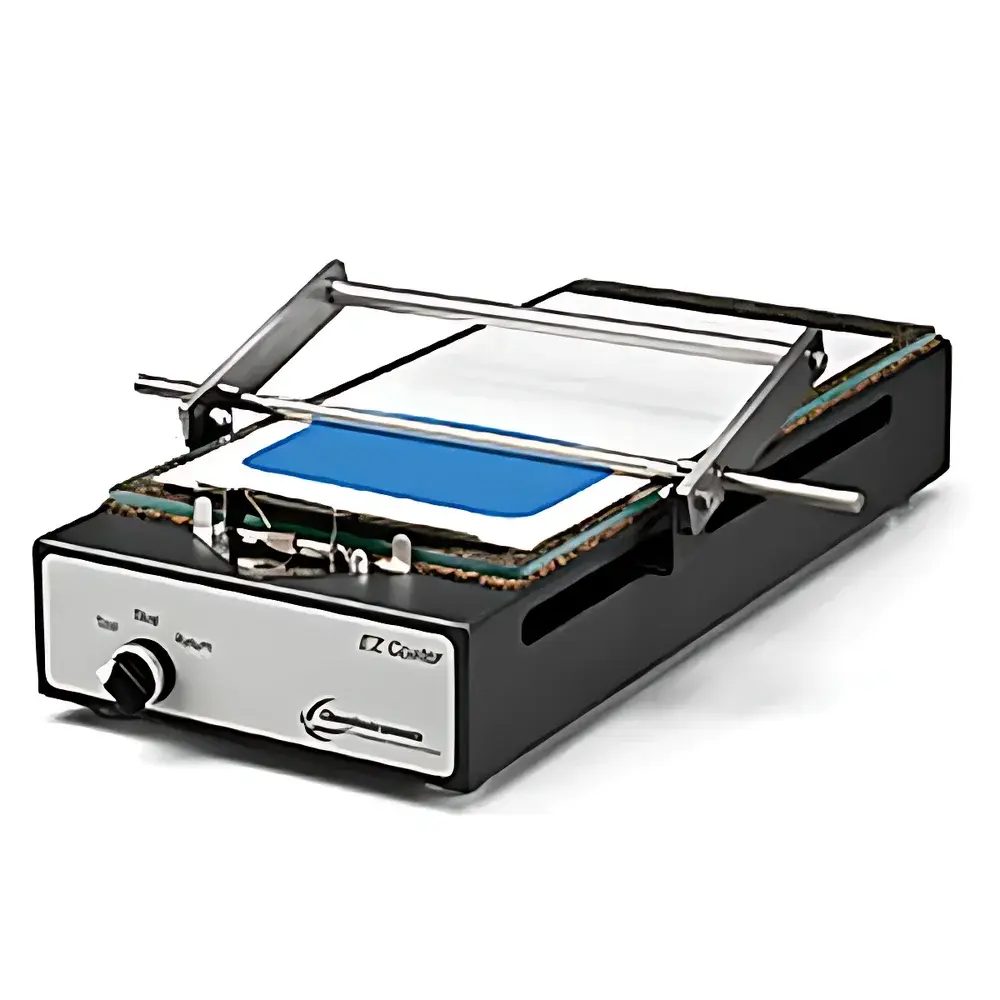
ChemInstruments EC-100 Motorized Fixed-Speed Drawdown Coater
| Origin | USA |
|---|---|
| Manufacturer Type | Authorized Distributor |
| Origin Category | Imported |
| Model | EC-100 |
| Price | Upon Request |
| Coating Area | 220 mm × 340 mm |
| Coating Speed | 1.19 m/min (fixed) |
| Coating Bed Material | Float Plate Glass |
| Rod Diameter | 13 mm |
| Rod Length | 300 mm |
| Maximum Coating Load | 600 g |
| Operating Temperature Range | 0 °C to 70 °C |
| Power Supply | 120 V AC, 50/60 Hz |
| Dimensions (L×W×H) | 56 cm × 30 cm × 18 cm |
| Net Weight | 8.2 kg |
| Optional Accessories | Wire-Wound Rods |
Overview
The ChemInstruments EC-100 Motorized Fixed-Speed Drawdown Coater is an engineered solution for standardized sample preparation in quality control, R&D, and regulatory testing laboratories. It operates on the principle of controlled wire-wound rod drawdown—where a precisely wound stainless-steel rod traverses a substrate at a fixed linear velocity across a rigid float plate glass bed. This geometry ensures uniform shear application during film formation, minimizing variability introduced by manual technique. Unlike variable-speed coaters, the EC-100’s fixed 1.19 m/min traverse speed eliminates operator-dependent timing errors and reduces calibration complexity—making it especially suitable for routine QC environments where procedural consistency and audit traceability are critical. Its compact footprint (56 × 30 × 18 cm) and low mass (8.2 kg) enable seamless integration onto lab benches or production-floor workstations without requiring structural reinforcement or dedicated power conditioning.
Key Features
- Fixed-speed motorized drive system delivering precise, repeatable 1.19 m/min traverse velocity—engineered for high inter-operator reproducibility and minimal setup drift.
- Optically flat float plate glass coating bed (220 mm × 340 mm usable area) providing thermal stability and surface planarity essential for uniform wet-film thickness distribution.
- Ergonomic swing-arm rod holder with indexed loading slots—enabling rapid rod exchange and alignment verification without tools or recalibration.
- Integrated foam sheet support system accommodating substrates of varying rigidity (e.g., paper, polymer films, metal foils) while maintaining consistent contact pressure during drawdown.
- Thermally stable housing rated for continuous operation between 0 °C and 70 °C—compatible with solvent-based, waterborne, and UV-curable formulations.
- Compliance-ready design: CE-marked power supply (120 V AC, 50/60 Hz), grounded chassis, and non-corrosive anodized aluminum frame meeting general laboratory safety standards (IEC 61010-1).
Sample Compatibility & Compliance
The EC-100 accommodates standard sheet substrates up to 340 mm in length and 220 mm in width—including ASTM D823-compliant Leneta charts, ISO 2808 test panels, and custom-cut coupons. Its 13 mm diameter × 300 mm long rod interface accepts industry-standard wire-wound rods (e.g., RD series, Elcometer 3100) sold separately—allowing users to select metering rods calibrated for specific wet-film thickness ranges (e.g., 12 µm to 250 µm). The system supports method validation per ASTM D1308 (resistance to household chemicals), ASTM D3359 (adhesion by tape test), and ISO 2409 (cross-cut adhesion), as well as internal SOPs aligned with GLP and GMP frameworks. No firmware or software components require FDA 21 CFR Part 11 compliance; however, raw operational logs (start/stop time, ambient temperature) may be manually recorded for audit purposes.
Software & Data Management
The EC-100 is a hardware-only instrument with no embedded microprocessor, touchscreen, or digital interface. All operation is electro-mechanically controlled via a sealed induction motor and mechanical speed governor—eliminating firmware vulnerabilities, software licensing, or data export dependencies. This architecture ensures long-term operational integrity and simplifies qualification (IQ/OQ) under regulated environments where electronic records are not mandated. Users maintain full control over documentation workflows: coating parameters (rod type, substrate ID, batch number, ambient conditions) are recorded externally using LIMS-integrated spreadsheets or paper-based lab notebooks compliant with ISO/IEC 17025 clause 7.5.2.
Applications
- Preparation of standardized coated panels for gloss, hardness, pencil adhesion, and impact resistance testing (ASTM D523, D3363, D3359, D2794).
- Routine viscosity correlation studies using rod selection to generate known wet-film thicknesses for rheological characterization of architectural paints and industrial coatings.
- QC screening of inkjet and flexographic inks—ensuring batch-to-batch consistency in optical density and drying behavior across print-relevant substrates.
- Accelerated aging studies requiring identical initial film morphology across multiple exposure chambers (e.g., QUV, Xenon arc).
- Adhesive bond-line simulation for peel strength and shear testing (ASTM D903, D1002), where controlled coat weight directly influences joint performance.
FAQ
Is the EC-100 compatible with international voltage standards (e.g., 230 V AC)?
No—the EC-100 is configured exclusively for 120 V AC, 50/60 Hz input. A step-down transformer is required for use outside North American and Japanese markets.
Can the coating speed be adjusted?
No—speed is mechanically fixed at 1.19 m/min to ensure metrological stability and eliminate user-induced variability.
What rod specifications are supported?
Any standard 13 mm diameter, 300 mm long wire-wound rod with a cylindrical shank and defined wire pitch (e.g., Elcometer RD10–RD40, Paul N. Gardner Co. rods). Rods are purchased separately.
Does the unit include a coating rod?
No—rods are optional accessories. The base configuration includes only the coater body, glass bed, foam support sheets, and power cord.
How is maintenance performed?
Routine cleaning involves wiping the glass bed with isopropyl alcohol and lint-free wipes; the rod holder pivot points require annual lubrication with food-grade silicone grease. No scheduled calibration is required due to fixed-speed mechanical design.





