
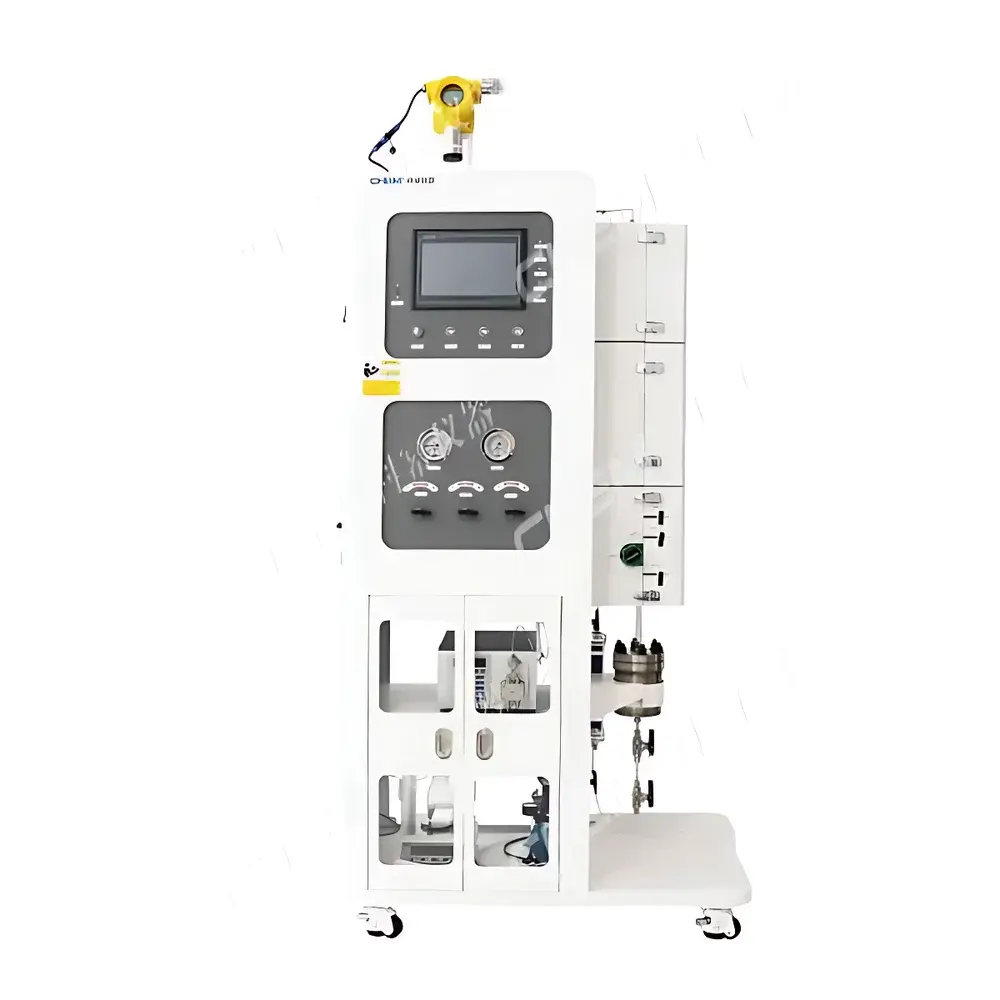
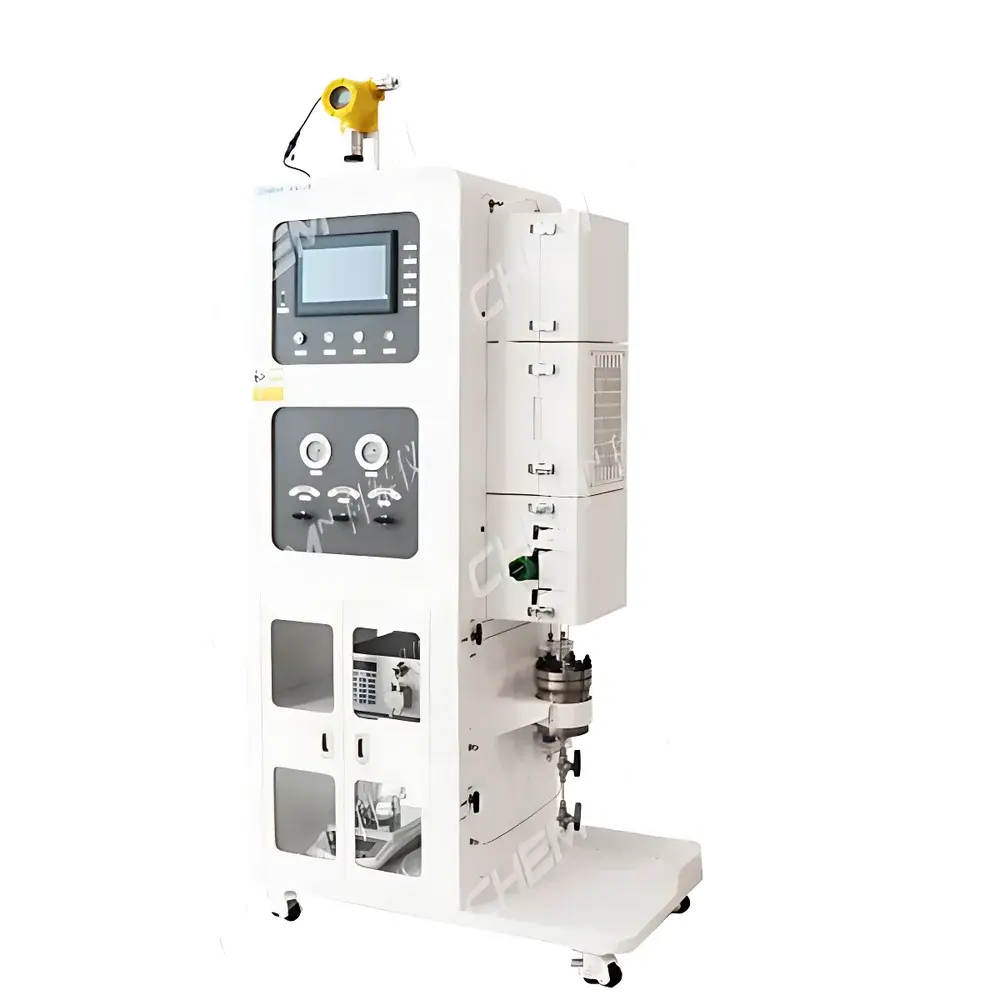
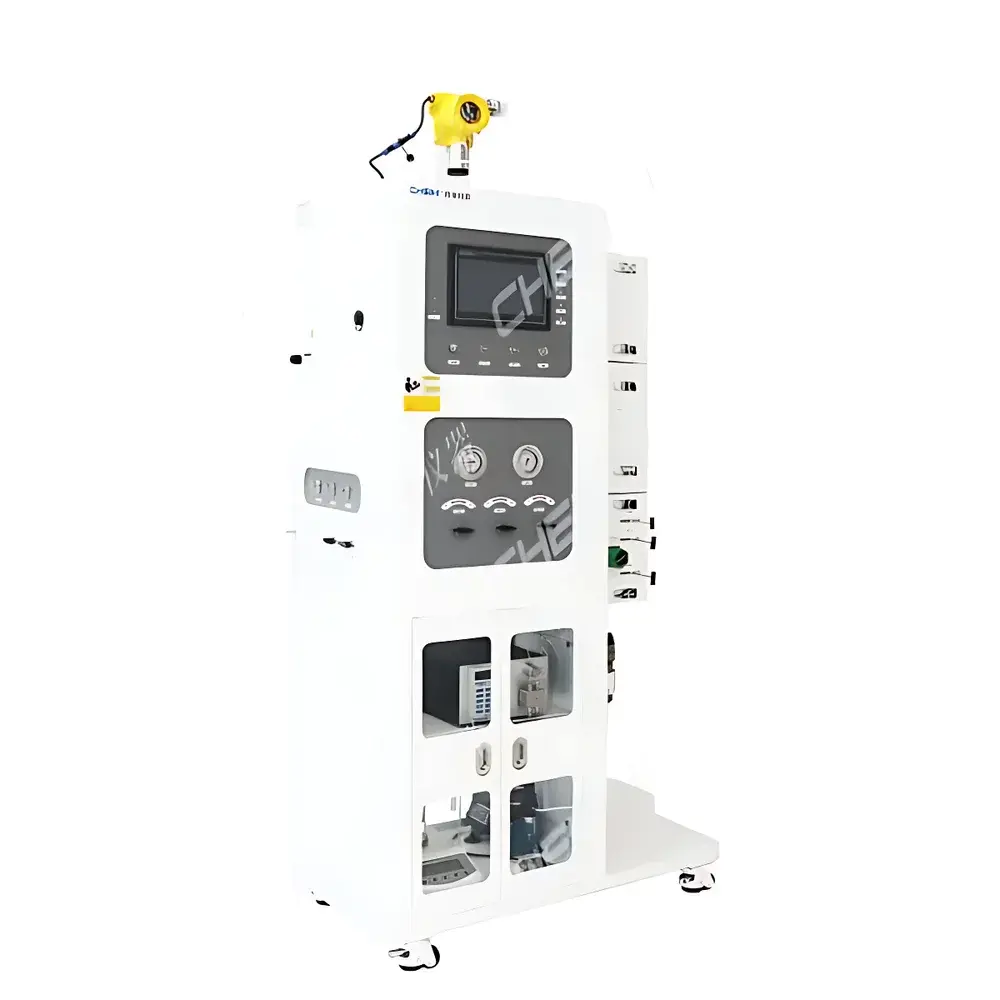
Chemn CFRF-L1G3-600 Hydrodechlorination Fixed-Bed Reactor with Tri-Gas & Single-Liquid Feed
| Brand | Chemn |
|---|---|
| Origin | Anhui, China |
| Model | CFRF-L1G3-600 |
| Design Temperature | 600 °C |
| Design Pressure | 6 MPa (60 bar) |
| Catalyst Bed Volume | 1–5 mL |
| Heating Zone Configuration | Triple-Zone Furnace (80 mm isothermal length per zone) |
| Reactor Tube Material | Hastelloy C-276 |
| Gas Inlets | 3 independent mass-flow-controlled channels |
| Liquid Inlet | 1 precision syringe pump or HPLC-grade liquid delivery channel |
| Safety Systems | Integrated pressure relief valve, dual-stage overtemperature/overpressure alarms, combustible gas detector with audible/visual alert |
| Power Supply | 220 V, 50 Hz |
| Dimensions (W×D×H) | 1000 mm × 500 mm × 1830 mm |
| Data Interface | Local HMI touchscreen + Ethernet-enabled remote PC control (Modbus TCP / OPC UA compatible) |
Overview
The Chemn CFRF-L1G3-600 is a purpose-engineered fixed-bed catalytic reactor system designed for high-pressure, high-temperature hydrodechlorination studies—particularly the selective conversion of trichloroethylene (TCE) or chlorotrifluoroethylene (CTFE) to trifluoroethylene (TFE) under controlled hydrogenation conditions. It operates on classical heterogeneous catalysis principles, where gaseous reactants (e.g., H2, CTFE, inert carrier gas) and a volatile liquid feed (e.g., CTFE dissolved in solvent or neat liquid phase) are co-fed into a vertically oriented, Hastelloy C-276 reaction tube packed with solid catalyst. The reactor employs a triple-zone furnace architecture to establish a stable, axially uniform isothermal region (80 mm), minimizing thermal gradients that could compromise kinetic fidelity or induce undesired side reactions such as cracking or polymerization. All wetted components—including the reactor tube, fittings, and pre-mixing coil—are rated for continuous operation at 6 MPa and 600 °C, enabling rigorous evaluation of catalyst stability, deactivation mechanisms, and long-term performance under industrially relevant severity conditions.
Key Features
- Triple-zone electric furnace with independent PID control per zone, delivering ±1 °C temperature uniformity across the 80 mm isothermal section
- Quick-release clamp-style reactor tube mounting, enabling tool-free catalyst loading/unloading while maintaining ASME BPVC Section VIII Div. 1 compliance for pressure boundary integrity
- Integrated vaporization and mixing subsystem: heated vaporizer vessel (up to 200 °C) coupled with static mixing coil to ensure complete liquid-phase volatilization and homogeneous gas-phase mixing prior to catalyst bed entry
- Product conditioning train featuring trace-heated transfer lines (maintained ≥120 °C), insulated separation chamber, and dual-path outlet routing—supporting either direct online GC analysis (with integrated HCl neutralization via alkali scrubber, water wash, and desiccant drying) or cryogenic condensation followed by liquid-phase offline GC/HPLC quantification
- Automated 6-port pneumatic switching valve for seamless alternation between analytical GC carrier gas flow and process effluent sampling stream—eliminating manual valve manipulation during extended runs
- Embedded industrial HMI with real-time visualization of all critical parameters (mass flow rates, zone temperatures, system pressure, alarm status); supports CSV export of time-stamped operational logs and remote supervision via secure Ethernet connection
Sample Compatibility & Compliance
The CFRF-L1G3-600 accommodates catalysts in pellet, extrudate, or powder form within the 1–5 mL bed volume range, with compatibility extending to noble metals (Pd, Pt), transition metal sulfides (NiMo, CoMo), and supported base-metal oxides. Its design conforms to ISO 4126-1 (safety valves), IEC 61508 (functional safety of electrical systems), and incorporates hardware-level safeguards aligned with OSHA 1910.119 (process safety management for highly hazardous chemicals). The system supports GLP-compliant data acquisition when paired with validated software; audit trails, user access levels, and electronic signature capability are available through optional Chemn ControlSuite™ software (21 CFR Part 11 ready).
Software & Data Management
Local operation is managed via a 7-inch capacitive touchscreen HMI running embedded Linux, supporting multi-language UI, configurable alarm thresholds, and automatic event logging (start/stop, parameter deviations, safety interlock triggers). For advanced workflow integration, the reactor communicates via Modbus TCP and OPC UA protocols—enabling synchronization with LIMS, DCS, or third-party automation platforms. Historical datasets (flow, T, P, valve positions) are timestamped and stored internally (32 GB onboard flash) with USB export functionality. Optional Chemn ControlSuite™ provides full remote desktop access, script-based sequence execution (e.g., ramp-hold-cool cycles), and automated report generation compliant with ASTM D7213 (catalyst testing standard reporting format).
Applications
- Kinetic modeling of hydrodechlorination pathways for chlorofluorocarbon (CFC) and hydrochlorofluorocarbon (HCFC) abatement
- Catalyst screening and lifetime assessment under simulated industrial regeneration cycles
- Reaction mechanism elucidation via in situ/operando spectroscopic coupling (FTIR, Raman probe ports available upon request)
- Process intensification studies involving co-feeding strategies, pressure-dependent selectivity mapping, and transient response analysis
- Validation of computational fluid dynamics (CFD) simulations for packed-bed reactors operating near critical fluid conditions
FAQ
What materials of construction are used for high-chloride environments?
The reactor tube, flanges, and internal fittings are fabricated from Hastelloy C-276, a nickel-molybdenum-chromium superalloy offering exceptional resistance to pitting, crevice corrosion, and stress-corrosion cracking in chloride- and HCl-rich process streams.
Can the system be configured for continuous liquid injection instead of batch vaporization?
Yes—optional high-pressure liquid chromatography (HPLC)-grade syringe pumps or diaphragm metering pumps can replace the standard vaporizer assembly for precise, pulseless liquid dosing directly into the preheated mixing zone.
Is the system compatible with common online gas analyzers beyond GC?
The effluent line features standardized Swagelok® 1/8″ VCR connections and includes pressure-reducing regulators; it interfaces natively with FTIR, MS, and TCD-based gas analyzers requiring sample flows between 10–100 mL/min at ≤1 MPa backpressure.
How is temperature calibration verified across the three heating zones?
Each zone includes dual redundant PT100 RTD sensors; factory calibration certificates (NIST-traceable) are provided, and users may perform field verification using a calibrated reference thermometer inserted into dedicated thermowell ports adjacent to the catalyst bed.
Does the system support automated catalyst reduction pretreatment sequences?
Yes—pre-programmed temperature-programmed reduction (TPR) profiles can be executed via the HMI or remote software, including controlled H2/Ar ramping, dwell steps, and purge cycles, with integrated mass flow and pressure monitoring for stoichiometric validation.



