
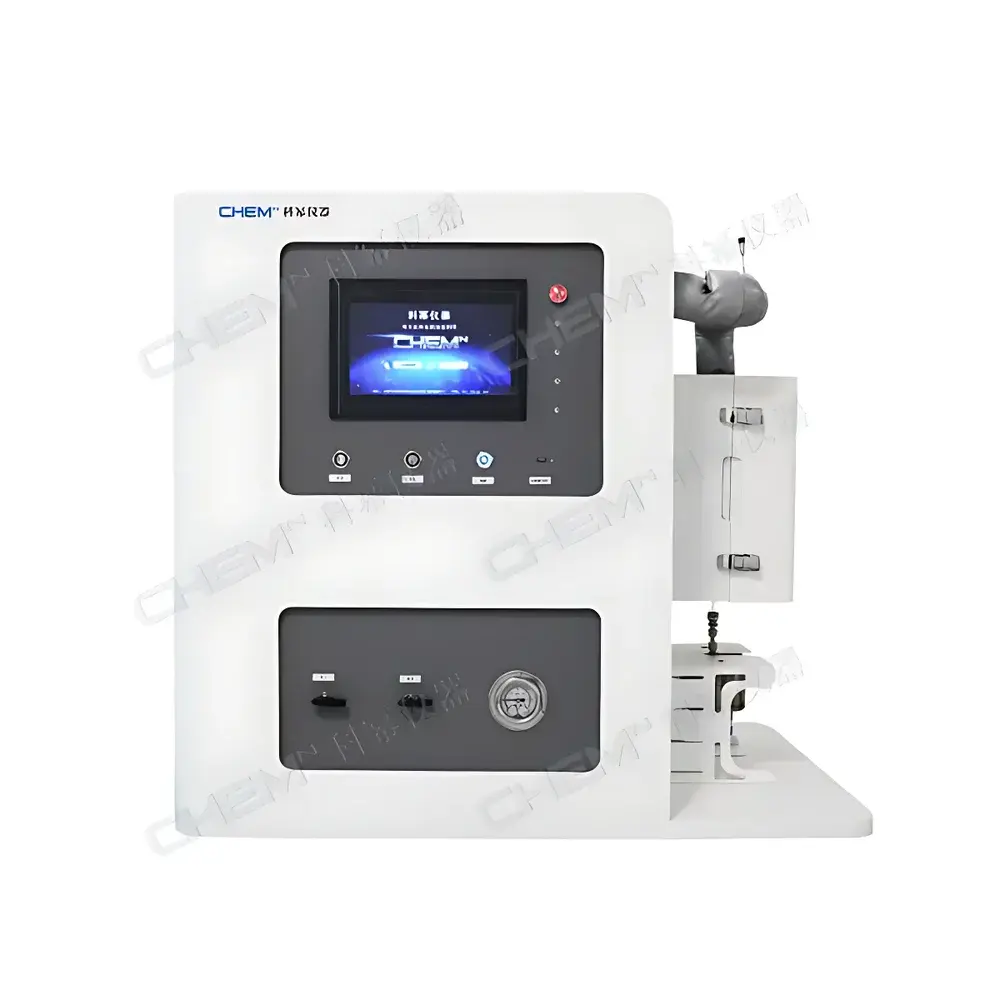
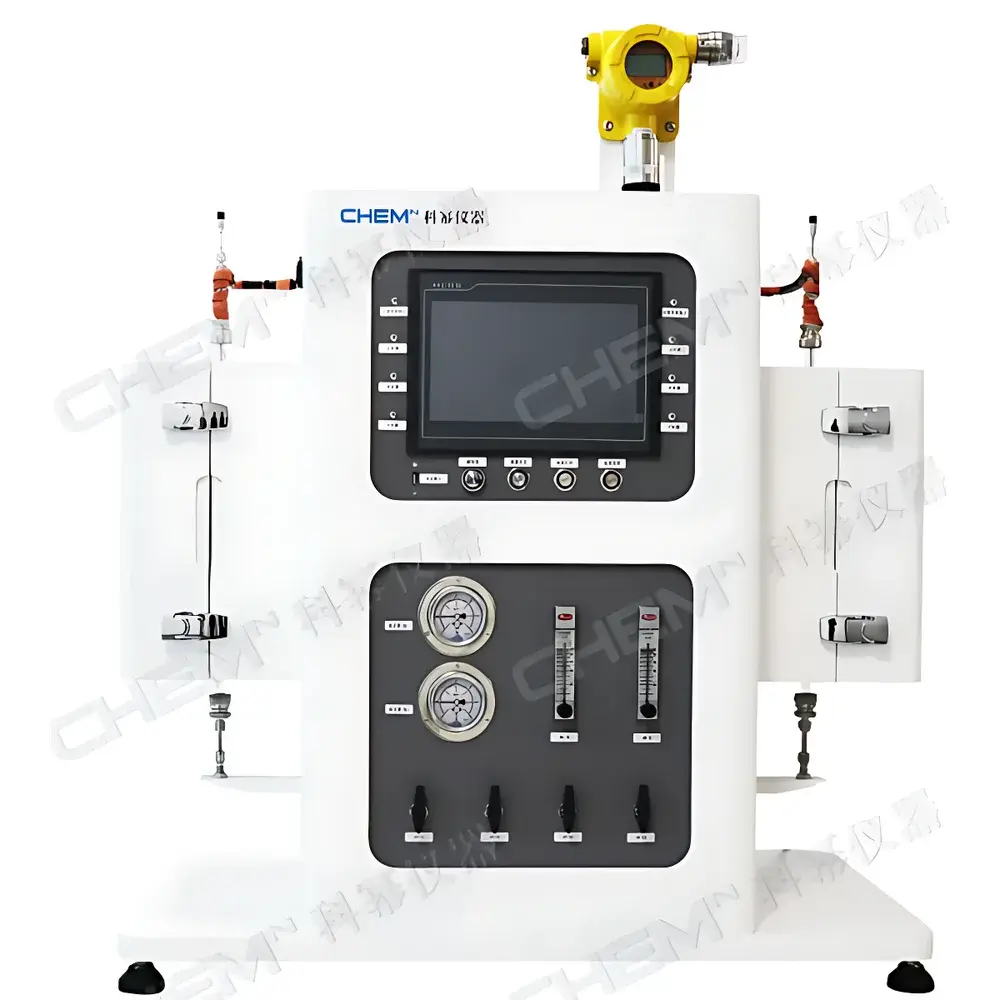
Chemn KMCFRF-G3-900 Fixed-Bed Catalytic Reactor for Ammonia Synthesis and Decomposition
| Brand | Chemn |
|---|---|
| Model | KMCFRF-G3-900 |
| Origin | Anhui, China |
| Reactor Type | Benchtop Fixed-Bed Catalytic Reactor |
| Maximum Operating Pressure | 10 MPa |
| Maximum Operating Temperature | 1000 °C |
| Catalyst Bed Volume | 0.5–5 mL |
| Heating Configuration | Triple-Zone Electric Furnace |
| Safety Features | Dual-Stage Pressure/Temperature Alarm & Interlock Protection |
| Remote Control | PC-based Software Interface with Real-Time Monitoring & Actuation |
| Gas Boosting Capability | Integrated Air-Driven Gas Booster (Up to 19 MPa) with 4–10 L Storage Tank |
| Construction | Powder-Coated Steel Frame |
| Reaction Tube Material | Hastelloy C-276 Outer Tube + Internally Nested Constricted Quartz Liner |
| Flow Control | High-Pressure Mass Flow Controllers (MFCs) with Back-Pressure Regulation |
| Modular Design | Customizable Reactor Tube Length & Inner Diameter |
| Compliance | Designed for GLP-compliant catalyst screening under ISO 17025-aligned laboratory practices |
Overview
The Chemn KMCFRF-G3-900 is a benchtop fixed-bed catalytic reactor engineered for quantitative evaluation of heterogeneous catalysts in both ammonia synthesis (N₂ + 3H₂ ⇌ 2NH₃) and ammonia decomposition (2NH₃ ⇌ N₂ + 3H₂) reactions. It operates on the principle of steady-state flow-through catalysis under precisely controlled thermodynamic conditions—namely, isothermal and isobaric regimes—enabling kinetic parameter extraction (e.g., turnover frequency, activation energy, apparent rate constants) via differential or integral reactor modeling. The triple-zone electric furnace ensures axial temperature uniformity within ±1.5 °C across a 150 mm active heating zone, critical for minimizing axial temperature gradients that distort intrinsic reaction kinetics. All pressure and temperature transducers are calibrated traceable to NIST standards, supporting reproducible data acquisition required for peer-reviewed publication or industrial catalyst benchmarking.
Key Features
- Triple-zone programmable furnace with independent PID control per zone, enabling precise thermal profiling and suppression of endothermic/exothermic hot/cold spots during ammonia decomposition or synthesis.
- Integrated gas boosting module: air-driven diaphragm-type booster pump capable of elevating low-pressure H₂, N₂, or NH₃ feed streams up to 19 MPa; includes 4–10 L ASME-coded storage tank and automatic pressure-hold logic for stable downstream delivery.
- 10.1″ capacitive TFT touchscreen interface with real-time animated process visualization—including dynamic flow path schematics, temperature gradient mapping, and alarm status flags—reducing cognitive load during multi-variable experiments.
- Hastelloy C-276 outer reactor tube rated for 10 MPa at 550 °C, combined with a constricted quartz liner (ID: 8–12 mm) facilitating uniform catalyst packing and minimizing wall effects during low-flow operation (0.5–5 mL bed volume).
- Full remote operability via Ethernet-connected PC software: synchronized control of MFC setpoints, furnace ramp/soak profiles, back-pressure valve positioning, and automated safety interlocks compliant with IEC 61508 SIL1 functional safety requirements.
- Modular architecture supports rapid reconfiguration—e.g., replacement of quartz liner, installation of thermocouple sheaths at multiple axial positions, or integration of online GC sampling loops—without system recalibration.
Sample Compatibility & Compliance
The KMCFRF-G3-900 accommodates powdered, pelletized, or extruded catalysts (including Fe-, Ru-, Ni-, or Co-based formulations) within its defined bed volume range. Its pressure-rated fluidic path—comprising Swagelok® SS-316 fittings, VCR face-seal valves, and high-purity stainless-steel tubing—meets ASTM E2914-13 specifications for high-pressure catalytic testing. All electronic subsystems conform to CE EN 61326-1 (EMC) and EN 61010-1 (safety). Data integrity protocols align with FDA 21 CFR Part 11 requirements through audit-trail-enabled software logging, electronic signatures, and immutable raw-data export (CSV/Excel). The system is routinely deployed in academic and industrial labs conducting catalyst screening under ISO 17025-accredited quality management systems.
Software & Data Management
The proprietary ChemnControl™ software provides a deterministic real-time operating environment (RTOS kernel) for synchronized acquisition from up to 16 analog/digital channels—including dual RTD inputs per zone, absolute pressure transducers (0–20 MPa full scale), and mass flow signals (0–100 sccm to 5 slpm ranges). Data is timestamped with microsecond resolution and stored locally in HDF5 format, supporting post-experiment kinetic modeling in MATLAB®, Python (SciPy), or Aspen Custom Modeler®. Batch report generation includes metadata tagging (catalyst lot ID, operator, ambient humidity), deviation alerts, and automatic pass/fail flagging against pre-defined operational envelopes.
Applications
- Structure–activity relationship (SAR) studies of promoted iron catalysts for low-pressure ammonia synthesis.
- Thermal stability assessment of Ru/Ba-LaNiO₃ catalysts under cyclic ammonia decomposition conditions (T = 600–850 °C, P = 0.1–5 MPa).
- Deactivation kinetics modeling under sulfur-poisoning or steam-aging protocols.
- Validation of microkinetic models using transient response data (e.g., step-change H₂/N₂ ratio experiments).
- Multi-channel comparative testing—e.g., four parallel reactors evaluating four distinct promoters under identical space velocity and thermodynamic constraints.
- Hydrogen production process intensification via coupled ammonia cracking and PEM electrolyzer integration.
FAQ
What is the maximum allowable catalyst bed height in the quartz liner?
The standard quartz liner accommodates up to 120 mm of packed catalyst at 0.5–5 mL volume; custom liners with extended length (up to 250 mm) are available upon request.
Can the system operate under true isothermal conditions during highly exothermic ammonia synthesis?
Yes—the triple-zone furnace enables active axial temperature compensation; optional embedded micro-thermocouples (Type K, 0.25 mm diameter) allow real-time gradient correction via closed-loop power modulation.
Is the gas booster compatible with corrosive feedstocks such as anhydrous ammonia?
The booster’s wetted materials (Hastelloy C-22 diaphragms, PTFE seals) are certified for continuous NH₃ service per NACE MR0175/ISO 15156; compatibility documentation is provided with each unit.
How is calibration traceability maintained across temperature and pressure sensors?
All transducers ship with individual calibration certificates (NIST-traceable, 3-point verification); annual recalibration services include as-found/as-left reports and uncertainty budgets per ISO/IEC 17025.
Does the system support automated long-duration unattended runs (e.g., 168-hour stability tests)?
Yes—software-scheduled shutdown, emergency venting sequences, and battery-backed real-time clock ensure robust execution of extended protocols with zero operator intervention.



