
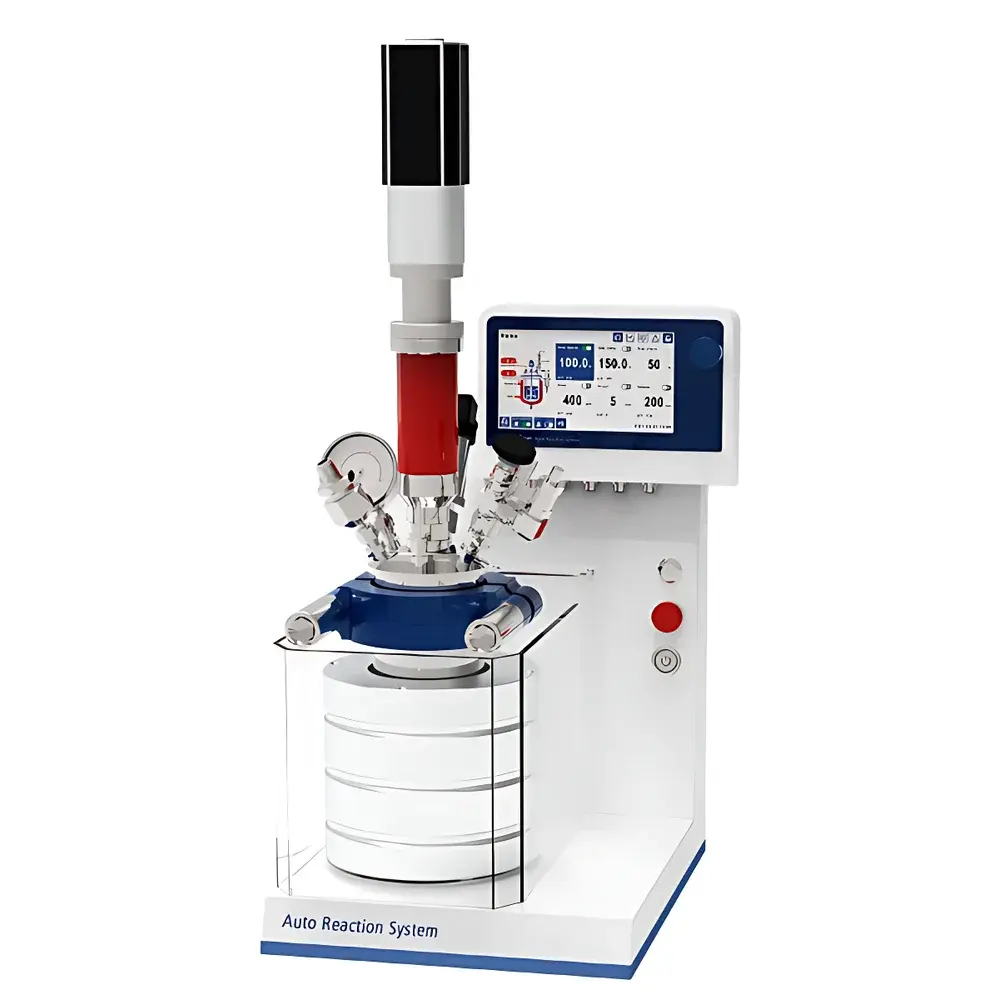
ChemTron BR-4000 High-Pressure Reaction Autoclave
| Brand | ChemTron |
|---|---|
| Origin | Germany |
| Model | BR-4000 |
| Vessel Capacity | 4 L |
| Maximum Operating Pressure | 150 bar (2175 psig) |
| Maximum Design Temperature | 300 °C (PTFE-lined: 230 °C) |
| Construction Material | ASTM A240 UNS S31603 Ti-stabilized stainless steel (1.4571) or Hastelloy® C-276 |
| Sealing System | Quick-release clamp with LC-KEY safety interlock |
| Stirring Configuration | Top-driven magnetic coupling seal with optional bottom-mounted magnetic stirrer for smaller volumes |
| Pressure Relief | Certified rupture disk (standard), optional pressure relief valve, pressure transducer, and vent valve |
| Temperature Control | Integrated heating mantle (CHM-4000) or oil-jacketed heating/cooling system (CTM-4000) |
| Compliance | ASME BPVC Section VIII Div. 1 design basis |
| Sealing Materials | PTFE (≤230 °C), FFKM (≤300 °C) |
| Accessories | Constant-pressure addition funnel, high-pressure syringe pump, sampling valve, thermowell, pressure gauge, digital controller interface |
Overview
The ChemTron BR-4000 High-Pressure Reaction Autoclave is an engineered solution for controlled synthesis, catalytic screening, hydrogenation, hydrothermal reactions, and supercritical fluid processing under rigorously defined thermal and mechanical conditions. Designed and manufactured in Germany to stringent European pressure equipment directives (PED 2014/68/EU), the BR-4000 operates on a robust Couette-type flow principle within its sealed vessel geometry—ensuring homogeneous mass and heat transfer during dynamic reaction monitoring. Its 4 L working volume places it within the mid-scale laboratory reactor category, bridging benchtop feasibility studies with pilot-scale process development. The reactor’s core architecture integrates ASME BPVC Section VIII Division 1–compliant pressure containment with dual-material construction options: Ti-stabilized 316 stainless steel (1.4571) for general corrosion resistance or Hastelloy® C-276 for extreme halide- and acid-rich environments. All wetted surfaces are precision-machined and passivated per ASTM A967, guaranteeing surface integrity essential for reproducible kinetic studies and catalyst lifetime evaluation.
Key Features
- Quick-release clamping system with LC-KEY mechanical interlock—physically prevents lid opening at elevated pressure, meeting SIL-2 functional safety requirements per IEC 61508.
- Multi-layer sealing architecture: primary static seal using FFKM elastomer (rated to 300 °C) or PTFE (230 °C), supplemented by metallic backup rings and radial compression control.
- Top-mounted magnetic drive coupling (WB20C/18C series) delivering torque transmission up to 2.5 N·m without dynamic seal wear—eliminating leakage pathways common in gland-packed shafts.
- Modular thermal management: CHM-4000 electric heating mantle (0–300 °C, ±1 °C stability) or CTM-4000 jacketed system enabling simultaneous heating/cooling via external circulator; integrated cooling ring allows sub-60 s temperature ramp-down from 250 °C to 80 °C.
- Pressure safety stack: factory-installed rupture disk (set at 150 bar), redundant manual vent valve, and optional certified pressure relief valve (PRV) with ASME stamp; all vessels undergo 24-hour nitrogen hold test at 240 bar prior to shipment.
- Digital readiness: standardized 4–20 mA and RS485 Modbus RTU interfaces for integration into LabVIEW, DeltaV, or Siemens PCS7 control environments; compatible with FDA 21 CFR Part 11–compliant data logging systems.
Sample Compatibility & Compliance
The BR-4000 accommodates heterogeneous slurries, viscous polymer precursors, gas–liquid–solid triphasic systems, and aggressive media including concentrated HCl, HF, H₂SO₄, and supercritical CO₂. Its PTFE liner option (4700 mL internal volume) enables trace-metal-free operation for organometallic synthesis and pharmaceutical intermediate development—fully compliant with ICH Q5A and USP analytical instrument qualification protocols. Non-lined configurations support direct contact with Hastelloy® or 316Ti surfaces, validated for ASTM D7215 (hydrogen embrittlement testing) and ISO 15156-3 (NACE MR0175). All pressure-retaining components carry CE marking per PED 2014/68/EU Annex I, with full material test reports (MTRs) traceable to EN 10204 3.1 certification.
Software & Data Management
While the BR-4000 operates as a standalone hardware platform, its analog and digital I/O ports support seamless integration with third-party process data historians. When paired with ChemTron’s optional CTS-4000 control module, users gain access to time-synchronized logging of pressure (0–200 bar), temperature (−20 to 300 °C), stir speed (0–500 rpm), and real-time torque feedback. Audit trails comply with ALCOA+ principles: attributable, legible, contemporaneous, original, accurate, complete, consistent, enduring, and available. Electronic signatures, role-based access control, and encrypted SQLite database storage meet GLP and GMP documentation requirements per Annex 11 and ISO/IEC 17025:2017.
Applications
- Catalytic hydrogenation and asymmetric reduction under 100–150 bar H₂ partial pressure
- Hydrothermal carbonization (HTC) of biomass feedstocks at 220–280 °C
- Solvothermal synthesis of MOFs and perovskite nanocrystals
- High-pressure oxidation kinetics (e.g., NOₓ abatement catalyst testing)
- Supercritical fluid extraction (SFE) method development with CO₂ or ethanol co-solvents
- Corrosion testing per ASTM G31 in simulated geothermal brines
FAQ
What is the maximum allowable working pressure (MAWP) for the BR-4000, and how is it verified?
The MAWP is 150 bar at 300 °C. Each unit undergoes hydrostatic proof testing at 240 bar (1.6× MAWP) and helium leak testing per ISO 15848-1 Class A (<1 × 10⁻⁶ mbar·L/s), with full test records supplied.
Can the BR-4000 be used for exothermic reactions requiring rapid quenching?
Yes. The integrated cooling ring, coupled with a solenoid-controlled coolant bypass and external chiller (−20 to +150 °C), achieves ≥15 °C/min cooling rates from 250 °C to 100 °C under 100 bar N₂ backpressure.
Is the PTFE liner chemically bonded or mechanically retained?
The liner is press-fit and radially constrained by the vessel wall geometry—no adhesives or coatings are used, preserving purity and enabling full liner replacement without machining intervention.
Does ChemTron provide validation documentation for GMP environments?
Yes. IQ/OQ protocols, calibration certificates traceable to DKD/DAkkS standards, and material compliance dossiers (including REACH SVHC and RoHS declarations) are included with each system.
What stirring torque range is supported for viscous reaction mixtures?
The WB20C magnetic drive delivers 0.8–2.5 N·m continuously at 100–500 rpm; optional high-torque variants (WB181D) extend peak torque to 4.2 N·m for polymerization-grade viscosities up to 50,000 cP.



