
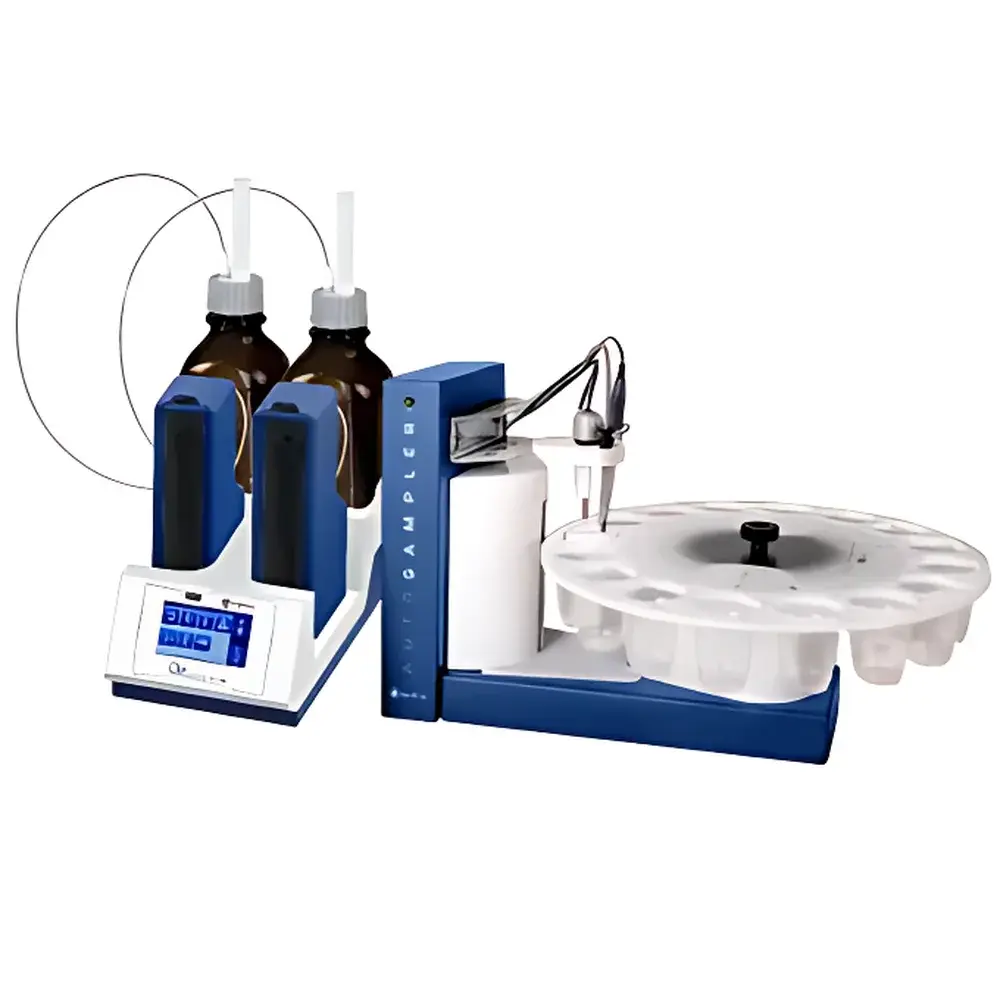
Chemtron CAT2-35 Series Automatic Potentiometric Titrator
| Brand | JULABO-Chemtron |
|---|---|
| Origin | Italy |
| Model | CAT2-35 Series |
| Titration Types | Endpoint, Equivalence Point, Linear, Dynamic, Continuous pH Monitoring |
| pH Range | 0–14 |
| mV Range | ±2000 mV |
| Current Range | ±10 µA |
| Temperature Range | 0–100 °C |
| pH Accuracy | ±0.02 |
| pH Resolution | ±0.01 |
| mV Accuracy | ±2 mV |
| mV Resolution | ±0.1 mV |
| Current Accuracy | ±2 µA |
| Current Resolution | ±0.1 µA |
| Temperature Accuracy | ±1 °C |
| Temperature Resolution | ±0.1 °C |
| Burette Capacity | 10 mL (dual mountable) |
| Burette Precision | <0.2% (2 µL @ 10 mL) |
| Burette Repeatability | ±0.2% |
| Pump Flow Rate | 1 mL/s (up to 3 peristaltic pumps) |
| Display | 4.3″ capacitive touchscreen |
| Method Storage | 30 preloaded templates (EP, EQ, Free/Total SO₂, Double SO₂) |
| Data Storage | 50 titration reports + 10 calibration records |
| Interfaces | pH/mV/µA electrode ports, USB-A, USB-B, RS232, Bluetooth |
Overview
The Chemtron CAT2-35 Series Automatic Potentiometric Titrator is an engineered solution for routine and high-throughput potentiometric titration in quality control, research, and regulatory laboratories. Built on a robust electrochemical measurement architecture, it operates via potentiometric endpoint detection—measuring the potential difference between a reference and indicator electrode as titrant is incrementally delivered—enabling precise determination of equivalence points in acid-base, redox, precipitation, and complexometric reactions. Designed and manufactured in Italy under JULABO-Chemtron’s quality system, the CAT2-35 integrates real-time pH/mV/µA/temperature acquisition with adaptive dosing logic, supporting both classical endpoint titrations and continuous pH monitoring workflows. Its modular platform accommodates up to two 10 mL burettes and three independently controlled peristaltic pumps, allowing method flexibility without hardware reconfiguration. The instrument complies with fundamental metrological requirements for volumetric analysis as defined in ISO 8655-3 (burettes), ISO 7870-2 (control charts for analytical precision), and supports traceability frameworks aligned with GLP and GMP documentation practices.
Key Features
- 4.3″ high-resolution capacitive touchscreen with icon-driven navigation—enabling intuitive method setup, real-time curve visualization, and one-touch execution of calibration, titration, and cleaning routines
- Dual-burette capability (10 mL each) with 12,000-step resolution and certified volumetric accuracy <0.2% (2 µL at full scale), meeting ISO 8655-3 Class A tolerances
- Triple-peristaltic pump support (1 mL/s max flow per channel) for automated sample aspiration, reagent delivery, and waste evacuation—enabling unattended multi-step protocols
- Integrated Pt100 temperature sensor input with automatic thermal compensation across 0–100 °C (±0.1 °C resolution), critical for pH and activity-corrected titrations
- Multi-electrode compatibility: standardized BNC and mini-DIN interfaces accept pH, Ag/AgCl, Pt, dual-Pt, and ion-selective electrodes—validated for ASTM D6470 (SO₂ in wine), USP , and EN 14111 (free fatty acids)
- Real-time dual-curve display: simultaneous plotting of titration curve (E vs. V) and first-derivative (dE/dV) or integrated slope profiles during analysis
- Automated liquid-level balancing system—synchronizes peristaltic aspiration with electrode immersion depth to minimize sample volume uncertainty in batch processing
Sample Compatibility & Compliance
The CAT2-35 supports aqueous and mildly organic matrices (e.g., ethanol/water mixtures up to 20% v/v) typical in food, beverage, pharmaceutical, and environmental testing. Its electrode interface design conforms to IEC 61000-4-3 (EMC immunity) and IP20 enclosure rating for laboratory benchtop use. Preloaded method templates—including EP (endpoint), EQ (equivalence point), Free/Total SO₂ (AOAC 990.28), and Double SO₂ (OIV-MA-AS313-01A)—are structured to align with internationally recognized standard operating procedures. All calibration and titration events generate timestamped, user-attributed records with audit-trail metadata—compatible with FDA 21 CFR Part 11 compliance when paired with validated CAT2 software and networked storage. Temperature-compensated pH measurements adhere to NIST-traceable buffer definitions (DIN 19266, ISO 3696), and mV readings are referenced to Ag/AgCl (3 M KCl) per IUPAC recommendations.
Software & Data Management
The CAT2 software suite (Windows-based, USB/Bluetooth connected) provides secure method authoring, result review, and report generation. Each titration session logs raw sensor data (pH, mV, µA, T), burette position, pump actuation timestamps, and derivative calculations—exportable in CSV or PDF format via USB drive. Calibration history—including zero-point, slope, Nernstian validation, and wine-specific pH offset corrections—is stored separately from analytical results to preserve data integrity. The system maintains 50 most recent titration reports and 10 calibration logs onboard; extended archival is supported through scheduled network backups. Software validation documentation (IQ/OQ protocols) and electronic signature modules are available upon request for regulated environments.
Applications
- Acid-base titrations: Total acidity in wines (OIV-MA-AS312-01), titratable acidity in dairy products (IDF 141), and alkalinity in wastewater (ISO 9963-1)
- Redox titrations: Ascorbic acid quantification (AOAC 967.21), iodometric determination of copper (ASTM E1069), and permanganate-based COD analysis
- Precipitation titrations: Chloride by Mohr or Volhard methods (ISO 9297, EN ISO 9297) using Ag electrodes
- Complexometric titrations: Calcium and magnesium hardness (ISO 6059) with EDTA and metallochromic indicators
- Sulfur dioxide analysis: Free and total SO₂ in must and wine per OIV and AOAC standards, utilizing dual-platinum amperometric detection
- Continuous pH profiling: Kinetic monitoring of hydrolysis, fermentation, or dissolution processes over extended timeframes
FAQ
What electrode types are natively supported?
The CAT2-35 accepts standard BNC pH electrodes, mini-DIN Ag/AgCl reference electrodes, Pt working electrodes, dual-Pt amperometric sensors, and custom ion-selective probes with compatible output impedance and signal range.
Can the instrument perform temperature-controlled titrations?
Yes—via integrated Pt100 input, it applies real-time temperature compensation to pH and potential readings and supports external Peltier or water-jacketed titration vessels when paired with JULABO temperature controllers.
Is method validation support available for regulated labs?
Full IQ/OQ documentation, 21 CFR Part 11 configuration files, and electronic signature implementation guidance are provided with enterprise software licensing.
How is volumetric accuracy verified?
Burette performance is validated per ISO 8655-3 using gravimetric assessment with certified weights and Class A volumetric glassware; factory calibration certificates include uncertainty budgets at 1 mL, 5 mL, and 10 mL dispense volumes.
What is the maximum sample throughput with the 35-position autosampler?
Using optimized rinse and equilibration cycles, the system achieves ≤90 seconds per sample for standard acid-base titrations—yielding ~400 analyses per 10-hour shift without manual intervention.





