
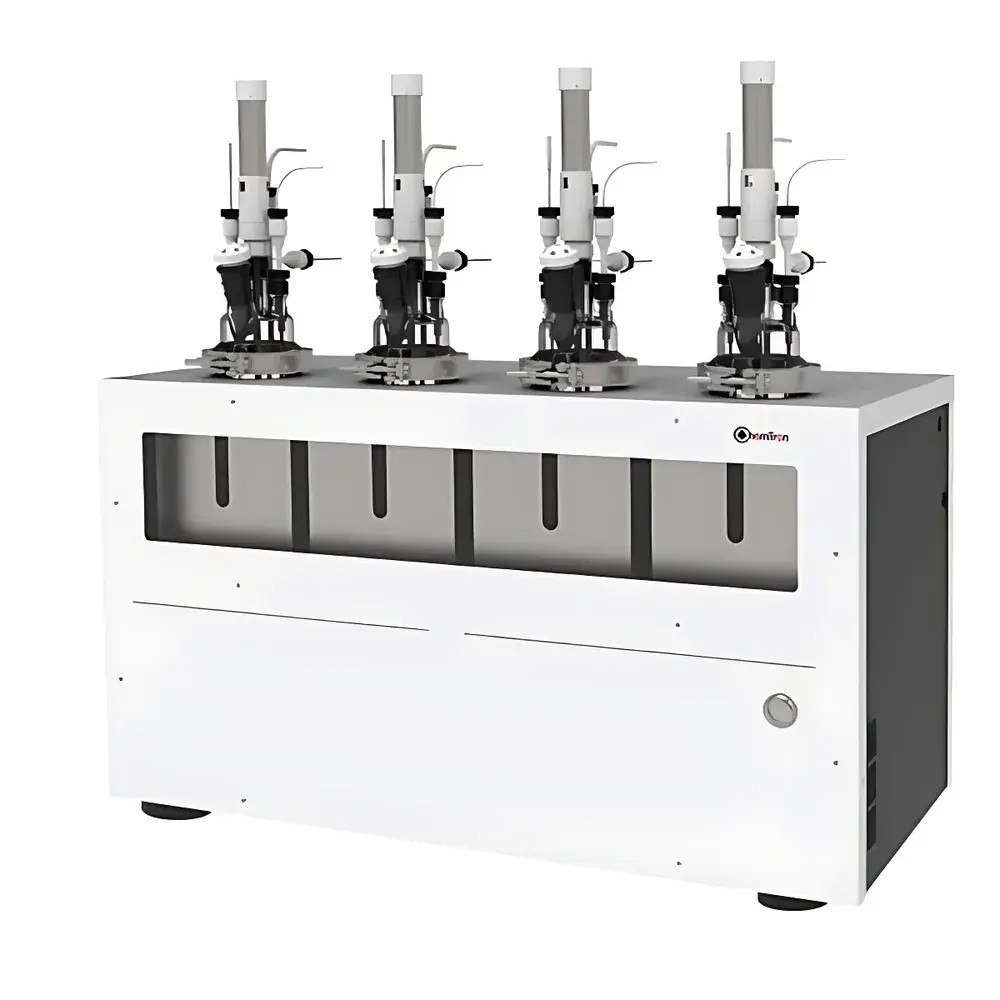
ChemTron Chem 4 Multi-Channel Automated Reaction Station
| Brand | ChemTron |
|---|---|
| Origin | Germany |
| Model | Chem 4 |
| Temperature Range | −30 °C to 180 °C |
| Reaction Positions | 4 |
| Reaction Volume Capacity | 2 mL–400 mL |
| Vessel Compatibility | Borosilicate 3.3 glass or PTFE contact materials |
| Control Interface | Integrated touchscreen panel with embedded calorimetric modeling and real-time data logging |
Overview
The ChemTron Chem 4 Multi-Channel Automated Reaction Station is an engineered platform for parallel and sequential chemical synthesis under precisely controlled thermal, mechanical, and temporal conditions. Based on a modular architecture with four independent reaction modules, it implements a hybrid thermal management system—combining resistive heating with recirculating jacketed cooling—to deliver stable, reproducible temperature profiles across the full operational range of −30 °C to 180 °C. Each reaction position operates autonomously in terms of setpoint, ramp rate, hold duration, and agitation mode, enabling true multi-condition experimentation within a single instrument footprint. The system integrates embedded thermodynamic modeling (including real-time heat flow estimation via jacket power balance) to support reaction calorimetry workflows without requiring external sensors. Designed for unattended operation over extended periods—including continuous 24/7 runs—the Chem 4 meets core requirements for process development, reaction optimization, and scale-up studies in pharmaceutical, fine chemical, and academic research laboratories.
Key Features
- Four independently controllable reaction positions with simultaneous yet decoupled thermal and agitation control
- Temperature uniformity and stability maintained across ±0.3 °C at steady state; inter-position differential capability up to 200 °C
- Dual agitation options: integrated overhead mechanical stirrer (speed range 50–1200 rpm, torque-compensated) and optional magnetic stirring compatibility
- Modular vessel mounting system using standardized aluminum profile frames; rapid tool-less reactor exchange via push-to-connect fluidic interfaces
- Integrated touchscreen HMI with intuitive workflow editor, step-based protocol builder, and real-time graphical overlay of temperature, power, and stirring parameters
- Thermal actuation via electrically heated jackets and closed-loop chilled fluid circulation—eliminating hazards associated with oil baths, dry ice, or liquid nitrogen handling
- Standard reactor configuration includes four 250 mL vessels fabricated from DIN ISO 3585 borosilicate 3.3 glass or chemically inert PTFE-lined variants
Sample Compatibility & Compliance
The Chem 4 accommodates a broad spectrum of vessel geometries and volumes—from 2 mL vials and test tubes to 400 mL round-bottom flasks and custom jacketed reactors—without hardware modification. All wetted materials conform to USP Class VI and FDA-compliant specifications; glass components meet ISO 1797-1 for dimensional tolerance and hydrolytic resistance. The system supports GLP-compliant data integrity through audit-trail-enabled operation logs, user authentication, and electronic signature readiness. While not pre-certified for GMP manufacturing environments, its architecture aligns with key elements of ASTM E2500-21 (verification of laboratory equipment), ISO/IEC 17025:2017 (testing and calibration laboratories), and ICH Q5C (stability testing of biopharmaceuticals) when deployed with validated SOPs.
Software & Data Management
The onboard firmware provides native support for time-stamped parameter logging at configurable intervals (100 ms–60 s resolution), exporting structured CSV or proprietary .chem4 binary files containing synchronized thermal, mechanical, and event-triggered metadata. Optional ChemTron LabLink software extends functionality to remote PC-based control, integration with third-party peripherals (e.g., syringe pumps, pressure transducers, FTIR flow cells), automated reagent dispensing sequences, vacuum regulation via solenoid-valve manifolds, and generation of PDF-formatted experiment reports compliant with ALCOA+ principles. All software modules implement role-based access control, change history tracking, and exportable electronic records suitable for regulatory review.
Applications
- Reaction screening across temperature, stoichiometry, and catalyst loading variables
- Kinetic profiling of exothermic or endothermic transformations under controlled heat removal
- Process safety evaluation including adiabatic temperature rise estimation and MTBR (maximum temperature of synthesis reaction) determination
- Crystallization optimization with precise supersaturation control via programmed cooling ramps
- Multi-step cascade reactions requiring sequential addition, quenching, and intermediate isolation
- Development of continuous-flow hybrid protocols using batch-to-flow transition modules
FAQ
Can the Chem 4 operate under inert or vacuum conditions?
Yes—each reactor module includes dedicated gas inlet/outlet ports compatible with standard Swagelok fittings; optional vacuum-rated seals and pressure-rated vessel caps are available as accessories.
Is calibration traceable to national standards?
Temperature sensors are factory-calibrated against PTB-traceable references; users may perform field verification using certified reference thermometers per ISO/IEC 17025 guidelines.
What level of cybersecurity is implemented in the control software?
LabLink employs TLS 1.2 encryption for network communications, local database encryption at rest, and adherence to NIST SP 800-53 Rev. 5 controls for laboratory information systems.
Does the system support integration with LIMS or ELN platforms?
Via RESTful API endpoints and configurable ODBC drivers, enabling bidirectional data exchange with major ELN/LIMS vendors including LabArchives, Benchling, and Thermo Fisher SampleManager.
Are replacement parts and service contracts available globally?
ChemTron maintains authorized service centers in EMEA, North America, and APAC regions; all critical subassemblies—including heating jackets, cooling manifolds, and stirrer motors—are stocked with documented mean time between failures (MTBF) exceeding 25,000 hours.



