
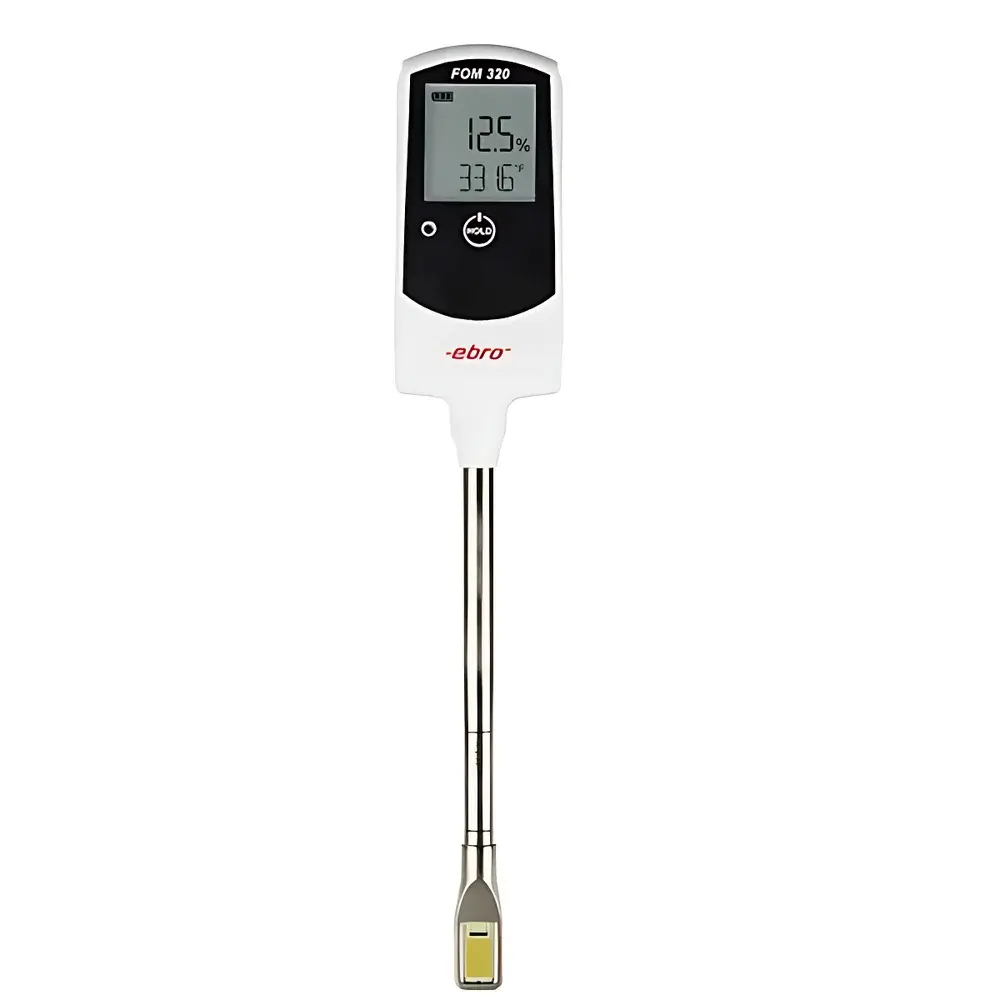
ChemTron FOM 320 Edible Oil Quality Analyzer
| Brand | ChemTron |
|---|---|
| Origin | Germany |
| Model | FOM 320 |
| Measurement Range (TPM) | 0–40 % |
| Accuracy (TPM) | ±2 % |
| Resolution (TPM) | 0.5 % |
| Temperature Range | +50–+200 °C |
| Temperature Accuracy | ±1 °C |
| Temperature Resolution | 0.1 °C |
| Operating Temperature | −20–+50 °C |
| Storage Temperature | −25–+60 °C |
| Power | 3 V replaceable lithium battery (up to 3-year service life) |
| Dimensions (L×W×H) | 304 × 54 × 22 mm |
| Weight | 200 g |
| Housing Material | Food-grade ABS |
| Protection Rating | IP67 |
| Calibration | Factory-calibrated with certificate |
| Order No. | 1340-1570 |
Overview
The ChemTron FOM 320 Edible Oil Quality Analyzer is a handheld, field-deployable instrument engineered for rapid, non-destructive assessment of frying oil degradation in commercial food preparation environments. It operates on the principle of dielectric constant measurement—correlating changes in the oil’s electrical permittivity with total polar materials (TPM) accumulation, a well-established indicator of thermal oxidation and hydrolytic breakdown. Unlike laboratory-based methods requiring solvent extraction or chromatography, the FOM 320 delivers real-time TPM quantification directly in hot oil at temperatures ranging from +50 °C to +200 °C. This enables immediate decision-making during active frying operations, supporting predictive maintenance of cooking media and minimizing off-spec product risk. Designed for compliance with HACCP-based process control frameworks, the device supports traceable, repeatable measurements without sample dilution or reagent consumption.
Key Features
- IP67-rated rugged housing constructed from food-grade ABS polymer—resistant to thermal shock, grease ingress, and mechanical impact in high-humidity kitchen or industrial fryer environments.
- One-touch measurement interface with intuitive visual feedback: LED indicators and numeric display confirm measurement status and result validity.
- Integrated temperature-compensated sensor architecture ensures stable TPM readings across the full operational temperature range (+50–+200 °C), eliminating manual correction factors.
- Factory-calibrated with documented traceability to reference standards; calibration certificate included with each unit (Order No. 1340-1570).
- Long-life 3 V lithium battery (replaceable) providing up to three years of typical usage—no charging infrastructure required, reducing downtime and logistical overhead.
- Compact ergonomic form factor (304 × 54 × 22 mm, 200 g) optimized for single-hand operation and portability between fry stations, QA checkpoints, or audit locations.
Sample Compatibility & Compliance
The FOM 320 is validated for use with common edible frying oils—including soybean, sunflower, palm, canola, and blended vegetable oils—under dynamic thermal stress conditions. It is not intended for use with non-edible lubricants, biodiesel, or highly viscous or particulate-laden media. The instrument conforms to IEC 60529 for IP67 ingress protection and meets EU RoHS Directive 2011/65/EU requirements for hazardous substance restriction. While not a regulatory testing device per se, its TPM measurement protocol aligns with established industry benchmarks referenced in ISO 8534 (frying oil quality management), AOCS Cd 19a-99 (determination of polar compounds), and national food safety guidelines governing oil replacement thresholds (e.g., ≤24–27 % TPM in EU member states). Its design supports GLP-aligned recordkeeping when paired with external documentation systems.
Software & Data Management
The FOM 320 operates as a standalone, embedded-system analyzer with no onboard data logging or Bluetooth/Wi-Fi connectivity. All measurement results are displayed in real time and must be manually recorded or transcribed into facility-specific quality logs, LIMS, or digital checklists. This architecture intentionally minimizes cybersecurity surface area and eliminates firmware update dependencies—critical for environments where IT policy restricts networked peripherals. For facilities requiring electronic traceability, the device integrates seamlessly with paperless HACCP workflows via standardized entry templates compatible with FDA 21 CFR Part 11–compliant platforms (when used with appropriate audit-trail-enabled software layers). No proprietary drivers or cloud services are required.
Applications
- Real-time monitoring of oil degradation during continuous frying in fast-food chains, snack manufacturing lines, and institutional kitchens.
- Validation of oil change intervals against internal SOPs or third-party certification schemes (e.g., BRCGS, SQF, ISO 22000).
- Root-cause analysis of off-flavor development or inconsistent browning in fried products.
- Training tool for line operators to reinforce sensory–instrumental correlation between smoke point decline and TPM rise.
- Preventive maintenance scheduling for fryer filtration and heat-exchange systems based on quantitative oil aging trends.
- Supporting sustainability initiatives by optimizing oil turnover—reducing waste volume and lowering average oil consumption by up to 10 % versus fixed-time replacement protocols.
FAQ
What does TPM stand for, and why is it critical for frying oil management?
TPM stands for Total Polar Materials—the sum of all oxidized, polymerized, and hydrolyzed compounds formed during thermal degradation. Accumulation above 24–27 % indicates significant loss of functional performance and potential health-related concerns; regulatory bodies and food safety standards widely adopt TPM as the primary metric for oil discard decisions.
Can the FOM 320 measure oils below 50 °C?
No. The sensor is thermally stabilized for operation only within +50 °C to +200 °C. Measurements taken outside this range yield non-representative dielectric responses and are automatically inhibited or flagged as invalid.
Is recalibration required in the field?
The FOM 320 is factory-calibrated and designed for long-term stability. ChemTron recommends verification against a certified reference oil every six months or after 500 measurements, using optional verification kits (not included). Full recalibration must be performed by an authorized service center.
Does the IP67 rating permit submersion in oil during measurement?
Yes—IP67 certifies protection against temporary immersion in liquids up to 1 m depth for 30 minutes. The probe tip is fully submersible in hot oil; however, prolonged exposure above +200 °C or contact with solidified residue may affect sensor longevity and should be avoided.
How does the FOM 320 differ from laboratory-based TPM analyzers?
Lab instruments (e.g., AOCS Cd 19a-99 compliant systems) require solvent extraction, column separation, and gravimetric quantification—processes taking 30–60 minutes per sample. The FOM 320 provides equivalent TPM estimation in 100 measurements per shift without disrupting production flow.




