
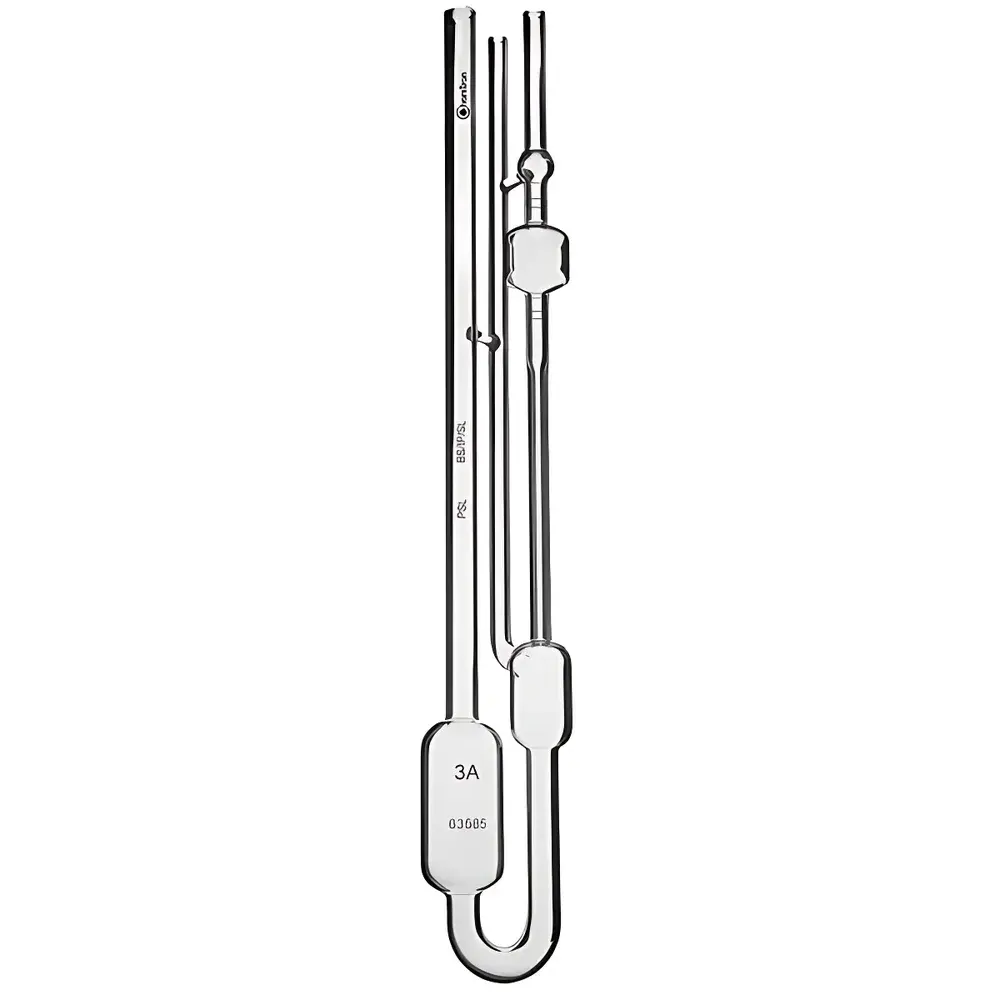
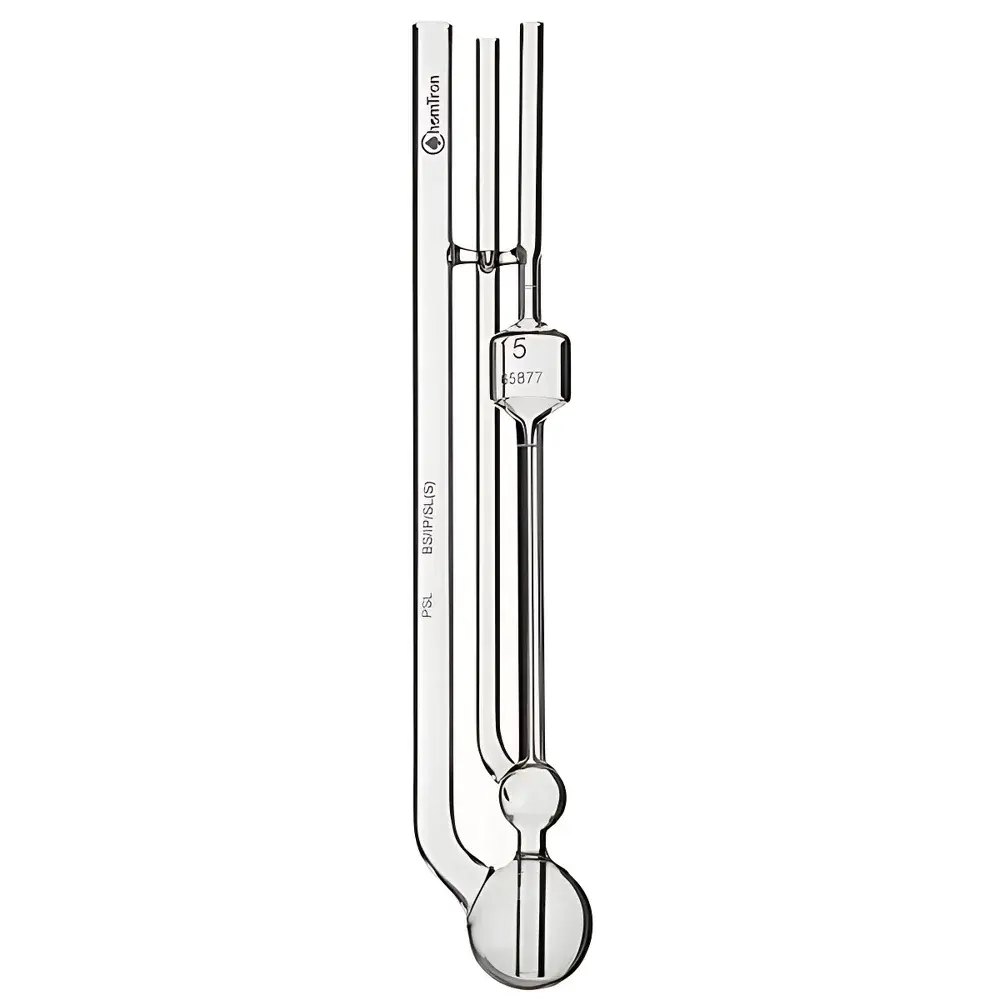
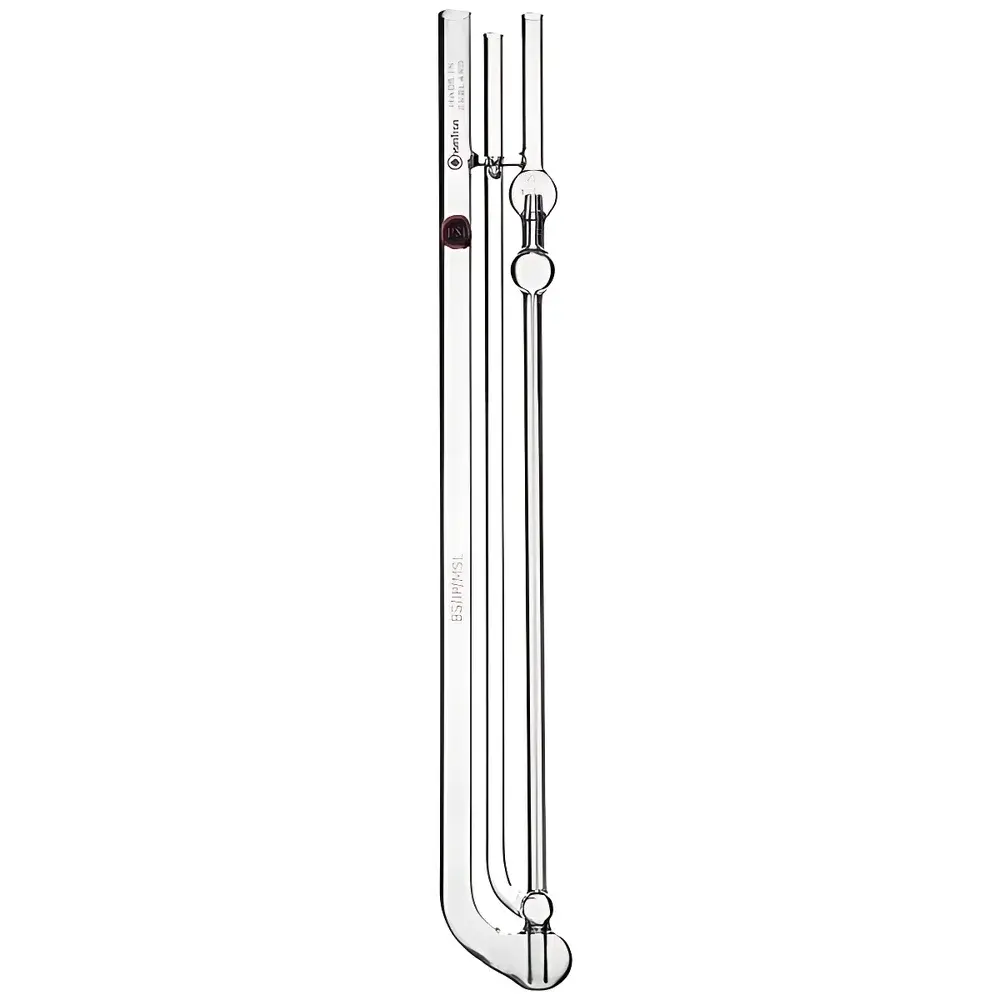
ChemTron Model 1625/1628/1631 Suspension-Level Capillary Viscometers
| Brand | ChemTron |
|---|---|
| Origin | Germany |
| Model Series | 1625, 1628, 1631 |
| Viscometer Type | Suspension-level (Ubbelohde-type) capillary viscometer |
| Portability | Portable |
| Operating Environment | Ambient temperature |
| Kinematic Viscosity Range | 0.6 – 100,000 mm²/s (cSt) |
| Calibration Compliance | ISO/IEC 17025-accredited |
| Sample Requirement | Transparent Newtonian or near-Newtonian liquids |
| Fill Volume | 4–40 mL |
| Total Length | 250–330 mm |
| Capillary Stand Compatibility | BS/IP/SL and BS/IP/MSL standards (A1/A2 series adapters) |
Overview
The ChemTron Model 1625, 1628, and 1631 suspension-level capillary viscometers are precision-engineered instruments for the gravimetric determination of kinematic viscosity in transparent liquids. Based on the Ubbelohde capillary principle, these viscometers operate under laminar flow conditions governed by the Hagen–Poiseuille equation, where kinematic viscosity (ν, in mm²/s or cSt) is calculated from the efflux time (t) and a certified calibration constant (K): ν = K × t. The suspension-level design ensures hydrostatic head stability during measurement by maintaining the liquid meniscus at a fixed reference level—eliminating errors associated with variable head pressure in suspended-level or dilution-type capillaries. Each unit is individually calibrated in accordance with ISO/IEC 17025 requirements, traceable to national metrology institutes, and supplied with a documented K-value certificate. These instruments are widely employed in quality control laboratories across petrochemical, lubricant, solvent, and polymer industries where ASTM D445, ISO 3104, IP 71, and DIN 51562 compliance is mandatory.
Key Features
- Three modular model families (1625, 1628, 1631) optimized for distinct viscosity ranges and sample volumes—from ultra-low-viscosity solvents (0.6 cSt) to heavy base oils (100,000 cSt)
- Suspension-level geometry ensures consistent hydrostatic head and high inter-laboratory reproducibility (CV < 0.3% under controlled conditions)
- Individually certified K-values engraved on each capillary stem; full calibration documentation provided per ISO/IEC 17025 clause 6.6
- Optimized fill volumes: 4 mL (Model 1631), 10 mL (Model 1628), and 22–40 mL (Model 1625), minimizing sample consumption while ensuring laminar flow integrity
- Robust borosilicate glass construction (Duran® or equivalent), resistant to thermal shock and chemical corrosion from common organic solvents and hydrocarbons
- Modular stand compatibility: 1824/A1 (BS/IP/SL #1–#4), 1824/A2 (#4A & #5), 1827/A1 (S-type, #1–#9), and 1830/A1 (BS/IP/MSL #1–#7)
- No external power, electronics, or moving parts—designed for manual operation in field labs, production floors, or accredited testing facilities requiring passive instrumentation
Sample Compatibility & Compliance
These viscometers are validated for use with homogeneous, particle-free, transparent Newtonian fluids—including mineral oils, synthetic lubricants, fuels, glycols, esters, and halogenated solvents. Non-Newtonian behavior (e.g., shear-thinning polymers) must be assessed separately using rotational rheometry. Particulate contamination or air bubbles invalidate measurements due to flow disruption and capillary blockage. All models comply with the geometric and dimensional tolerances specified in ASTM D445 Annex A1, ISO 3104 Table 1, and IP 71 Section 4. Routine verification per ASTM D445 Section 8.2 is recommended using certified reference oils (CRM 250, CRM 500, etc.). For regulated environments, the documented calibration history, K-value traceability, and adherence to ISO/IEC 17025 support GLP/GMP audit readiness and FDA 21 CFR Part 11-aligned data integrity protocols when paired with compliant manual logbooks or LIMS-integrated reporting.
Software & Data Management
As fully manual, analog instruments, the ChemTron suspension-level viscometers require no embedded firmware, drivers, or proprietary software. Efflux time is recorded using a Class 1 stopwatch (per ISO 9001 and ASTM D445 Section 7.2), and kinematic viscosity is computed manually or via laboratory spreadsheets. To meet modern data governance requirements, users may integrate measurements into validated electronic lab notebooks (ELN) or LIMS platforms using standardized templates that capture: operator ID, ambient temperature (±0.1 °C), bath temperature (±0.01 °C), efflux time (±0.01 s), K-value, calculated ν, and calibration certificate number. Audit trails, electronic signatures, and version-controlled SOPs ensure compliance with 21 CFR Part 11 when digital records are generated. No cloud connectivity, remote access, or automatic data export is implemented—preserving measurement sovereignty and eliminating cybersecurity exposure vectors.
Applications
- Quality assurance of base oils and finished lubricants per API RP 1529 and ASTM D975
- Batch release testing of aviation turbine fuels (Jet A-1, JP-8) per ASTM D1655 and DEF STAN 91-91
- Viscosity grading of bitumen binders (penetration grade, viscosity grade) per ASTM D3381 and EN 12591
- Process monitoring of polymer solutions (e.g., PET, PVC) during solvent recovery and resin synthesis
- Calibration verification of automated viscometers (e.g., SVM, Stabinger, or rotational systems) using reference standards
- Educational laboratories demonstrating fundamental fluid mechanics principles including Reynolds number, Poiseuille flow, and Newton’s law of viscosity
FAQ
What does “suspension-level” mean in this context?
It refers to the capillary’s physical mounting configuration: the viscometer is suspended vertically so that the upper meniscus aligns precisely with a fixed etched mark, ensuring constant hydrostatic head regardless of fill volume.
Can I use these viscometers for non-Newtonian samples?
No—these instruments assume Newtonian behavior under laminar flow. Yield stress, thixotropy, or shear-rate dependence requires rotational or oscillatory rheometry.
How often should I recalibrate?
Per ISO/IEC 17025, recalibration is required before first use, after mechanical shock, and at intervals defined by your laboratory’s uncertainty budget—typically annually for routine QC use.
Why are multiple K-values listed per model?
Each K-value corresponds to a specific capillary bore geometry; selecting the appropriate K-range ensures optimal efflux time (typically 100–600 s) and minimizes timing error impact on final ν uncertainty.
Do these meet ASTM D445 requirements?
Yes—when used with temperature-controlled baths (±0.01 °C), calibrated stopwatches, and certified reference oils, they satisfy all instrumental criteria in ASTM D445 Sections 6–9.



