
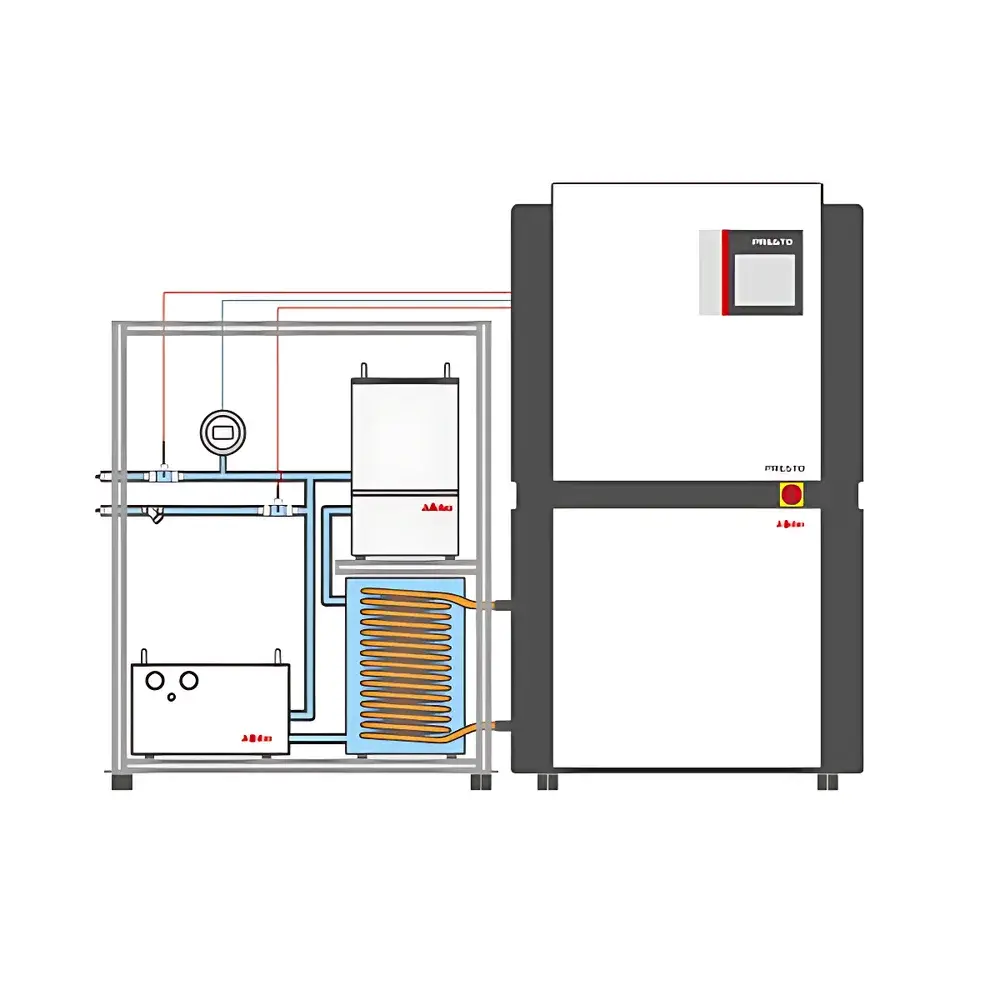
ChemTron NEB-40 / NEB-50 / NEB-91 Battery Electrochemical Performance Test Platform
| Brand | ChemTron |
|---|---|
| Origin | Germany |
| Model | NEB-40 / NEB-50 / NEB-91 |
| Temperature Range | −35 to +90 °C / −40 to +90 °C / −40 to +150 °C |
| Flow Rate | 1–20 L/min |
| Temperature Stability | ±0.01–±0.05 °C / ±0.05–±0.1 °C / ±0.05–±0.2 °C |
| Heating Power | 2.7 / 6 / 18 kW |
| Cooling Power (at 20 °C) | 1.2 / 7.5 / 11 kW |
| Pump Flow Range | 16–40 / 35–76 / 26–80 L/min |
| Pump Pressure | 0.3–1.7 / 0.48–3.2 / 0.5–3.0 bar |
Overview
The ChemTron NEB Series Battery Electrochemical Performance Test Platform is an engineered thermal management and electrochemical test system designed specifically for rigorous characterization of lithium-ion battery cells, modules, and packs under dynamically controlled thermal and hydraulic conditions. Built upon a closed-loop external circulation architecture, the NEB platform integrates precision temperature control, real-time flow regulation, and synchronized pressure monitoring to replicate realistic operational environments—such as automotive battery thermal management systems (BTMS), wireless charging thermal interfaces, and accelerated life-cycle testing protocols. Its core measurement principle relies on active thermal coupling: by circulating thermally conductive fluid (e.g., water-glycol mixtures) through custom-designed battery test fixtures or environmental chambers, the system enables precise imposition of boundary conditions while simultaneously acquiring time-synchronized data on temperature gradients, flow dynamics, and pressure response. This architecture supports both steady-state thermal validation and transient thermal profiling per ISO 12405-3, IEC 62660-2, and UN GTR 20 requirements.
Key Features
- Industrial 5.7-inch color touchscreen HMI with intuitive navigation, enabling local configuration of multi-stage temperature ramps, flow profiles, and pump pressure setpoints.
- EHC (Enhanced Heat Exchange) segmented impulse cooling/heating technology—improves thermal ramp rates by up to 40% compared to conventional single-zone systems, while minimizing thermal stress on internal components over extended duty cycles.
- ACC (Adaptive Compressor Control) dynamic refrigeration algorithm—maintains sub-ambient stability even at elevated ambient temperatures (up to 40 °C), delivering consistent cooling capacity without compressor overload or efficiency collapse.
- ICC (Intelligent Cascade Control) temperature regulation—achieves long-term stability within ±0.01 °C (NEB-40) via dual-sensor feedback, PID+feedforward logic, and real-time compensation for load inertia and fluid property drift.
- High-reliability magnetic-coupled circulation pump with programmable pressure modulation—supports constant-flow, constant-pressure, or hybrid modes across three calibrated ranges (low/mid/high head).
- Hydraulic-sealed fluid path rated for direct use of ethylene glycol/water mixtures (up to 60% v/v), eliminating need for secondary heat exchangers or fluid compatibility adapters.
- Dual-layer filtration (10 µm pre-filter + 5 µm inline filter) integrated into return manifold—prevents particulate ingress from battery test fixtures or chamber condensate into critical valves and sensors.
- Multi-protocol communication interface (RS485, Ethernet TCP/IP, CAN 2.0B optional)—enables seamless integration with battery cyclers (e.g., Arbin, Bitrode), PLC-based test benches, and MES-level data historians.
Sample Compatibility & Compliance
The NEB platform is compatible with cylindrical (18650, 21700, 4680), prismatic, and pouch-format Li-ion cells; modular battery assemblies (up to 400 V DC bus); and full-pack BTMS validation rigs. It meets mechanical and electrical safety requirements per EN 61000-6-2/6-4 (EMC), UL 61010-1 (lab equipment), and CE Machinery Directive 2006/42/EC. All firmware and control logic comply with IEC 61508 SIL2 for functional safety in automated test environments. When operated with validated software stacks (e.g., LabVIEW Real-Time or Python-based PyDAQ), the system supports audit-ready data capture aligned with FDA 21 CFR Part 11 and EU Annex 11 for GLP/GMP-regulated battery qualification studies.
Software & Data Management
The platform ships with ChemTron’s NEB-SCADA Suite—a Windows-based application supporting real-time visualization, script-driven test sequencing, and export to CSV, HDF5, or TDMS formats. All parameter logs include embedded timestamps, sensor calibration IDs, and hardware revision metadata. Optional add-ons include: (i) Remote Configuration Module (RCM) for secure TLS 1.3 web access and scheduled firmware updates; (ii) Traceability Plugin for electronic signature workflows and change-controlled SOP execution; (iii) Integration SDK for MATLAB, Python, and C# APIs—enabling custom model-in-the-loop (MiL) co-simulation with battery equivalent circuit models (ECMs) or electrochemical-thermal (ECT) multiphysics solvers.
Applications
- Dynamic thermal validation of battery thermal runaway propagation barriers under ISO 12405-4 fast-charge conditions.
- Electrochemical impedance spectroscopy (EIS) temperature sweep support—from −40 °C to +150 °C—with <10 mK step resolution and <30 s thermal equilibration per point.
- Wireless power transfer (WPT) coil thermal derating analysis under combined electromagnetic and convective loading.
- Accelerated calendar and cycle life testing per USP <1058> analytical instrument qualification (AIQ) guidelines.
- BTMS cold-start performance benchmarking per SAE J2929 and GB/T 31467.3-2015.
- Thermal interface material (TIM) resistance mapping using guarded hot plate methodology with active fluid-side boundary control.
FAQ
Does the NEB platform support integration with third-party battery cyclers?
Yes—via standardized Modbus TCP or CANopen protocols; configuration templates are provided for Arbin BT-5HC, Bio-Logic VSP-300, and Neware BTS-X series.
What is the maximum allowable fluid conductivity for glycol-water mixtures?
Up to 500 µS/cm at 25 °C; higher conductivity fluids require optional stainless-steel wetted parts upgrade (order code: NEB-SS-KIT).
Can temperature stability be verified independently per ASTM E740?
Yes—the system includes NIST-traceable PT100 sensors (Class A, IEC 60751) and supports periodic verification using external reference thermometers per ASTM E740 Annex A2.
Is remote firmware update capability included by default?
Firmware updates via USB or Ethernet are standard; over-the-air (OTA) updates require the optional Remote Configuration Module (RCM).
How is pump cavitation prevented during low-temperature operation?
The ICC control loop continuously monitors inlet pressure differential and adjusts pump speed to maintain net positive suction head (NPSHr > 1.2 m) across the full operating range.




