
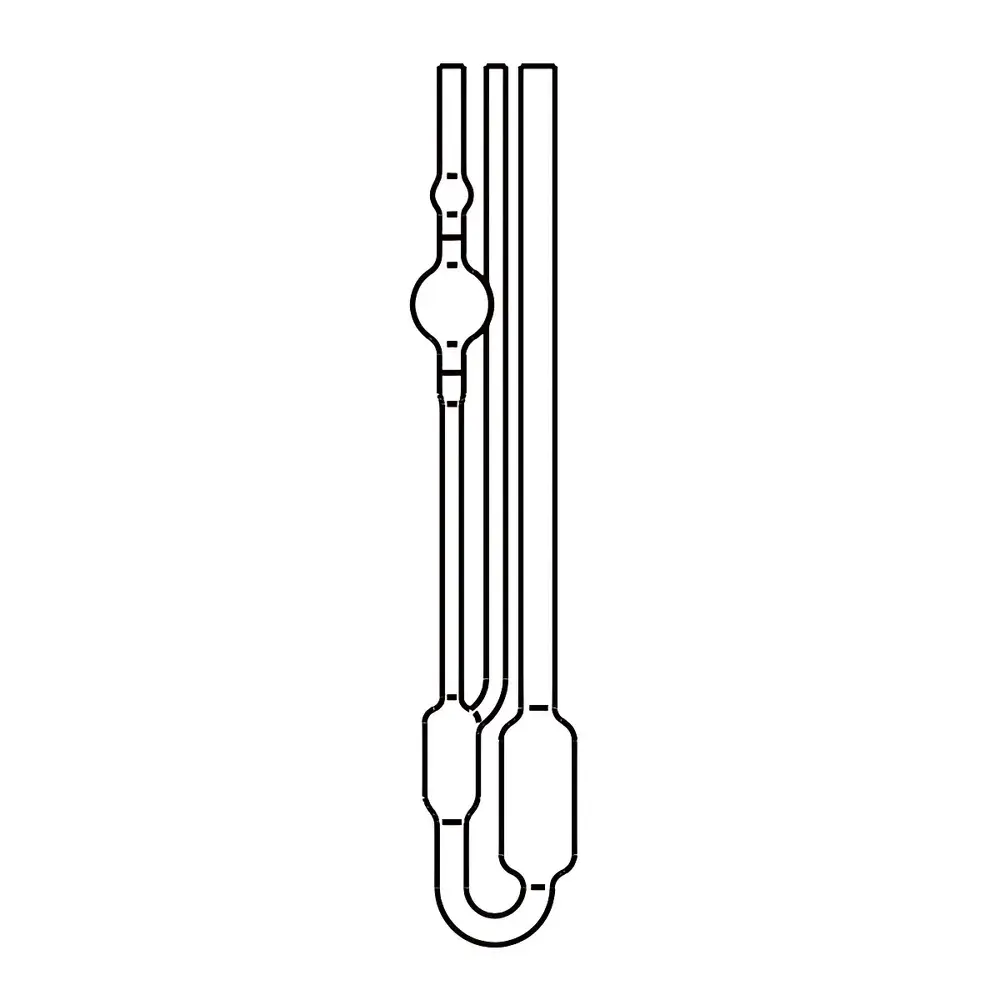
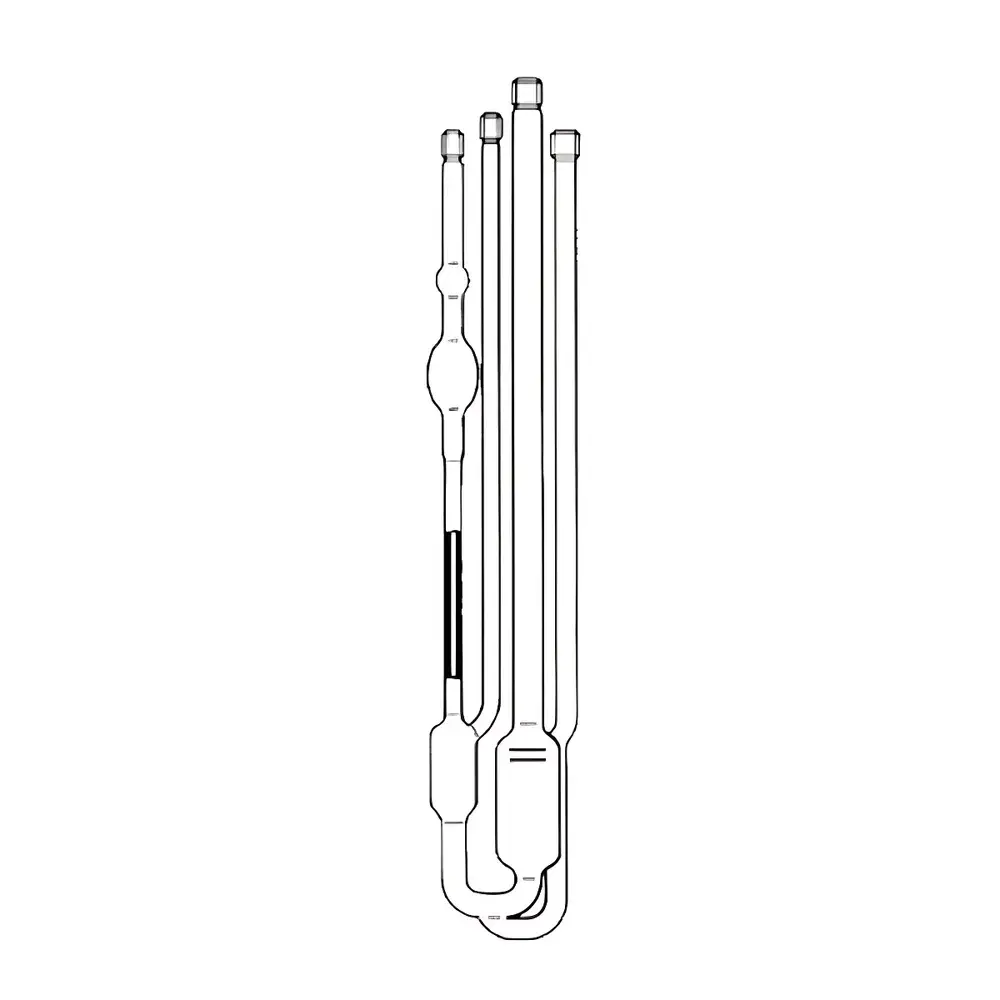
ChemTron Ubbelohde Viscometers (DIN & ASTM Types)
| Brand | ChemTron |
|---|---|
| Origin | Germany |
| Type | Capillary Viscometer |
| Design | Ubbelohde (Dilution-Compensated) |
| Compliance | DIN 51562-1, ISO 3105, ASTM D2515, ASTM D446 |
| Calibration | NIST-traceable K-value certified (4 significant figures, optional) |
| Capillary Diameter Range | 0.24–6.30 mm |
| Kinematic Viscosity Range | 0.35 to >100,000 mm²/s |
| Fill Volume | 15–22 mL |
| Total Length | 285–290 mm |
| Material | Borosilicate Glass 3.3 (DURAN®) |
| Application | Transparent Newtonian & near-Newtonian Liquids |
| Mounting | Threaded Stem with Integrated Cleaning Tube (Models 541xx & 545xx) |
| Configuration | Manual or Automated Compatibility |
Overview
ChemTron Ubbelohde Viscometers are precision-engineered capillary viscometers based on the classical dilution-compensated Ubbelohde design. They operate on the principle of Poiseuille flow, where kinematic viscosity (ν, in mm²/s) is calculated from the efflux time (t) and a calibrated instrument constant (K), following the fundamental equation ν = K × t. This geometry eliminates hydrostatic pressure dependence on liquid column height, ensuring high reproducibility across multiple dilutions—making them indispensable for intrinsic viscosity determination of polymers (e.g., PET, PA6, cellulose derivatives) per ISO 1628, ASTM D4603, and USP . Manufactured in Germany from high-purity borosilicate glass (DURAN® 3.3), each unit undergoes rigorous thermal and dimensional stability validation. The Ubbelohde configuration features a suspended capillary with a separate reservoir arm, enabling true single-point calibration and eliminating meniscus correction errors inherent in Ostwald-type instruments.
Key Features
- Dual-standard compliance: Fully aligned with DIN 51562-1 (German), ISO 3105 (International), and ASTM D2515/D446 (U.S.) for method validity in regulated environments
- Traceable calibration: Models 501xx, 525xx, 541xx, and 545xx include NIST-traceable K-values certified to four significant figures; certificates comply with ISO/IEC 17025 requirements
- Modular capillary selection: 22 distinct capillary diameters (0.24–6.30 mm) cover a continuous kinematic viscosity range from 0.35 to >100,000 mm²/s—enabling seamless transition from low-viscosity solvents to highly concentrated polymer solutions
- Automated integration ready: Threaded stem and integrated cleaning tube (541xx & 545xx series) ensure secure, leak-free mounting in AVS-series automated viscometry platforms (e.g., AVS26, AVS370) and support full-cycle solvent rinsing without disassembly
- Thermal stability optimized: Wall thickness and geometry conform to ISO 3105 tolerance limits for capillary bore deviation (<±0.5%); all units annealed to minimize residual stress and drift during thermostatic bath operation (±0.01 °C)
- Optical clarity assurance: Manufactured exclusively for transparent liquids; no ground joints or opaque components that could interfere with meniscus detection in automated optical timing systems
Sample Compatibility & Compliance
These viscometers are validated for use with Newtonian and pseudo-Newtonian liquids exhibiting minimal shear-thinning under gravity-driven laminar flow conditions. Common applications include organic solvents (chloroform, phenol/o-chlorophenol mixtures), polymer solutions (polystyrene in toluene, polyacrylonitrile in DMF), and pharmaceutical excipients (propylene glycol, PEG 400). They are not suitable for suspensions, emulsions, or highly viscous non-Newtonian fluids requiring controlled shear rate application. All models meet GLP documentation requirements when used with validated bath systems (e.g., Julabo F25 HL) and calibrated timers. For FDA-regulated environments, K-value certificates and batch-specific calibration records support 21 CFR Part 11 audit readiness when paired with compliant LIMS or electronic lab notebook (ELN) integration.
Software & Data Management
While inherently analog instruments, ChemTron Ubbelohde viscometers serve as primary reference standards within digital viscometry workflows. When coupled with automated systems (e.g., Lovis 2000 M/ME, Anton Paar AMVn), they feed time-stamped efflux data into software modules that apply temperature-corrected K-values, perform multi-point Huggins/Kraemer extrapolations, and generate intrinsic viscosity reports compliant with ISO 1628-1. Raw K-values are supplied in SI-traceable format and can be imported directly into ASTM-compliant spreadsheets (e.g., ASTM D4603 Annex A1 calculators). All calibration documentation includes uncertainty budgets per GUM (JCGM 100:2008) and is archived for ≥10 years to satisfy long-term stability verification per ISO/IEC 17025 clause 7.7.
Applications
- Intrinsic viscosity determination of synthetic and natural polymers per ISO 1628-1, ASTM D4603, and pharmacopoeial monographs (USP , Ph. Eur. 2.2.47)
- Quality control of industrial solvents and monomers where viscosity correlates directly with purity (e.g., acrylonitrile, vinyl chloride)
- Stability assessment of formulated products including coatings, adhesives, and ink vehicles under accelerated aging protocols
- Educational laboratories requiring traceable, hands-on instruction in rheological fundamentals and capillary flow theory
- Reference standard deployment in metrology labs performing inter-laboratory comparisons under ILAC P15 guidelines
FAQ
What distinguishes the Ubbelohde design from the Ostwald viscometer?
Unlike Ostwald viscometers, the Ubbelohde features a gas-isolated lower bulb and suspended capillary—eliminating dependence of efflux time on the volume of liquid above the capillary. This enables accurate serial dilution measurements without recalibration, essential for polymer molecular weight analysis.
Can these viscometers be used with automatic timing systems?
Yes—models 541xx (DIN-threaded + cleaning tube) and 545xx (ASTM-threaded + cleaning tube) are mechanically and dimensionally compatible with AVS26, AVS370, and equivalent automated platforms. Their standardized stem geometry ensures repeatable positioning and optical sensor alignment.
Is K-value certification mandatory for regulatory submissions?
For GLP, GMP, or FDA submission contexts (e.g., ANDA, NDA), K-value traceability to national standards (e.g., PTB, NIST) is required. ChemTron’s 4-significant-figure certificates meet ICH Q5C and USP validation expectations.
How often should recalibration be performed?
Recalibration is not routine for glass capillaries unless physical damage occurs. However, periodic verification against a reference fluid (e.g., Cannon-Fenske certified oils) every 6–12 months is recommended per ISO/IEC 17025 clause 7.7.2 to confirm K-value stability.
Are there limitations regarding sample opacity or particulate content?
Yes—these instruments require optically clear samples for manual meniscus observation or automated photometric detection. Suspended particles >1 µm or turbidity exceeding 5 NTU will obstruct timing accuracy and risk capillary clogging; filtration through 0.45 µm membranes is mandatory prior to measurement.



