
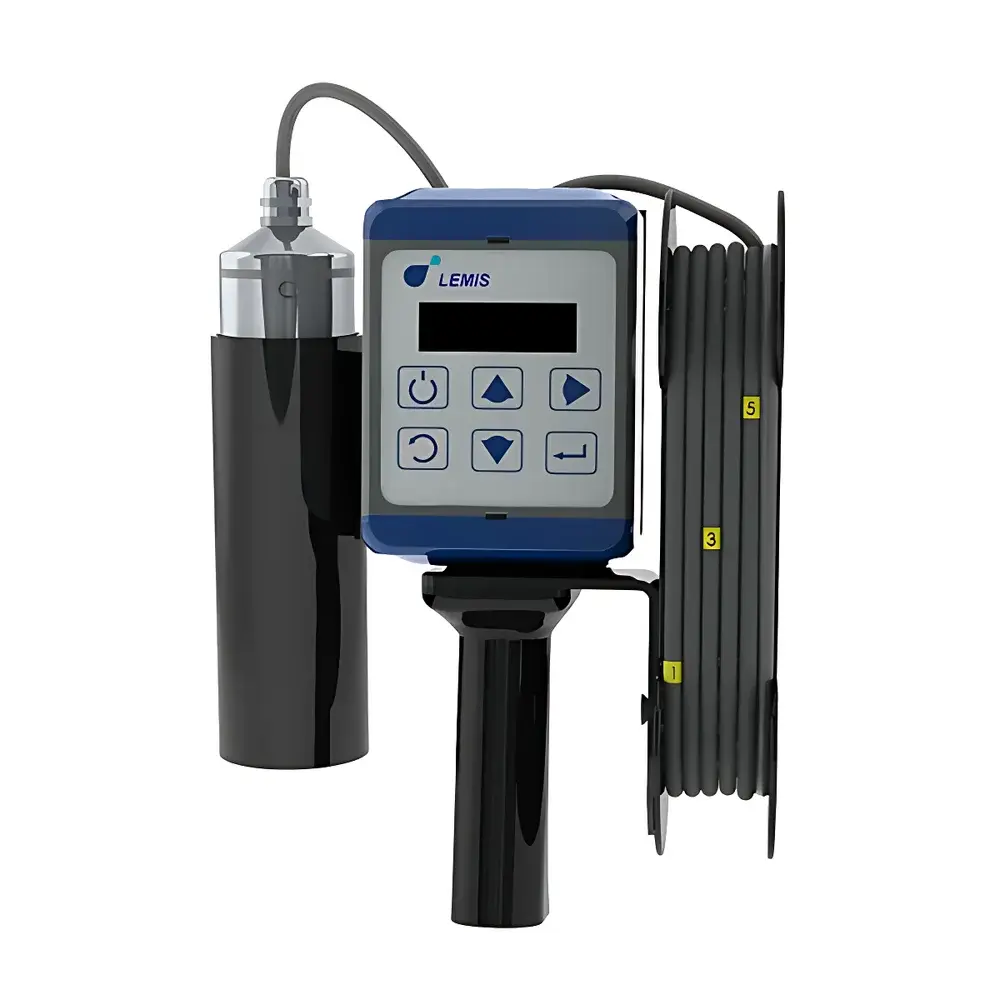
ChemTron VDM-250.1N Portable Immersion Density and Viscosity Meter
| Brand | ChemTron |
|---|---|
| Origin | Germany |
| Model | VDM-250.1N |
| Instrument Type | Portable Immersion Densimeter & Viscometer |
| Density Range | 0–3 g/cm³ (0–3000 kg/m³) |
| Density Accuracy | ±0.0003 or ±0.0005 g/cm³ |
| Density Repeatability | ±0.00015 or ±0.00025 g/cm³ |
| Temperature Range | −40 to +85 °C |
| Temperature Accuracy | ±0.1 or ±0.2 °C |
| Viscosity Range | up to 10,000 mPa·s (cP) |
| Viscosity Accuracy | ±1% of span |
| Viscosity Repeatability | ±0.5% of span |
| Measurement Depth | up to 6 m |
| Display | OLED with backlight |
| Data Storage | 2000 records |
| Communication | Bluetooth & USB |
| Sensor Materials | SS 316L, NiSpan C, or Hastelloy C-22 (optional) |
| Certifications | ATEX, IECEx HazLoc |
| Battery | NiMH 3.6 V, 2500 mAh (≈40 h operation) |
Overview
The ChemTron VDM-250.1N is a rigorously engineered portable immersion density and viscosity meter designed for in-situ, real-time characterization of liquid samples directly within storage tanks, pipelines, and process vessels. Unlike traditional benchtop densimeters requiring sample withdrawal and conditioning, the VDM-250.1N employs oscillating U-tube principle for density measurement and rotational viscometry via a coaxial cylindrical sensor geometry—both principles compliant with ISO 12185 (petroleum products), ASTM D4052 (density), and ASTM D2196 (viscosity of non-Newtonian fluids). Its immersion-based architecture eliminates sampling bias, thermal equilibration delays, and contamination risks associated with offline analysis. With operational capability from −40 to +85 °C and sub-milligram-per-cubic-centimeter precision, the instrument delivers metrologically traceable data under field conditions where environmental stability cannot be assumed.
Key Features
- True dual-parameter measurement: simultaneous acquisition of density (g/cm³, kg/m³, API, SG, lb/gal) and dynamic viscosity (mPa·s, cP, mm²/s, cSt) at point-of-use.
- ATEX Zone 1 and IECEx certified for safe deployment in hazardous areas—certified per EN 60079-0, -1, and -11 for Group IIB T4 temperature class.
- Oscillating U-tube transducer with temperature-controlled reference oscillator ensures long-term stability and minimizes thermal drift; integrated Pt100 RTD provides high-fidelity temperature compensation per ASTM D1250 and ISO 91-1.
- Ruggedized housing fabricated from marine-grade stainless steel (SS 316L) with optional NiSpan C or Hastelloy C-22 wetted parts for aggressive chemical environments including caustic solutions, hydrocarbons, and ethanol blends.
- Self-contained power system: rechargeable NiMH battery (3.6 V, 2500 mAh) supports continuous operation for up to 40 hours—validated across −20 to +60 °C ambient range.
- Real-time data logging with timestamp, GPS-tagged location (when paired with external module), depth marker, and user-defined batch ID—fully compatible with GLP/GMP audit trails when exported via encrypted Bluetooth 5.0 or USB 2.0.
Sample Compatibility & Compliance
The VDM-250.1N is validated for Newtonian and mildly shear-thinning liquids with kinematic viscosities up to 10,000 mm²/s and densities spanning 0–3 g/cm³. It meets regulatory requirements for routine quality control in petroleum refining (ASTM D1298, D4052), biofuel production (EN 14214, ASTM D6751), food-grade ethanol (USP , FDA 21 CFR Part 11–ready data export), and pharmaceutical excipient verification (ICH Q5C, Ph. Eur. 2.2.39). All firmware and calibration routines are developed in accordance with ISO/IEC 17025:2017 clause 7.7 (traceability of measurements) and support full uncertainty budgeting per GUM (JCGM 100:2008). Device firmware includes configurable pass/fail limits and automated deviation alerts aligned with internal SOPs.
Software & Data Management
Data capture and post-processing are managed via ChemTron’s proprietary VDM Connect Suite—a Windows-based application supporting raw data import, multi-point profile generation (density vs. depth, temperature gradient mapping), statistical summary (mean, SD, min/max), and compliance-ready reporting. Export formats include CSV, PDF (with digital signature), and XML for LIMS integration. The software enforces role-based access control (RBAC), electronic signatures, and full 21 CFR Part 11 audit trail functionality—including user action logs, parameter change history, and calibration event tracking. Bluetooth pairing enables wireless transfer without physical port exposure—critical for maintaining IP67-rated enclosure integrity during field use.
Applications
- Petroleum & Petrochemicals: On-site verification of crude oil API gravity stratification, blended fuel homogeneity, and terminal tank inventory reconciliation.
- Biofuels: Real-time monitoring of ethanol/water phase separation, biodiesel FAME purity assessment, and fermentation broth density profiling.
- Food & Beverage: Concentration control in syrup, juice, and dairy processing; alcohol content validation in spirits per OIML R 22.
- Pharmaceuticals: Excipient density verification (e.g., glycerin, propylene glycol), cleaning solution concentration checks, and bioreactor broth density trending.
- Chemicals & Cosmetics: Batch-to-batch consistency testing of surfactant solutions, polymer emulsions, and fragrance oil blends.
FAQ
Is the VDM-250.1N suitable for measuring highly viscous or non-Newtonian fluids?
Yes—its coaxial cylinder sensor design accommodates shear rates from 1 to 200 s⁻¹, enabling reliable viscosity determination for pseudoplastic and dilatant systems within its 10,000 mPa·s range.
How is calibration traceability maintained in field use?
Each unit ships with NIST-traceable calibration certificates for density (using certified water and air standards) and viscosity (standard mineral oils). Field recalibration is supported using ChemTron’s portable calibration kit (Cat. No. CAL-VDM-KIT), documented per ISO 9001 clause 7.1.5.2.
Can measurement data be integrated into an existing MES or SCADA system?
Yes—via Modbus TCP gateway (optional accessory) or direct CSV/XML export, enabling seamless ingestion into OSIsoft PI, Siemens Desigo, or Rockwell FactoryTalk environments.
What is the recommended maintenance interval under continuous industrial use?
Sensor inspection and zero-check verification every 6 months; full recalibration recommended annually or after 500 immersion cycles—documented in the included Maintenance Logbook template.
Does the device support custom unit conversions or industry-specific tables?
Yes—built-in lookup tables include ASTM D1250 (petroleum), AOAC Table 12 (alcohol), and ISO 291 (standard ambient conditions); users may import custom polynomial coefficients for proprietary formulations.



