
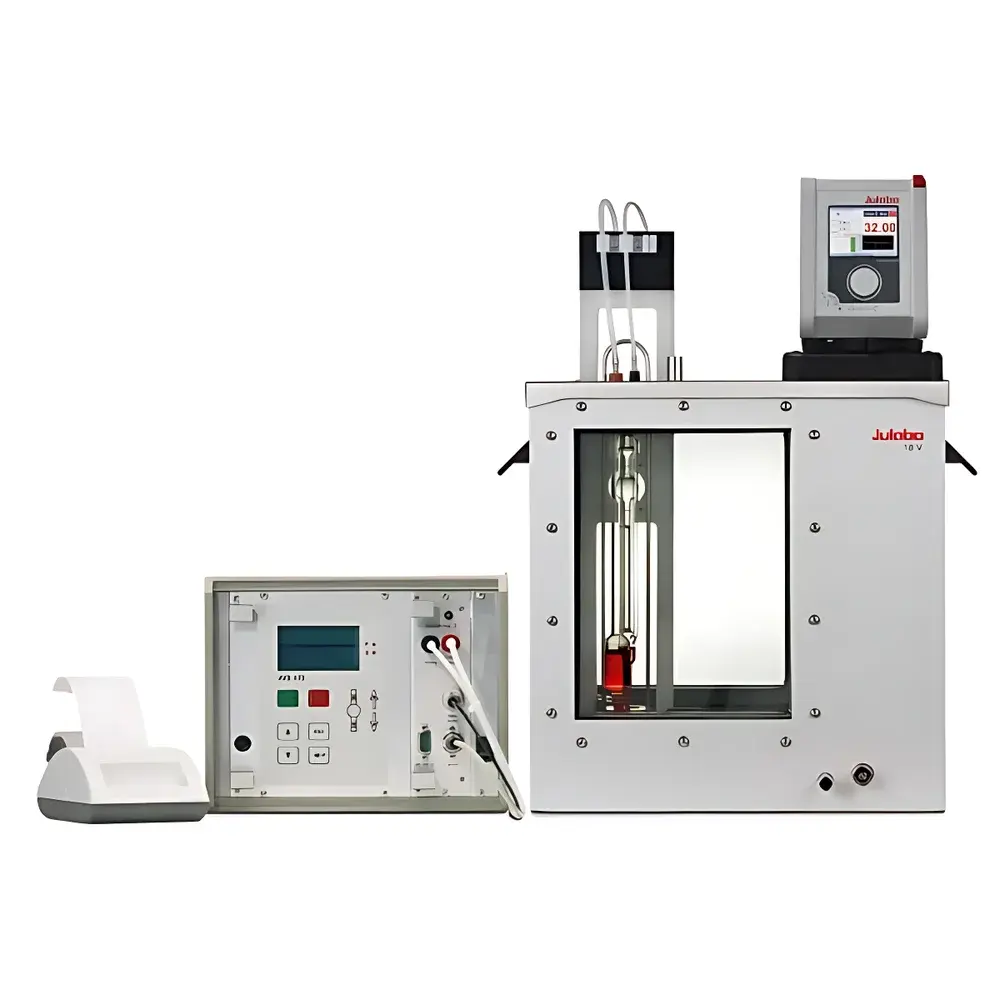
ChemTron VISCO 270 Semi-Automatic Polymer Viscometer
| Brand | ChemTron |
|---|---|
| Origin | Germany |
| Model | VISCO 270 |
| Instrument Type | Falling-Ball Viscometer |
| Viscosity Range | 5–1200 mPa·s |
| Kinematic Viscosity Range | 0.35–1800 mm²/s (cSt) under pressure mode |
| Pressure/Vacuum Control | ±160 mbar |
| Time Measurement Resolution | 0.01 s |
| Time Accuracy | ±0.01% |
| Sensor Options | Photoelectric or Pt100 thermal resistance sensor |
| Compatible Capillary Types | Ubbelohde, Cannon-Fenske, Ostwald, dilution, and micro-capillaries |
| Optional Accessory | VISCO 26 Automated Capillary Cleaning System |
Overview
The ChemTron VISCO 270 Semi-Automatic Polymer Viscometer is an engineered solution for precise kinematic viscosity determination of polymer solutions, synthetic oils, and other Newtonian or near-Newtonian liquids in quality control and R&D laboratories. Based on the standardized capillary viscometry principle—governed by Poiseuille’s law—the system measures flow time through calibrated glass capillaries under controlled hydrostatic pressure or vacuum. Its dual-mode operation (pressure or vacuum) enables reliable measurement across a broad dynamic range—from low-viscosity solvents to highly viscous polymer melts—without requiring hardware replacement beyond the pump module. Designed in accordance with ISO 3104, ASTM D445, and DIN 51562 standards, the VISCO 270 delivers traceable, reproducible results essential for regulatory submissions, material certification, and process validation.
Key Features
- Dual-mode fluid drive: Switch seamlessly between +160 mbar pressure-driven and −160 mbar vacuum-driven capillary flow—configurable via modular pump interchange without recalibration.
- High-precision timing architecture: Dual-sensor compatibility (photoelectric or Pt100 thermal resistance) ensures accurate fall-time detection for both transparent polymer solutions and opaque industrial oils.
- Autonomous operation: Integrated keypad interface and built-in thermal printer eliminate dependency on external PCs; all measurement logic—including replicate execution, outlier rejection (Dixon’s Q-test or Grubbs’ method), and arithmetic averaging—is handled onboard.
- Capillary protection system: Optional safety bottle alarm prevents over-aspiration into the measurement unit during vacuum operation, minimizing risk of capillary contamination or blockage.
- Modular bath integration: Supports interchangeable temperature-controlled viscosity baths (e.g., 25 °C, 30 °C, 50 °C) and a wide selection of certified capillaries—including Ubbelohde, Cannon-Fenske, Ostwald, dilution, and micro-capillaries—to meet application-specific shear history and sample volume requirements.
Sample Compatibility & Compliance
The VISCO 270 accommodates a broad spectrum of polymeric systems, including polystyrene, polyethylene oxide, polyacrylamide, and cellulose derivatives dissolved in organic solvents (e.g., chloroform, tetrahydrofuran, dimethylformamide) or aqueous media. It complies with GLP-aligned operational practices: all measurement events—including start/stop timestamps, sensor type, capillary ID, bath temperature, and applied pressure/vacuum—are logged with immutable metadata in internal non-volatile memory. Audit trails support 21 CFR Part 11 readiness when paired with validated documentation protocols. The system is routinely deployed in environments adhering to ISO/IEC 17025 accreditation requirements for testing laboratories.
Software & Data Management
While fully functional as a standalone instrument, the VISCO 270 supports optional RS-232 or USB-to-serial connectivity for integration into LIMS or ELN platforms. Raw time data and calculated viscosity values (in cSt and mPa·s) are exportable in CSV format. Internal memory retains up to 1,000 test records with full parameter context. All firmware updates are delivered via encrypted SD card, ensuring version traceability and integrity verification. No proprietary runtime or license keys are required—operation remains deterministic and vendor-agnostic at the firmware level.
Applications
- Molecular weight estimation of linear polymers via intrinsic viscosity (IV) using Huggins or Kraemer extrapolation from concentration-dependent measurements.
- Batch release testing of synthetic lubricants, transformer oils, and hydraulic fluids per ASTM D445 and IEC 60296.
- Process monitoring of polymerization reactions—tracking viscosity evolution during condensation or addition polymerization.
- Quality assurance of pharmaceutical excipients (e.g., hydroxypropyl methylcellulose) in accordance with USP <911> and Ph. Eur. 2.2.34.
- Research-scale rheological screening where capillary-based shear-rate independence and minimal sample disturbance are critical.
FAQ
What capillary types are certified for use with the VISCO 270?
Ubbelohde, Cannon-Fenske, Ostwald, dilution, and micro-capillaries—all traceably calibrated per ISO 3105 and supplied with individual certificate numbers.
Can the VISCO 270 perform intrinsic viscosity calculations automatically?
Yes—when used with serial dilutions and configured with concentration inputs, the onboard processor computes Huggins and Kraemer plots and extrapolates intrinsic viscosity at zero concentration.
Is the VISCO 26 cleaning system compatible with all capillary geometries?
The VISCO 26 supports all capillary types listed above; its programmable solvent delivery and vacuum-drying sequence adapts to internal diameter and total volume constraints.
Does the system meet FDA 21 CFR Part 11 requirements?
The VISCO 270 provides foundational data integrity features (audit trail, electronic signature support via external authentication, and immutable logs); full Part 11 compliance requires site-specific validation and procedural controls.
How is temperature stability maintained during extended measurement sequences?
When coupled with a certified thermostatic bath (e.g., Julabo F25 or similar), the system maintains ±0.02 °C stability over 24 h—verified using NIST-traceable PRT sensors embedded in the bath manifold.



