
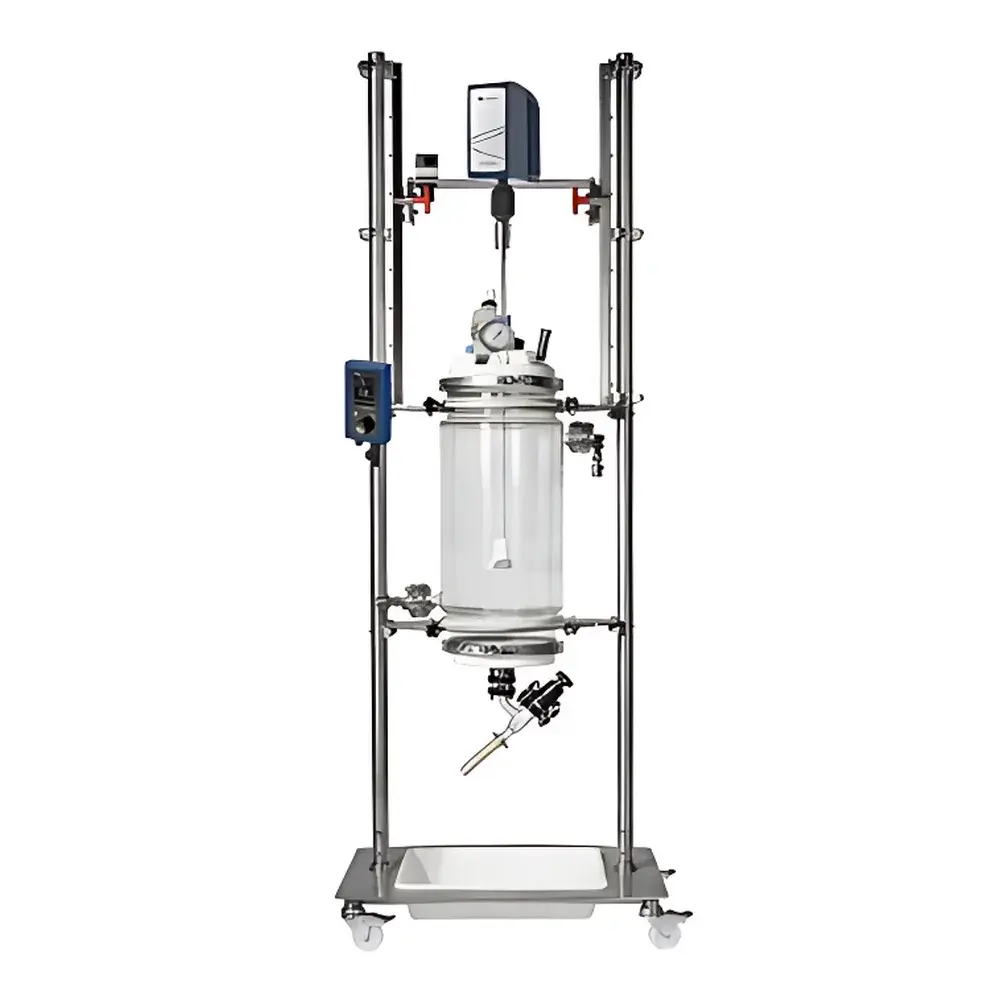
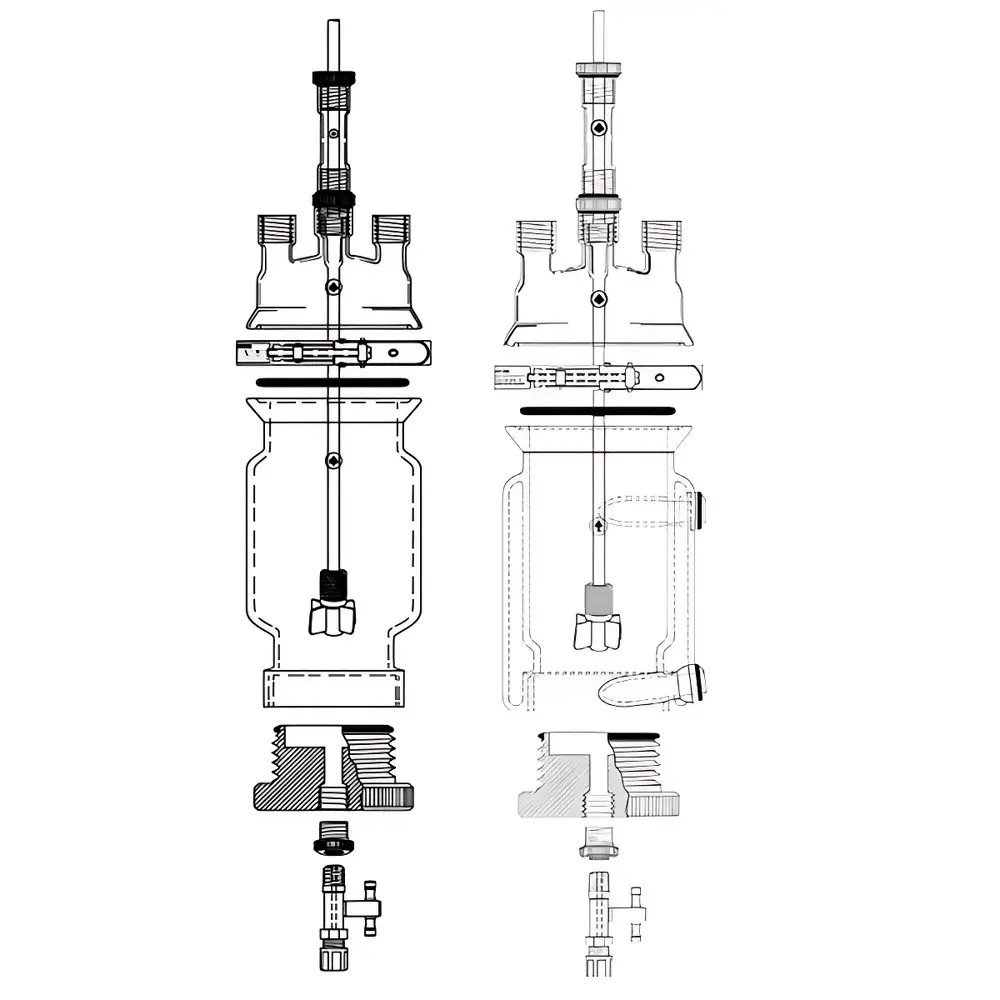
ChemTron VPFR Glass Pressure/Vacuum Filtration & Drying Integrated Reactor
| Brand | ChemTron |
|---|---|
| Origin | Germany |
| Model | VPFR |
| Vessel Material | Borosilicate Glass 3.3 (Duran®/Schott®) |
| Operating Pressure Range | Up to 2.4 bar (35 psig) at 100 °C |
| Vacuum Capability | Down to ≤10 mbar (absolute) |
| Available Volumes | 150–6000 mL |
| Standard Flange Sizes | 60 mm (≤600 mL), 100 mm (1000–2000 mL), 150 mm (3000–6000 mL) |
| Bottom Port Thread | #50 (≤600 mL), #80 (≥1000 mL) |
| Filter Disc | Sintered Glass, Certified Pore Sizes (e.g., 10–100 µm), ASTM E128-compliant testing |
| Safety System | Integrated Pressure Relief Assembly with Burst Disc Rated at 2.4 bar |
| Thermal Integration | Compatible with Julabo heating circulators and PID-controlled temperature management systems |
Overview
The ChemTron VPFR Glass Pressure/Vacuum Filtration & Drying Integrated Reactor is an engineered solution for multi-step synthesis workflows requiring seamless transition from reaction to solid-liquid separation and post-filtration drying — all within a single, chemically inert, visually transparent vessel. Built on high-purity borosilicate glass 3.3 (Duran®/Schott®), the VPFR operates under controlled pressure (up to 2.4 bar gauge at 100 °C) or deep vacuum (≤10 mbar absolute), enabling heterogeneous catalysis, hydrogenations, Grignard reactions, crystallizations, and moisture-sensitive transformations under inert atmosphere (N₂ or Ar). Its integrated design eliminates intermediate transfer steps, minimizing exposure to ambient contaminants, reducing operator handling risk, and preserving stoichiometric integrity across process stages. The reactor leverages differential pressure-driven filtration — either vacuum-induced suction or inert-gas-assisted positive-pressure displacement — through precision-sintered glass frits, ensuring reproducible cake formation and consistent filtrate clarity.
Key Features
- Monolithic thick-walled glass construction compliant with DIN ISO 3585 standards for chemical resistance and thermal shock tolerance (ΔT ≥ 120 K).
- Modular flange system (60/100/150 mm Schott®-type) supporting standardized ground-glass joints (ISO KF, NS, or CG standard ports) for interchangeable condensers, addition funnels, gas inlets, and sampling valves.
- Bottom-mounted filtration assembly including reinforced glass support plate, PTFE-sealed drain valve with ISO-KF 25/40 interface, and quick-release adapter for rapid filter disc replacement.
- Pressure-rated safety enclosure with certified burst disc (2.4 bar) and redundant mechanical pressure relief, meeting PED 2014/68/EU essential safety requirements.
- Thermally coupled design compatible with Julabo heating circulators (e.g., F25 HL or R15 W) for precise jacketed or external mantle-based temperature control (−20 °C to +200 °C range).
- Optional VPFR-T variant features double-jacketed vessel for active cooling during exothermic filtration or cryo-crystallization protocols.
Sample Compatibility & Compliance
The VPFR is validated for use with corrosive reagents (e.g., concentrated HCl, HF-diluted etchants, organolithiums), halogenated solvents (CH₂Cl₂, chlorobenzene), and high-boiling media (DMSO, NMP, sulfolane). All wetted surfaces are Class A borosilicate glass per ASTM E438 Type I, Class A; filtration discs undergo individual pore-size certification per ASTM E128 (mean flow pore size ±5% tolerance). The system supports GLP-compliant operation when paired with Julabo’s CFR 21 Part 11–enabled temperature controllers (e.g., TR-2000 with audit trail logging). Pressure and vacuum cycles comply with ISO 10523 (pH measurement of filtrates) and USP for residual solvent analysis following filtration/drying.
Software & Data Management
When integrated with Julabo’s Labworldsoft® or optional ChemTron ProcessLog™ interface, the VPFR enables synchronized logging of temperature (±0.1 °C), pressure (±0.02 bar), and time-stamped filtration duration. Digital setpoints for ramp-hold-cool profiles, real-time deviation alerts, and exportable CSV/PDF reports meet ALCOA+ data integrity principles. Optional Ethernet/IP or Modbus TCP connectivity allows centralized supervision within distributed lab automation networks (e.g., DeltaV or LabArchives ELN integration).
Applications
- Multi-stage API synthesis: Reaction → in-situ crystallization → vacuum filtration → inert-gas purge drying — all without vessel opening.
- Catalyst recovery: Pd/C or Ni/Raney filtration under N₂ blanket, followed by solvent displacement and low-temperature drying to preserve activity.
- Polymorph screening: Controlled cooling crystallization under pressure, graded sintered-glass filtration (e.g., 40 µm → 10 µm cascade), and residual moisture quantification via Karl Fischer coupling.
- Electrochemical synthesis: Anode/cathode compartment isolation using dual-frit configuration (available as custom option), with simultaneous electrolyte filtration and electrode washing.
- Material science precursor processing: MOF or perovskite nanocrystal synthesis, where oxygen/moisture exclusion during isolation is critical to phase purity.
FAQ
What maximum operating temperature is supported under full 2.4 bar pressure?
The VPFR is rated for continuous operation up to 100 °C at 2.4 bar gauge pressure. For extended high-temperature use (>120 °C), derating to 1.6 bar is recommended per EN 13445-3 Annex C fatigue assessment.
Can the sintered glass frit be autoclaved?
Yes — all frits are autoclavable at 121 °C / 2 bar for 20 min; however, repeated steam sterilization may gradually reduce mechanical strength. We recommend periodic pore-size verification using bubble point testing per ISO 4022.
Is the VPFR suitable for GMP manufacturing environments?
The base unit qualifies as a Class 3.2 laboratory-scale reactor per ICH Q5D. For GMP deployment, validation packages (IQ/OQ/PQ), material traceability dossiers (EN 10204 3.1), and calibration certificates for integrated pressure transducers are available upon request.
How is temperature uniformity maintained during pressure filtration?
Julabo heating mantles provide radial thermal symmetry (±1.5 °C across vessel height); for critical crystallization, the VPFR-T jacketed model enables active cooling during filtration to suppress Ostwald ripening.
What maintenance intervals are recommended for the pressure relief system?
Burst discs must be replaced after each activation or annually under non-activated service; pressure transducers require biannual calibration traceable to NIST standards.
Related Products



