
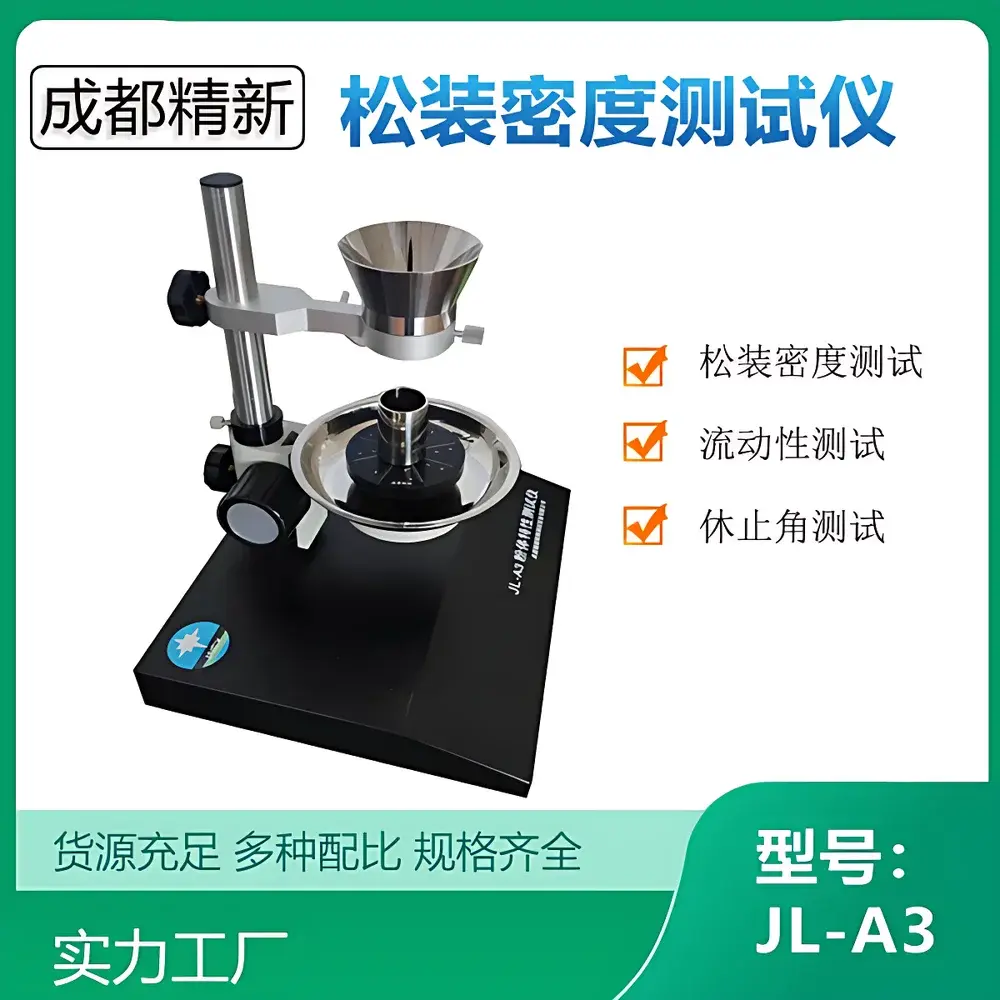
Chengdu Jingxin JL-A-3 Powder Characterization Tester: Hall Flow Rate, Apparent Density & Angle of Repose Analyzer
| [Brand | Chengdu Jingxin (CDJX) |
|---|---|
| Origin | Sichuan, China |
| Manufacturer Type | Direct Manufacturer |
| Instrument Type | Hall Flow Tester, Apparent Density Tester, Angle of Repose Tester |
| Measurable Parameters | Flow Time (s/50g), Angle of Repose (°), Apparent Density (g/cm³) |
| Standardized Compliance | GB/T 1482–2010, GB/T 1479.1–2017, GB/T 16913–2008 |
| Sample Mass Range | 50–100 g |
| Stainless Steel Cup Volume | 25 mL |
| Funnel Orifice Diameter | 5 mm (standard), optional 2.5 mm |
| Funnel Cone Angle | 60° |
| Repose Plate Diameter | 80 mm |
| Ruler Width | 25 mm |
| Dimensions | 300 × 260 × 260 mm |
| Net Weight | ~5 kg] |
Overview
The Chengdu Jingxin JL-A-3 Powder Characterization Tester is an integrated, benchtop instrument engineered for standardized measurement of three fundamental powder bulk properties: Hall flow rate (as defined by GB/T 1482–2010), apparent (bulk) density (per GB/T 1479.1–2017), and angle of repose (in accordance with GB/T 16913–2008). It implements classical gravitational flow principles—namely free-fall discharge through a calibrated orifice, static cone formation under controlled deposition, and volumetric filling under gravity—to deliver reproducible, operator-independent results essential for quality control, process development, and regulatory documentation in powder-handling industries. The system is not a multi-sensor analytical platform but a precision mechanical test station designed to replicate standardized manual procedures with enhanced repeatability, reduced human intervention, and traceable data output.
Key Features
- Triple-function modular design: single instrument performs Hall flow time measurement, apparent density determination, and angle of repose evaluation—eliminating need for separate dedicated units.
- Stainless steel (AISI 304) construction throughout critical components: funnel, 25 mL measuring cup, leveling ruler, and repose plate—ensuring corrosion resistance, dimensional stability, and long-term calibration integrity.
- Optimized funnel geometry: 60° conical angle and precisely machined 5 mm orifice (with optional 2.5 mm variant) conform to national standard specifications for consistent flow dynamics across test batches.
- Adjustable vertical positioning mechanism: fine-thread height adjustment knob enables precise alignment between funnel outlet and receptacle (cup or repose plate), minimizing parallax error and ensuring repeatable drop distance.
- Integrated gate shutter: spring-loaded stainless steel baffle at funnel base prevents premature powder discharge during sample loading—removing manual occlusion and improving inter-operator consistency.
- Dedicated calculation software: Windows-based application accepts raw inputs (flow time, pile height, cup mass, etc.) and computes final values per standard equations; supports bilingual (EN/CN) report generation in Word, Excel, and PDF formats with embedded metadata and timestamping.
Sample Compatibility & Compliance
The JL-A-3 is validated for dry, free-flowing, non-cohesive powders within the 50–100 g mass range. It accommodates metallic powders (e.g., stainless steel, aluminum, titanium alloys), battery cathode/anode materials (LiCoO₂, graphite), pharmaceutical excipients (microcrystalline cellulose, lactose), food-grade starches, and ceramic precursors. Moisture-sensitive samples require pre-conditioning at 105 °C per GB/T 1479.1–2017 prior to testing. While not certified to ISO 4490 (metal powder flowability) or ASTM B213 (Hall flow), its mechanical configuration and operational protocol align closely with those standards’ physical requirements. The instrument supports GLP-aligned workflows: all input parameters are logged digitally, reports include operator ID, date/time stamps, and instrument ID—facilitating audit readiness in regulated environments.
Software & Data Management
The accompanying software operates as a standalone desktop application (Windows 10/11 compatible) without cloud dependency or internet connectivity. It enforces mandatory entry fields corresponding to each test type (e.g., flow time + mass for Hall flow; pile height + plate radius for repose angle; net cup mass + volume for apparent density). Calculations follow exact formulas from referenced Chinese national standards—no interpolation or curve-fitting applied. Each report contains a header with instrument model, serial number placeholder, test standard reference, and environmental notes (e.g., “sample dried at 105 °C for 2 h”). Exported files retain editable fields in Word, structured tables in Excel, and immutable archival format in PDF—suitable for internal SOP documentation or third-party lab submissions.
Applications
This tester serves as a primary QC tool in metal additive manufacturing (AM) feedstock qualification, where Hall flow time directly correlates with powder spreadability in laser powder bed fusion systems. In lithium-ion battery production, apparent density and repose angle inform electrode slurry formulation consistency and die-fill uniformity. Pharmaceutical manufacturers apply it during excipient selection and blend uniformity assessment under ICH Q5C guidelines. Research laboratories utilize its reproducible geometry to benchmark new powder surface treatments (e.g., silanization, plasma coating) against baseline flow behavior. Educational institutions deploy it for hands-on instruction in particulate science, emphasizing the relationship between particle morphology, interparticle forces, and macroscopic bulk response.
FAQ
What standards does the JL-A-3 comply with?
It is configured and validated for GB/T 1482–2010 (Hall flow), GB/T 1479.1–2017 (apparent density), and GB/T 16913–2008 (angle of repose). Its mechanical dimensions and procedural logic are functionally equivalent to ISO 4490 and ASTM B213, though formal certification under those standards requires third-party verification.
Can the instrument measure cohesive or moist powders?
No—it is intended for free-flowing, dry powders. Cohesive or hygroscopic materials must be pre-dried per GB/T 1479.1–2017 (typically 105 °C for 2 hours) before testing; otherwise, flow interruption and unstable repose cones compromise result validity.
Is the software compliant with FDA 21 CFR Part 11?
The current version provides electronic records with timestamps and user-defined identifiers but lacks full Part 11 features (e.g., digital signatures, audit trail encryption, role-based access control). For GMP environments, it functions as a data capture tool upstream of validated LIMS or ELN systems.
How many replicates are recommended per test?
Per GB/T 1482–2010, ≥3 flow time measurements are required; per GB/T 1479.1–2017, ≥2 apparent density determinations; per GB/T 16913–2008, ≥3 independent repose angle trials. The software calculates arithmetic means and flags outliers exceeding ±5% deviation.
Does the system support automated data export to LIMS?
Not natively—data must be exported manually as CSV or Excel files. However, the structured output format allows straightforward ingestion via LIMS import modules or Python-based ETL pipelines.



