
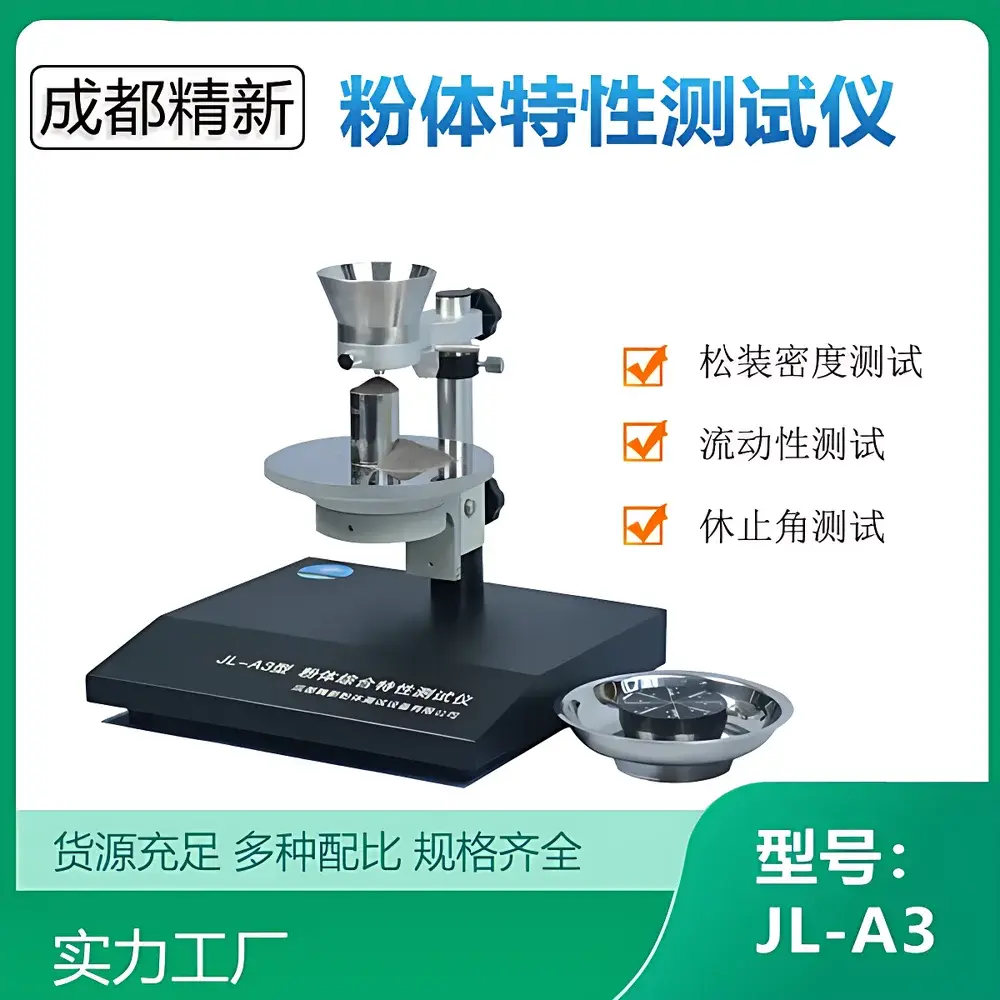
Chengdu Jingxin JL-A3 Powder Flowability & Bulk Property Analyzer
| [Brand | Chengdu Jingxin |
|---|---|
| Origin | Sichuan, China |
| Manufacturer Type | Direct Manufacturer |
| Instrument Type | Angle of Repose Tester, Bulk Density Tester, Flow Rate Tester |
| Measurable Parameters | Angle of Repose, Bulk Density, Flow Rate (Haller Flow Time) |
| Maximum Sample Capacity | 100 g |
| Minimum Sample Requirement | 50 g |
| Funnel Orifice Diameter | 5 mm (standard), optional 2.5 mm or custom |
| Stainless Steel Cup Volume | 25 mL |
| Funnel Cone Angle | 60° |
| Repose Plate Diameter | 80 mm |
| Ruler Width | 25 mm |
| Dimensions | 300 × 260 × 260 mm |
| Net Weight | ~5 kg |
| Material | AISI 304 Stainless Steel (funnel, cup, ruler, plate)] |
Overview
The Chengdu Jingxin JL-A3 Powder Flowability & Bulk Property Analyzer is a benchtop, multi-function physical property tester engineered for standardized measurement of three fundamental powder bulk characteristics: angle of repose (also known as angle of rest or static repose angle), bulk density (loose density), and flow rate (Haller flow time). It operates on well-established gravity-driven principles defined in internationally referenced national standards—including GB/T 1482–2010 (metal powder flow rate by Haller funnel), GB/T 1479.1–2017 (bulk density by funnel method), and GB/T 16913–2008 (angle of repose determination for dusts and powders). The instrument implements a fixed-geometry, manual-operated funnel system with precise mechanical alignment, calibrated stainless steel components, and repeatable sample handling protocols—ensuring high reproducibility across routine QC testing environments in powder processing industries.
Key Features
- Triple-function design: Simultaneous capability for angle of repose, bulk density, and Haller flow time measurements—eliminating the need for separate single-purpose instruments.
- AISI 304 stainless steel construction: Funnel, measuring cup, leveling ruler, and repose plate are all fabricated from corrosion-resistant, non-magnetic, food-grade stainless steel with optimized wall thickness to prevent deformation and surface wear during repeated use.
- Modular, adjustable mechanical platform: Precision-height adjustment knob enables fine vertical positioning of the repose plate relative to the funnel outlet; locking mechanisms ensure stable coaxial alignment between funnel centerline and sample container or plate center.
- Integrated gate control: A manually actuated stainless steel shutter at the funnel outlet prevents premature powder discharge—enabling consistent sample loading and synchronized start/stop timing without operator hand-blocking.
- Standardized geometry compliance: Funnel cone angle (60°), orifice diameter (5 mm standard, with optional 2.5 mm variant), and 25 mL calibrated cup volume conform to ISO 4490, ASTM B212, and GB/T 1482 requirements for inter-laboratory comparability.
- Dedicated calculation software: Windows-based application accepts raw input values (flow time, pile height, mass, volume) and automatically computes final results per standard equations—supporting dual-language (English/Chinese) report generation in Word, Excel, and PDF formats with audit-ready timestamping.
Sample Compatibility & Compliance
The JL-A3 accommodates free-flowing to moderately cohesive dry powders and granules within the 50–100 g operational range. It is suitable for metallic powders (e.g., Ni, Co, Al alloys), battery cathode/anode materials (LiCoO₂, graphite), pharmaceutical excipients (lactose, microcrystalline cellulose), food-grade starches and flours, ceramic precursors, and polymer granules. All test procedures align with recognized regulatory frameworks: GB/T standards (China National Standards), and functionally equivalent to ASTM D6393 (Flow Function Index), ISO 4490 (metal powder flow rate), ISO 3953 (bulk density), and USP & EP general chapters on powder characterization. While not inherently 21 CFR Part 11 compliant, the software supports user-defined electronic signatures and exportable data logs required for GLP/GMP-aligned documentation.
Software & Data Management
The bundled Windows application provides intuitive data entry fields mapped directly to each test protocol. Users input measured values—including flow duration (s), repose pile height (mm), sample mass (g), and cup volume (mL)—and select the corresponding test type. The software applies standard-compliant arithmetic (e.g., bulk density = mass / volume; angle of repose = arctan[h/(r − d/2)]) and displays intermediate and final results in real time. Reports include test date, operator ID, instrument ID, environmental notes (optional), and digital signature fields. Export options include editable .docx, tabular .xlsx, and archival .pdf files—each embedding metadata and calculation logic traceability. No cloud storage or remote telemetry is implemented; all data remains local unless explicitly exported.
Applications
This analyzer serves as a primary tool for quality control laboratories in powder metallurgy, lithium-ion battery manufacturing, pharmaceutical solid dosage development, additive manufacturing feedstock qualification, and food ingredient blending validation. It supports formulation screening (e.g., comparing flow enhancement effects of glidants), incoming raw material inspection, batch release testing, and process troubleshooting related to hopper discharge, die filling inconsistency, or pneumatic conveying instability. In academic and research settings, it provides baseline rheological descriptors for correlating with more advanced dynamic or shear-based measurements (e.g., FT4, Schulze Ring Shear).
FAQ
What standards does the JL-A3 comply with?
It implements GB/T 1482–2010 (flow rate), GB/T 1479.1–2017 (bulk density), and GB/T 16913–2008 (angle of repose), which are technically aligned with ISO 4490, ISO 3953, and ASTM D6393.
Can the instrument measure cohesive or damp powders?
It is designed for dry, free-flowing powders. For hygroscopic or cohesive materials, pre-drying at 105 °C (per GB/T 1479.1) is recommended prior to testing.
Is calibration certification included?
The instrument ships with dimensional verification documentation for funnel geometry and cup volume. Users are advised to perform periodic verification using NIST-traceable mass standards and calibrated calipers.
Does the software support automated data import from balances or timers?
No—data entry is manual. However, the interface allows copy/paste from spreadsheet sources and supports keyboard navigation for rapid throughput in high-volume labs.
What maintenance is required?
Routine cleaning with lint-free cloth and isopropyl alcohol; periodic visual inspection of funnel orifice for particle adhesion or deformation; no lubrication or consumables are required.



