
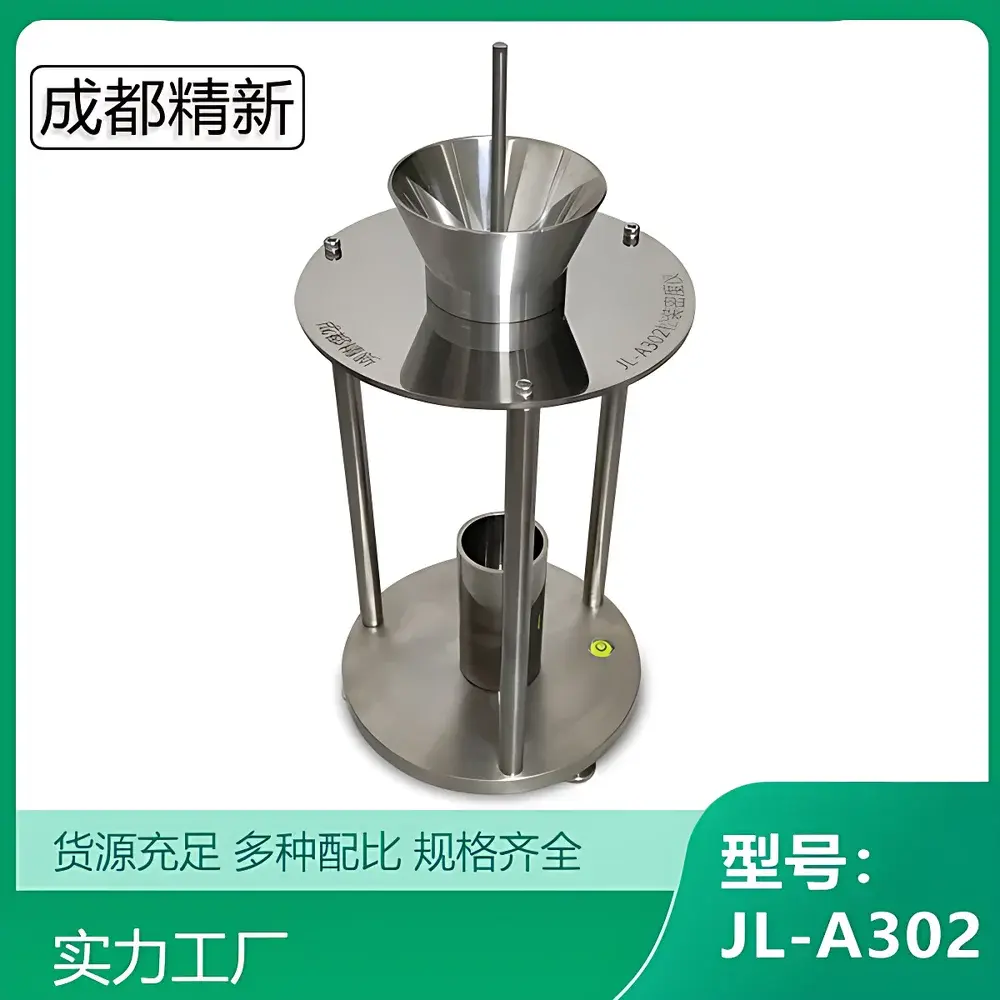
Chengdu Jingxin JL-A302 Bulk Density Tester (Natural Flow Method, ASTM/ISO-Compliant Design)
| Key Features | Stainless Steel 304 Construction |
|---|
Overview
The Chengdu Jingxin JL-A302 Bulk Density Tester is a precision-engineered, benchtop instrument designed for the standardized determination of bulk (loose) density of free-flowing powders and granular solids. It operates on the principle of natural gravitational flow—where powder is allowed to descend freely from a fixed-height, calibrated funnel into a volumetric cylinder under controlled geometric conditions. This method, codified in GB/T 16913–2008 (China), ASTM D1895–19 (Standard Test Methods for Apparent Density of Plastic Materials), and ISO 697–2017 (Fine Ceramics — Determination of Bulk Density of Powders), ensures high inter-laboratory reproducibility and regulatory acceptability across quality control and R&D environments. Unlike tapped or vibrated density measurements, the JL-A302 captures the material’s inherent packing behavior under minimal disturbance—critical for assessing flowability, hopper design, blending uniformity, and dosage consistency in pharmaceutical and battery electrode manufacturing.
Key Features
- High-precision stainless steel 304 construction throughout—funnel, cylinder, straightedge, and stopper rod—to ensure corrosion resistance, dimensional stability, and long-term repeatability.
- Geometrically validated funnel geometry: 60° cone angle and precisely machined 12.7 mm orifice diameter, aligned to international standard specifications for unrestricted powder discharge.
- Fixed vertical clearance of 115 mm ±2 mm between funnel orifice and top rim of the 100 mL calibrated cylinder—maintaining consistent kinetic energy and flow profile across tests.
- Integrated 25 mm wide stainless steel straightedge for precise, repeatable leveling of the powder surface without compaction or shear-induced density artifacts.
- Compact, self-contained mechanical architecture (160 × 160 × 300 mm; 3.7 kg) suitable for QC labs, production floors, and field-deployed testing—no power supply or pneumatic system required.
- Designed for seamless integration with user-supplied analytical balances meeting ISO/IEC 17025 traceability requirements (capacity ≥1000 g, readability ≤0.02 g).
Sample Compatibility & Compliance
The JL-A302 accommodates a broad range of dry, non-cohesive to moderately cohesive particulates—including API powders, excipients, food-grade starches, metal and ceramic powders, graphite anode materials, and catalysts—with particle size distributions typically spanning 10 µm to 2 mm. It excludes hygroscopic, electrostatic-prone, or fibrous materials unless preconditioned per ASTM D6393–22 (Flow Function Testing). The instrument conforms to national and international regulatory frameworks governing physical property characterization: GB/T 16913–2008 (dust property testing), ASTM D1895–19 (plastic materials), ISO 697–2017 (ceramic powders), and supports GLP/GMP documentation workflows when paired with balance audit trails and electronic lab notebook (ELN) integration.
Software & Data Management
As a fully manual, mechanically operated instrument, the JL-A302 does not incorporate embedded firmware or digital interfaces. However, its deterministic test protocol enables full traceability within regulated environments: all geometric parameters (orifice diameter, height, cylinder volume) are factory-certified and documented in the instrument’s calibration certificate. Users are advised to record raw mass values (g), calculated bulk density (g/mL or g/cm³), operator ID, ambient temperature/humidity, and sample lot number in compliant data capture systems. When used alongside balances compliant with FDA 21 CFR Part 11 (e.g., METTLER TOLEDO XSR series), the complete measurement chain supports audit-ready electronic records—including electronic signatures, change history, and user access controls.
Applications
- Pharmaceutical solid dosage development: evaluating excipient flow behavior prior to direct compression or capsule filling.
- Lithium-ion battery manufacturing: characterizing cathode/anode active material bulk density for slurry formulation and electrode calendering modeling.
- Food & nutraceutical processing: verifying consistency of powdered ingredients (e.g., milk powder, vitamin blends) across batches.
- Chemical & pigment industries: supporting specification definition and supplier qualification for bulk handling systems.
- Academic research & standards laboratories: serving as a reference method for validating automated density analyzers or developing new powder rheology models.
FAQ
What standards does the JL-A302 comply with?
It is engineered and verified to meet GB/T 16913–2008, ASTM D1895–19, and ISO 697–2017 for bulk density determination using the natural flow method.
Is a balance included with the instrument?
No—the JL-A302 requires an external analytical balance (≥1000 g capacity, ≤0.02 g readability); users must select a model compliant with their quality system requirements.
Can it measure tapped density?
No—tapped density requires mechanical vibration per ASTM D4781 or USP <616>; the JL-A302 is strictly configured for loose (untapped) density per natural flow protocol.
How many replicate measurements are recommended?
Per GB/T 16913–2008, a minimum of three independent determinations should be performed; the arithmetic mean is reported as the final bulk density value.
What maintenance is required?
Routine cleaning with lint-free cloth and isopropyl alcohol; periodic verification of funnel orifice diameter and cylinder volume using NIST-traceable gauges is recommended annually or per internal SOP.



