
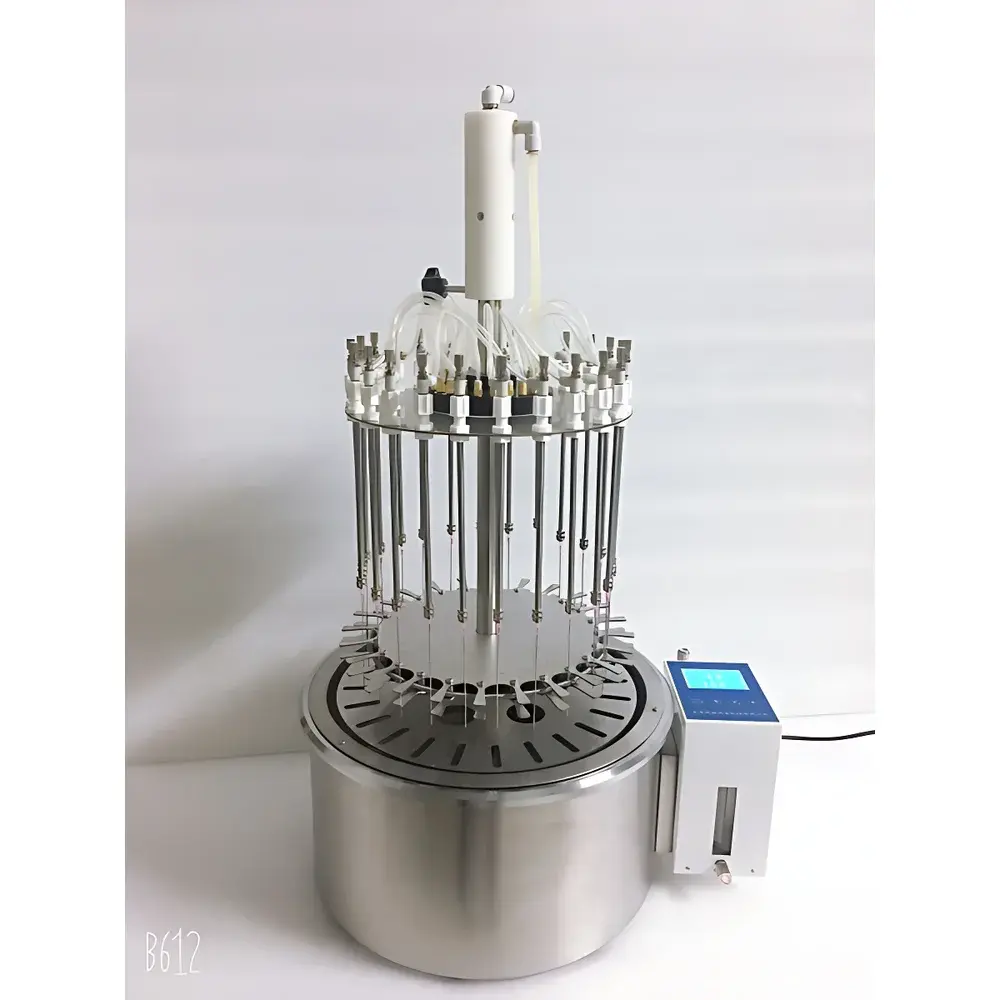
Chengmeng CM-24 Circular Water Bath Nitrogen Evaporator
| Brand | Chengmeng |
|---|---|
| Origin | Beijing, China |
| Model | CM-24 |
| Heating Method | Water Bath |
| Temperature Range | Ambient +5 °C to 99 °C |
| Temperature Uniformity @60 °C | ≤0.5 °C |
| Temperature Stability | ±0.5 °C (display resolution ±0.1 °C) |
| Sample Capacity | 24 positions |
| Tube Diameter Compatibility | Φ10–29 mm |
| Liquid Volume per Vial | 1–50 mL |
| Gas Flow Rate | 0–15 L/min (adjustable per channel) |
| Gas Pressure Limit | 0.2 MPa |
| Needle Length | 100 mm |
| Maximum Vertical Travel | 200 mm |
| Heating Power | 1000 W |
| Bath Dimensions | Ø400 × 200 mm (D × H) |
| Overall Dimensions | 420 × 420 × 850 mm (L × W × H) |
| Net Weight | 22 kg |
| Safety Features | Dry-run protection with audible/visual alarm |
| Construction Materials | Stainless steel bath, solvent-resistant silicone tubing, corrosion-resistant stainless steel gas manifolds |
Overview
The Chengmeng CM-24 Circular Water Bath Nitrogen Evaporator is an engineered solution for parallel sample concentration in analytical laboratories requiring precise thermal control and reproducible nitrogen gas delivery. It operates on the principle of gentle, inert gas-assisted solvent evaporation: nitrogen is directed through individually adjustable stainless steel needles positioned just above the liquid surface of heated samples, accelerating volatilization without thermal degradation or cross-contamination. Unlike dry-block or air-bath systems, the water bath design ensures exceptional temperature uniformity across all 24 sample positions—critical for quantitative recovery in trace-level analyses such as pesticide residue testing, pharmaceutical impurity profiling, and environmental contaminant quantification. The unit’s circular geometry enables smooth 360° rotation of the sample rack, facilitating rapid loading/unloading and ergonomic access—particularly advantageous during high-throughput workflows where operator fatigue and workflow interruption must be minimized.
Key Features
- 24-position circular sample platform with engraved numeric identification for unambiguous tracking and GLP-compliant documentation
- Independently height-adjustable stainless steel gas needles (100 mm length), each fitted with a precision needle valve for per-channel flow regulation (0–15 L/min total; ~330 mL/min typical per sample)
- Digital PID-controlled water bath with 66 × 45 mm LCD display, offering setpoint resolution of 0.1 °C and stability of ±0.5 °C at target temperatures up to 99 °C
- Temperature uniformity ≤0.5 °C across the bath surface at 60 °C—validated per ISO/IEC 17025 calibration practices for thermal equipment
- Full solvent compatibility: all wetted surfaces constructed from 316 stainless steel and certified solvent-resistant silicone tubing (non-leaching, odorless, FDA-compliant elastomer)
- Integrated dry-run detection system with dual-mode alarm (audible beep + visual indicator) to prevent heater element damage during low-water conditions
- Modular gas manifold with standardized 7 mm OD pneumatic fittings, compatible with laboratory-grade nitrogen generators or compressed gas cylinders equipped with pressure-reducing regulators
- Robust mechanical architecture: 22 kg reinforced chassis, IP20-rated enclosure, and CE-marked electrical safety compliance (250 V / 8 A fuse protection)
Sample Compatibility & Compliance
The CM-24 accommodates a broad range of container formats—including round-bottom test tubes (Φ10–29 mm), conical centrifuge tubes, and small-volume vials—with secure retention via spring-loaded stainless steel clamps mounted on a corrosion-resistant support disc. Its 1–50 mL per-vial capacity aligns with standard EPA Method 525.3, ASTM D7066, and USP requirements for residual solvent analysis. The instrument supports regulatory workflows under 21 CFR Part 11 when paired with validated electronic lab notebook (ELN) integration, as its digital interface logs timestamped temperature setpoints and runtime parameters. All materials meet ISO 10993 biocompatibility criteria for indirect contact with biological matrices, making it suitable for clinical specimen processing in accordance with CLIA and CAP guidelines.
Software & Data Management
While the CM-24 operates as a standalone benchtop instrument with embedded microcontroller-based controls, its operational parameters—including start time, duration (0–9999 minutes), final temperature, and real-time bath temperature—are fully recordable via manual log sheets or external data acquisition systems. For automated audit trails, users may integrate the unit into LIMS environments using RS-232 or optional USB-to-serial adapters (sold separately). Firmware supports firmware-upgradable protocols compliant with IEC 62443-3-3 for industrial cybersecurity baseline requirements. All calibration certificates—including temperature mapping reports per ASTM E2251—can be generated upon request for internal quality audits or external accreditation assessments (e.g., ISO/IEC 17025).
Applications
- Agricultural Residue Analysis: Concentration of organophosphate and pyrethroid extracts from fruit homogenates prior to GC-MS/MS analysis (AOAC 2007.01)
- Pharmaceutical Quality Control: Removal of acetonitrile and dichloromethane from API reaction mixtures during forced degradation studies (ICH Q5C)
- Environmental Monitoring: Pre-concentration of PAHs and PCBs from 1-L water samples processed via solid-phase extraction (EPA 8270D)
- Clinical Toxicology: Solvent removal from plasma protein precipitation supernatants prior to LC-MS/MS quantification of benzodiazepines
- Food Safety Testing: Final concentration step in dioxin and furan analysis workflows following silica gel cleanup (EU Commission Regulation (EC) No 1881/2006)
- Forensic Chemistry: Parallel evaporation of urine extracts for amphetamine metabolite screening under ISO/IEC 17025-accredited methods
FAQ
Is the CM-24 suitable for use with halogenated solvents such as chloroform or carbon tetrachloride?
Yes—the stainless steel bath, gas manifolds, and certified silicone tubing are chemically resistant to common halogenated and polar aprotic solvents. However, prolonged exposure to strong oxidizers (e.g., nitric acid vapors) is not recommended.
Can the instrument be operated inside a fume hood without performance loss?
Absolutely. The CM-24 is designed for full enclosure operation. Its low-profile footprint (420 × 420 mm) and rear-mounted gas inlet allow seamless integration into standard 1.2-m hoods while maintaining laminar nitrogen flow and thermal stability.
What maintenance is required to ensure long-term accuracy?
Monthly verification of bath water level and annual calibration of the PT100 sensor against a NIST-traceable reference thermometer are recommended. No routine lubrication or consumable replacement is needed beyond periodic inspection of silicone tubing integrity.
Does the unit support programmable ramp-and-hold temperature profiles?
No—the CM-24 provides single-setpoint temperature control. For multi-stage thermal protocols, external programmable chillers or cascade heating modules must be integrated via third-party automation interfaces.
How is traceability ensured during regulatory inspections?
Each unit ships with a factory calibration certificate referencing ISO/IEC 17025-accredited thermometry standards. Users are advised to perform in-house temperature mapping annually using at least nine calibrated probes distributed across the bath surface, documenting results per SOP-QC-012.



