
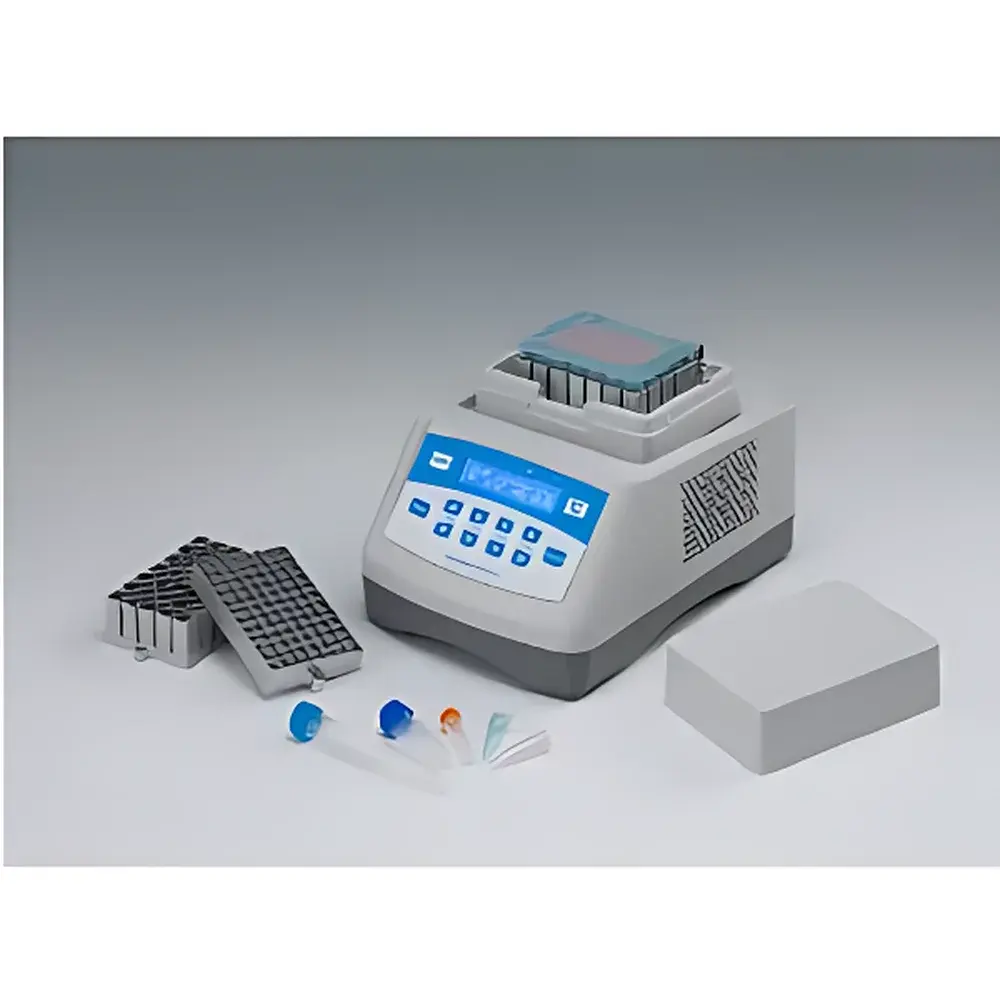
Chengmeng CM100 Temperature-Controlled Vortex Mixer with Metal Block Heating Bath
| Brand | Chengmeng |
|---|---|
| Model | CM100 |
| Temperature Range | 0–100 °C (Heating Only) |
| Control Accuracy | ±0.3 °C |
| Display Resolution | 0.1 °C |
| Temperature Uniformity | ±0.3 °C |
| Speed Range | 200–1800 rpm |
| Horizontal Orbit | 3 mm |
| Heating Time | ≤12 min (25 °C → 100 °C) |
| Power Input | 150 W |
| Voltage | AC 110–220 V, 50–60 Hz |
| Dimensions (W×D×H) | 260 × 195 × 150 mm |
| Net Weight | 7.5 kg |
| Timer Range | 1 min – 99 h 59 min or ∞ |
| Multi-Point Programming | Up to 5 setpoints |
| Cycle Repetition | Up to 99 cycles |
| Auto-Start on Power-On | Yes |
| Power-Fail Recovery | Yes |
| Fuse | 250 V, 3 A, Φ5 × 20 mm |
Overview
The Chengmeng CM100 Temperature-Controlled Vortex Mixer with Metal Block Heating Bath is an integrated benchtop instrument engineered for simultaneous temperature regulation and orbital mixing of small-volume liquid samples in tubes, vials, and microplates. It operates on a Peltier-free resistive heating principle, utilizing a solid aluminum alloy metal block with precisely machined wells to ensure rapid thermal response and high spatial uniformity across sample positions. Unlike water baths or air-based incubators, the metal block design delivers superior thermal conductivity, minimal evaporation risk, and mechanical stability during continuous agitation. The device supports precise kinetic control over biochemical reactions—including enzyme assays, DNA denaturation/annealing, cell lysis, and reagent equilibration—where consistent temperature and homogeneous mixing are critical to experimental reproducibility. Its compact footprint and low power consumption (150 W) make it suitable for shared lab environments, QC workflows, and resource-constrained research settings.
Key Features
- Simultaneous temperature control and orbital shaking: 200–1800 rpm speed range with 3 mm horizontal orbit ensures efficient suspension and homogenization without splashing or foaming.
- Wide operational temperature range: 0–100 °C (heating only); effective controllable range from ambient +5 °C up to 100 °C with ±0.3 °C accuracy and 0.1 °C display resolution.
- Rapid thermal response: ≤12 minutes to heat from 25 °C to 100 °C; optimized thermal mass and PID-controlled heating element minimize overshoot and stabilize within ±0.3 °C uniformity across all wells.
- Programmable multi-step protocols: Supports up to 5 independent temperature–speed–time setpoints per run, with up to 99 cycles for automated sequential processing (e.g., thermal ramping followed by incubation and mixing).
- Robust operational safeguards: Auto-start on power restoration, power-fail recovery with parameter retention, and hardware fuse protection (250 V, 3 A).
- Universal input compatibility: Accepts AC 110–220 V, 50–60 Hz; no voltage switching required—ideal for international deployment in academic, pharmaceutical, and contract testing laboratories.
Sample Compatibility & Compliance
The CM100 accommodates standard tube formats including 0.2 mL, 0.5 mL, 1.5 mL, and 2.0 mL microcentrifuge tubes, as well as 96-well PCR plates (with optional adapter). Its aluminum block is chemically inert and resistant to common laboratory solvents, supporting repeated sterilization via ethanol wipe-down or UV exposure. While not certified for IEC 61010-1 Class II or ISO 13485 out-of-the-box, the instrument meets fundamental electrical safety requirements for laboratory use under EN 61010-1:2010 and complies with RoHS 2011/65/EU directive for hazardous substance restriction. For GLP/GMP-regulated environments, users may implement procedural controls—including daily calibration verification using NIST-traceable thermistors—and document parameter logs manually or via external data acquisition systems.
Software & Data Management
The CM100 operates via an intuitive front-panel interface with LED display and tactile membrane keys; no proprietary software or driver installation is required. All protocol parameters—including temperature, speed, time, and cycle count—are stored in non-volatile memory and retained after power interruption. Though the unit lacks native USB/RS-232 connectivity or cloud integration, its timer and multi-point programming functions support audit-ready operation when paired with lab notebooks or LIMS-integrated manual logging. For labs requiring electronic records compliant with FDA 21 CFR Part 11, external temperature dataloggers (e.g., calibrated thermocouple arrays) can be used alongside the instrument to generate time-stamped, signed traceability reports.
Applications
- Enzymatic reaction optimization: Maintaining strict thermal conditions during kinetic assays (e.g., kinase activity, protease digestion) while ensuring substrate homogeneity.
- Molecular biology workflows: Pre-heating restriction enzyme buffers, equilibrating master mixes prior to PCR setup, and post-lysis mixing of genomic DNA extracts.
- Cell culture support: Warming media, sera, or transfection reagents to physiological temperatures immediately before use, minimizing cold shock effects.
- Quality control testing: Standardized dissolution testing of solid dosage forms, viscosity assessment of low-volume formulations, and accelerated stability studies under controlled agitation.
- Environmental and food safety labs: Homogenizing suspended particulates in water or soil extracts prior to filtration or instrumental analysis (e.g., HPLC, ICP-MS).
FAQ
Does the CM100 support cooling functionality?
No—the CM100 is a heating-only metal bath. For combined heating/cooling capability, consider the CMS10 variant (not covered in this specification).
What is the maximum recommended tube volume for stable operation at 1800 rpm?
For optimal vortex formation and thermal consistency, fill volumes should not exceed 70% of tube capacity—e.g., ≤1.05 mL in 1.5 mL tubes.
Can the CM100 be used with deep-well plates or custom adapters?
Yes—third-party or OEM-supplied adapters for 24-well, 48-well, and deep-well plates are mechanically compatible, provided thermal contact with the block remains unimpeded.
Is routine calibration required, and how often?
Calibration is recommended before first use and annually thereafter—or after any physical impact—using a certified reference thermometer inserted into a representative well.
How does the metal block design compare to water baths for evaporation-sensitive samples?
Metal blocks eliminate liquid medium contamination risks and reduce evaporation by >90% versus open water baths, especially during extended runs above 60 °C.



