
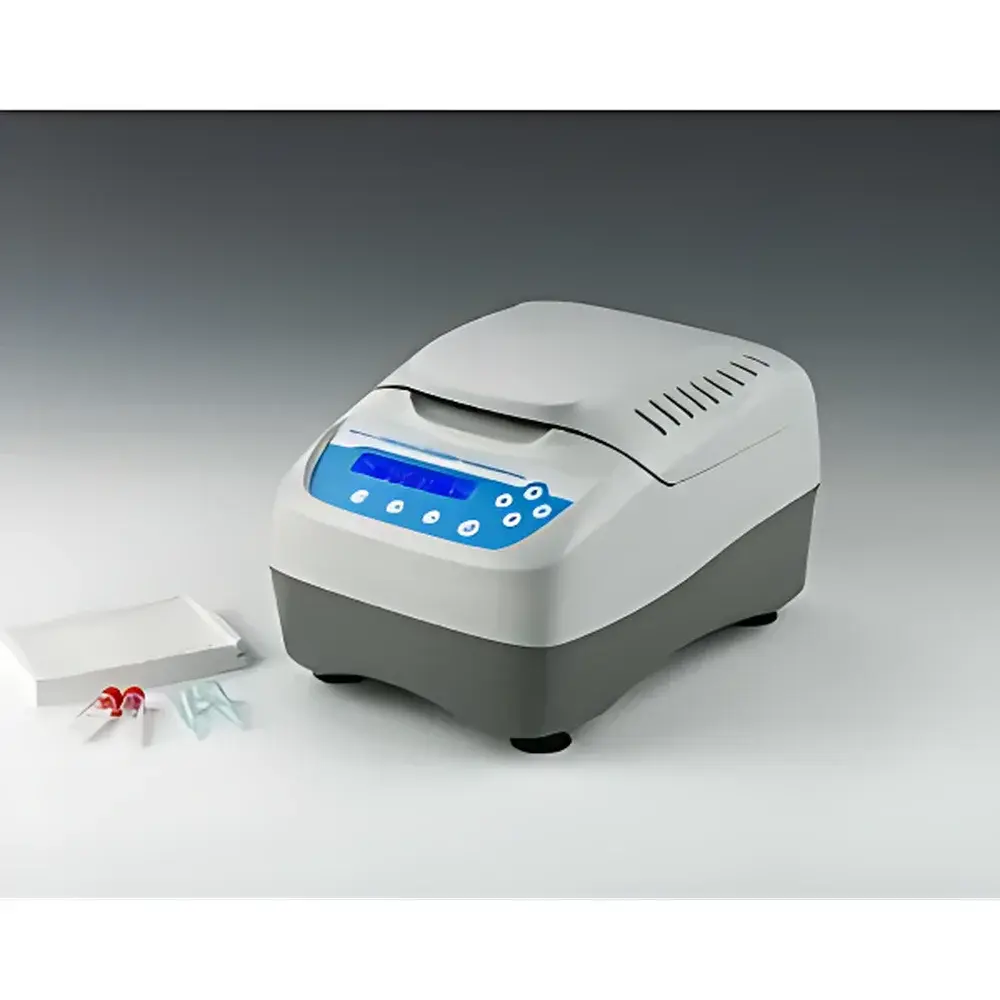
Chengmeng CM1000 Heat-Lid Constant-Temperature Vortex Mixer
| Brand | Chengmeng |
|---|---|
| Origin | Beijing, China |
| Model | CM1000 |
| Temperature Range | Ambient +5°C to 105°C |
| Temperature Accuracy | ±0.3°C |
| Display Resolution | 0.1°C |
| Temperature Uniformity | ±0.3°C |
| Heating Time | ≤10 min (25°C → 100°C) |
| Cooling Time | ≤12 min (100°C → 37°C) |
| Speed Range | 200–3000 rpm |
| Horizontal Amplitude | 2 mm |
| Heat Lid Range | OFF/AUTO/0°C–110°C |
| Heat Lid Heating Time | ≤10 min (25°C → 110°C) |
| Programmable Segments | 10 |
| Multi-Point Operation | Up to 5 points |
| Cycle Repetition | Up to 99 cycles |
| Auto-Preheat | Supported |
| End-of-Run Hold | Supported |
| Power Input | 335 W |
| Voltage | AC 220 V, 50–60 Hz |
| Fuse | 250 V, 3 A, Φ5×20 mm |
| Dimensions (W×D×H) | 296 × 212 × 164 mm |
| Net Weight | 6.9 kg |
Overview
The Chengmeng CM1000 Heat-Lid Constant-Temperature Vortex Mixer is an integrated thermal mixing platform engineered for precise temperature control and consistent orbital agitation in molecular biology, clinical diagnostics, and pharmaceutical R&D workflows. It combines Peltier-based heating with active heat-lid regulation and microprocessor-controlled vortex motion to maintain uniform thermal conditions across sample tubes while ensuring homogeneous mixing—critical for applications such as enzyme reactions, DNA denaturation/annealing, cell lysis, and reagent equilibration. Unlike conventional dry baths or standalone vortexers, the CM1000 implements dual-zone thermal management: a heated aluminum block maintains sample temperature with ≤±0.3°C accuracy and ±0.3°C uniformity across the well array, while an independently controllable heat lid (0–110°C) prevents condensation and evaporation during extended incubations—particularly essential for low-volume PCR setups and sensitive protein assays.
Key Features
- Dual independent thermal control: Sample block (ambient +5°C to 105°C) and heat lid (0°C to 110°C), both with programmable ramping and hold profiles
- Vortex mixing at 200–3000 rpm with fixed 2 mm horizontal amplitude, optimized for tube compatibility from 0.2 mL PCR strips to 15 mL conical tubes (via interchangeable modules)
- High-resolution digital interface with 0.1°C display resolution and real-time temperature feedback via embedded PT100 sensor
- 10-segment programmable protocol storage supporting multi-point temperature/time transitions and up to 99-cycle repetition
- Auto-preheat function minimizes thermal lag; end-of-run auto-hold maintains setpoint without manual intervention
- Intelligent cooling management with variable-speed fan activation, enabling rapid cooldown (≤12 min from 100°C to 37°C) without external chillers
- Robust safety architecture including over-temperature cutoff, fuse-protected power supply (250 V, 3 A), and automatic recovery after power interruption
- Flexible timing options: 1 sec–99 min 59 sec, 1 min–99 h 59 min, or continuous (∞) operation modes
Sample Compatibility & Compliance
The CM1000 accommodates standard laboratory consumables through modular aluminum blocks—including 96-well PCR plates, 0.2 mL tube strips, 1.5/2.0 mL microcentrifuge tubes, and 15 mL conical tubes—ensuring reproducible thermal transfer and mechanical stability during high-speed mixing. Its design conforms to IEC 61010-1:2010 safety standards for electrical equipment used in laboratory environments. While not certified for ISO 13485 or FDA 21 CFR Part 11 out-of-the-box, the instrument supports GLP/GMP-aligned documentation practices via timestamped parameter logging (when paired with optional USB data export) and configurable audit trails in connected software environments. All thermal performance specifications are validated per ASTM E2251-19 (Standard Practice for Calibration of Thermometers Used in Laboratory Applications).
Software & Data Management
The CM1000 operates autonomously via its front-panel interface but supports PC-based configuration and monitoring via optional RS232 or USB connectivity. Firmware enables protocol upload/download, real-time temperature/speed graphing, and event-triggered logging (start, pause, completion, fault). When integrated into regulated environments, users may implement external validation protocols to satisfy FDA 21 CFR Part 11 requirements for electronic records—specifically through third-party LIMS or ELN systems that enforce user authentication, electronic signatures, and immutable audit logs. No proprietary cloud service or vendor-hosted platform is required or embedded.
Applications
- PCR setup and pre-amplification thermal equilibration with condensation-free lid control
- Enzymatic digestions requiring simultaneous temperature maintenance and gentle agitation (e.g., restriction enzyme kinetics, ligase reactions)
- Cell suspension homogenization prior to centrifugation or flow cytometry analysis
- Antibody-antigen binding optimization under controlled thermal gradients
- Standard curve preparation in ELISA and qPCR workflows where inter-sample consistency is critical
- Routine QC testing of thermal stability for excipients, buffers, and biologics formulations
FAQ
Does the CM1000 support GLP-compliant data recording?
Yes—when used with validated external software (e.g., LabArchives, Benchling, or custom Python-based loggers), it enables traceable parameter capture, user attribution, and time-stamped event history.
Can the heat lid be disabled during non-evaporation-sensitive protocols?
Yes—the lid mode is fully configurable: OFF, AUTO (adaptive to block temperature), or manually set between 0°C and 110°C.
What is the maximum recommended sample volume per well for optimal thermal uniformity?
For best results, fill tubes to 30–70% capacity; volumes exceeding 1.5 mL in 2.0 mL tubes may reduce heating efficiency and increase gradient deviation.
Is the CM1000 compatible with 24 V DC power sources for mobile or field use?
No—it requires AC 220 V, 50–60 Hz input and is not designed for DC conversion or battery operation.
How frequently should calibration verification be performed?
Per ASTM E2251-19, users should verify temperature accuracy and uniformity at least quarterly using NIST-traceable reference thermometers placed at defined positions within the block.



