
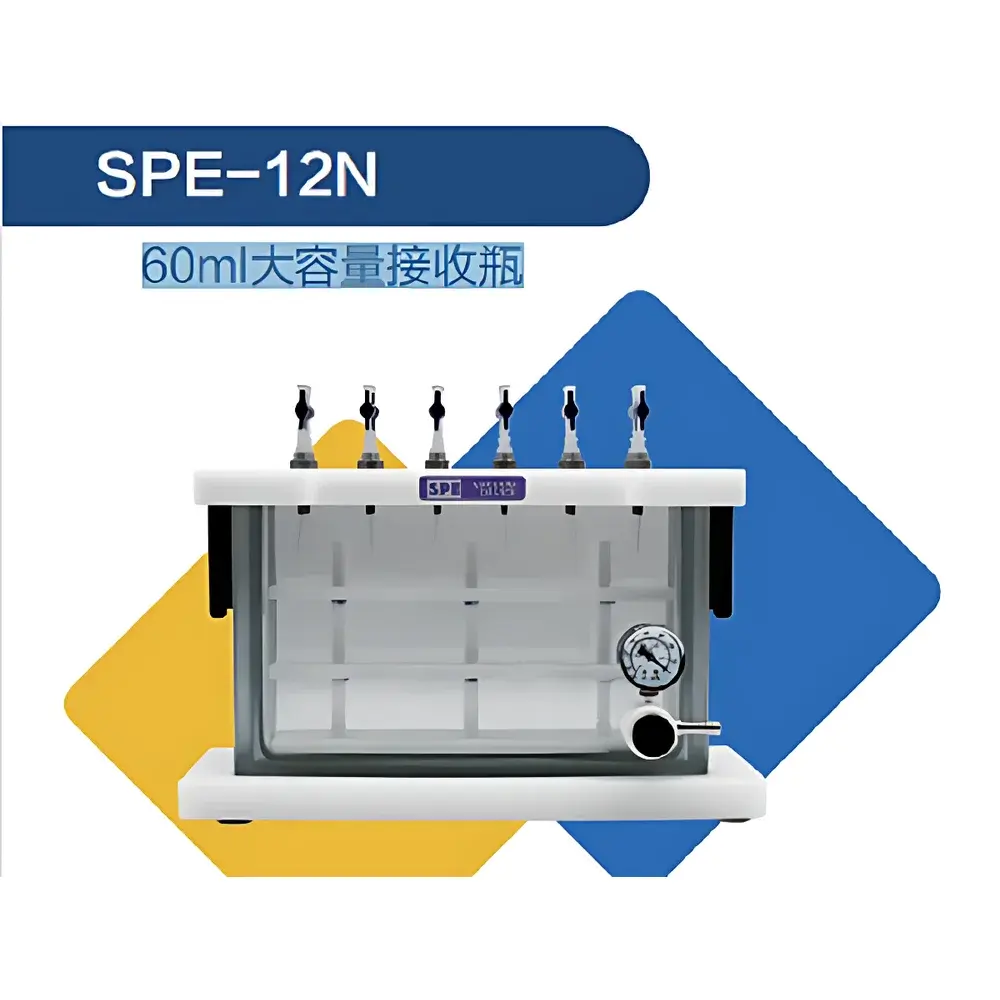
Chengmengweiye SPE-12N 12-Channel Manual Solid Phase Extraction System with 60 mL Glass Collection Vials
| Brand | Chengmengweiye |
|---|---|
| Origin | Beijing, China |
| Manufacturer Type | OEM Manufacturer |
| Product Category | Domestic |
| Model | SPE-12N |
| Price | USD 1,150 (FOB) |
| Automation Level | Manual |
| Channel Count | 12 |
| Extraction Format | Cartridge-Based Column Extraction |
| Flow Rate Control | Adjustable via vacuum manifold (max. 30 mL/min per channel) |
| Solvent Reservoir Capacity | 12 independent solvent ports |
| Sample Throughput | 12 samples simultaneously |
| Sample Loading Volume | Up to 60 mL per channel |
| Wetted Materials | Borosilicate glass (vials), PTFE-coated stainless steel (manifold), silicone-free elastomers (seals) |
| Pressure Range | 0–80 kPa (operational range) |
| Max. Safe Working Pressure | 65 kPa |
| Outlet Tubing ID | 8 mm |
| Vial Dimensions | Ø27.5 × 108 mm (60 mL nominal capacity) |
| Optional Accessories | Cartridge Adapter Kit (P/N: 321650-01) |
| High-Volume Sampling Manifold Extension (P/N | 324212-01) |
Overview
The Chengmengweiye SPE-12N is a manually operated, 12-channel solid phase extraction (SPE) manifold system engineered for reproducible, high-throughput sample preparation in analytical laboratories. It implements vacuum-driven column-based extraction using standardized SPE cartridges and employs borosilicate glass 60 mL collection vials as the primary receiving vessels—ensuring chemical inertness, thermal stability, and compatibility with volatile organic solvents commonly used in environmental, pharmaceutical, and food safety testing workflows. The system operates on the fundamental principle of selective analyte retention and elution via sorbent-packed cartridges under controlled vacuum pressure, enabling efficient removal of matrix interferences prior to instrumental analysis (e.g., HPLC, GC-MS, ICP-MS). Its robust architecture supports both routine QC/QA applications and method development protocols requiring precise flow regulation and consistent inter-channel performance.
Key Features
- 12-position parallel processing manifold with independent vacuum control per channel for optimized method flexibility
- Borosilicate glass 60 mL collection vials (Ø27.5 × 108 mm) certified for low extractables and resistance to acids, bases, and halogenated solvents
- Vacuum pressure range: 0–80 kPa, with mechanical safety stop at 65 kPa to prevent cartridge channeling or vial implosion
- Twelve dedicated solvent inlet ports accommodate sequential or simultaneous use of up to 12 different eluents or wash solutions
- PTFE-coated stainless steel manifold body ensures long-term corrosion resistance and minimal metal ion leaching
- Universal cartridge adapter compatibility (P/N: 321650-01) supports 1 mL, 3 mL, 6 mL, and 12 mL SPE cartridges from major vendors (e.g., Waters, Agilent, Thermo)
- High-volume sampling extension kit (P/N: 324212-01) enables direct large-volume loading (up to 1 L) with integrated flow distribution and drip-free transfer
- 8 mm internal diameter gas outlet tubing port designed for standard laboratory vacuum hose connections and inline pressure regulators
Sample Compatibility & Compliance
The SPE-12N is validated for use with aqueous, buffered, and organic-aqueous sample matrices across regulated and non-regulated environments. Its all-glass wetted path meets USP and ISO 3585 specifications for borosilicate glass composition. The system supports methods compliant with EPA Methods 508.1, 525.3, and 8270D; ASTM D7237-19 (for waterborne contaminants); and pharmacopeial guidelines including USP and EP 2.2.46. When operated within its specified pressure envelope (≤65 kPa), it delivers inter-channel flow variation ≤±5% (measured with 50% methanol/water at 25 °C), satisfying GLP documentation requirements for manual SPE systems. No electronic data capture is embedded; therefore, full 21 CFR Part 11 compliance requires integration with external LIMS or ELN platforms for audit-trail generation.
Software & Data Management
As a fully manual platform, the SPE-12N does not incorporate onboard electronics, firmware, or proprietary software. All operational parameters—including vacuum setpoint, solvent sequence, dwell times, and fraction collection—are documented externally using laboratory notebooks, SOPs, or digital workflow tools. Users may integrate the system into validated electronic lab notebook (ELN) environments (e.g., LabArchives, Benchling) for step-by-step protocol execution and metadata logging. Optional barcode-labeled vial racks and accessory kits support traceability in ISO/IEC 17025-accredited facilities.
Applications
- Pre-concentration and cleanup of trace-level pesticides in drinking water (EPA 525.3)
- Isolation of pharmaceutical residues (e.g., beta-blockers, NSAIDs) from wastewater effluents
- Purification of mycotoxins (aflatoxin B1, ochratoxin A) from cereal extracts prior to LC-FLD quantitation
- Removal of humic substances and dissolved organic carbon (DOC) from environmental soil leachates
- Sample preparation for elemental speciation analysis (e.g., Cr(VI), As(III)/As(V)) in regulatory compliance testing
- Method development for novel sorbent chemistries (e.g., molecularly imprinted polymers, mixed-mode resins)
FAQ
Is the SPE-12N compatible with 1-mL micro-SPE cartridges?
Yes—using the optional Cartridge Adapter Kit (P/N: 321650-01), the manifold accommodates 1 mL, 3 mL, 6 mL, and 12 mL cartridge formats without modification.
Can the 60 mL glass vials be autoclaved?
Yes—borosilicate glass vials are autoclavable at 121 °C for 20 minutes; however, PTFE-coated manifold components must not be subjected to steam sterilization.
What vacuum source is recommended?
A diaphragm vacuum pump with adjustable pressure control (0–100 kPa range) and oil-free operation is strongly advised to maintain solvent compatibility and avoid contamination.
Does the system include tubing or connectors?
No—standard 8 mm ID vacuum tubing, barbed fittings, and solvent-resistant stopcocks are sold separately to allow user-specific configuration.
How is method validation supported?
The system’s mechanical consistency, defined pressure limits, and interchangeable accessories enable straightforward IQ/OQ documentation per ISO/IEC 17025 Clause 6.4.1 and FDA guidance on laboratory equipment qualification.
Related Products



