
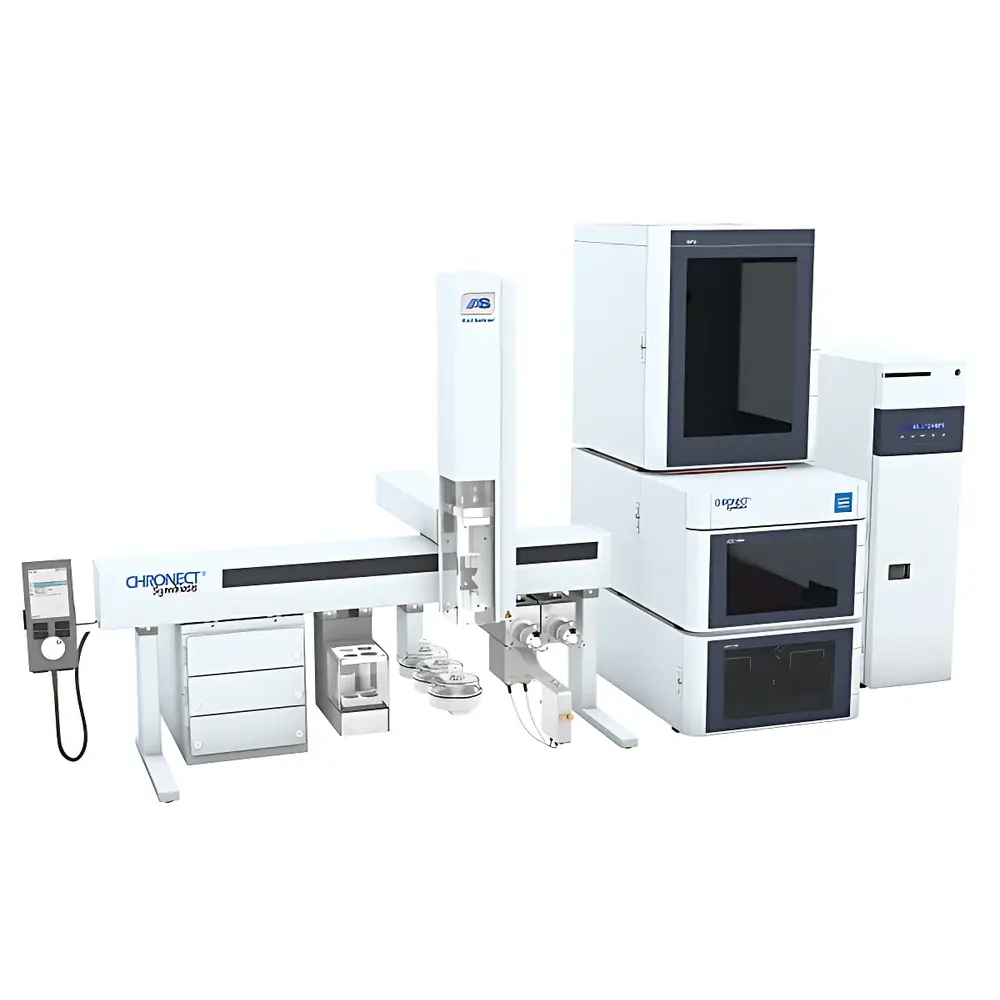
CHRONECT Symbiosis Online SPE–UHPLC System
| Brand | Axel Semrau |
|---|---|
| Origin | Germany |
| Model | CHRONECT Symbiosis |
| Automation Level | Fully Automated |
| Channel Configuration | Multi-channel |
| Extraction Format | Cartridge-based SPE |
| Flow Rate Range | 0.1–10 mL/min |
| Solvent Selection | 13 programmable elution solvents |
| Sample Capacity | Up to 24 shallow-well plates (96-well) or 12 deep-well plates (96-well), or hybrid configuration (>1000 samples per run) |
| Sample Injection Volume | 1–1000 µL |
| Wetted Materials | 316 stainless steel, PEEK, ruby, sapphire, PTFE, UHMWPE, Teflon AF |
Overview
The CHRONECT Symbiosis Online SPE–UHPLC System is a fully integrated, high-pressure platform engineered for automated, robust, and reproducible online solid-phase extraction coupled with ultra-high-performance liquid chromatography (Online SPE–UHPLC). Developed by Axel Semrau (Germany) in collaboration with Spark Holland’s proven Symbiosis architecture, the system implements a dual-pump, multi-valve fluidic architecture designed to eliminate manual sample preparation bottlenecks in LC/MS workflows. Its core operational principle relies on sequential column switching—where sample loading, washing, analyte elution, and analytical separation occur in parallel across dedicated SPE and analytical columns—enabling true unattended operation while maintaining chromatographic integrity under pressures up to 1300 bar. This architecture supports both time-resolved fractionation and direct coupling to mass spectrometry without post-extraction dilution or transfer steps, significantly reducing carryover and improving detection sensitivity for trace-level analytes in complex matrices such as plasma, urine, environmental water, and food extracts.
Key Features
- Fully automated multi-channel SPE–UHPLC platform with synchronized valve sequencing and pressure-compensated flow control
- Binary UHPLC gradient pump (SPH 1299) delivering stable flow from 0.001 to 5.0 mL/min at pressures up to 1300 bar
- CTC PAL3 robotic autosampler with temperature-controlled sample storage (4–40 °C) and precise low-volume injection (1–1000 µL)
- High-pressure delivery module (HPD) enabling seamless solvent transfer between SPE and analytical loops without pressure loss
- Automated cartridge exchange unit (ACE) supporting standardized 1–6 mL SPE cartridges with programmable conditioning, loading, washing, and elution steps
- Integrated 6-position column switcher (Mistral option) with thermostatically controlled column oven (5–85 °C) for method flexibility and retention time stability
- Chemically inert fluidic path constructed from 316 stainless steel, PEEK, ruby/sapphire check valves, and fluoropolymer seals (PTFE, Teflon AF, UHMWPE) ensuring compatibility with aggressive solvents and long-term system durability
Sample Compatibility & Compliance
The CHRONECT Symbiosis accommodates diverse sample formats—including 96-well shallow- and deep-well microplates—and handles viscous, particulate-laden, or protein-rich biological fluids following minimal pre-filtration. Its modular design allows method-specific optimization of SPE sorbent chemistry (e.g., C18, mixed-mode, ion-exchange) and elution strength without hardware modification. The system complies with GLP/GMP documentation requirements through Chronos software’s audit-trail functionality, electronic signatures, and secure user access levels aligned with FDA 21 CFR Part 11. All method parameters—including flow rates, valve positions, temperature setpoints, and solvent gradients—are stored as version-controlled, timestamped records. Routine performance verification adheres to ISO/IEC 17025 and ASTM D8083 (for online SPE validation), supporting regulatory submissions in clinical, pharmaceutical, and environmental testing laboratories.
Software & Data Management
Chronos software provides unified control of all hardware modules via a deterministic real-time scheduler. It enables method development through Advanced Method Development (AMD) mode: users define parameter ranges (e.g., SPE loading flow, wash volume, elution solvent strength), and the system autonomously executes combinatorial screening protocols while logging retention, peak shape, and recovery data for statistical evaluation. Raw data export follows AIA/ANDI standards; integration with third-party CDS platforms (e.g., Thermo Chromeleon, Waters Empower, Agilent OpenLab) is supported via OPC UA and ASCII-based API interfaces. All sequence logs, instrument status reports, and calibration certificates are archived in encrypted SQLite databases with configurable backup intervals and network drive synchronization.
Applications
- High-throughput bioanalysis: quantification of small-molecule drugs and metabolites in human plasma using LC–MS/MS with <2% CV inter-run precision
- Environmental monitoring: automated enrichment and analysis of polar pesticides (e.g., neonicotinoids) and PFAS compounds from surface water at sub-ng/L levels
- Food safety screening: multi-residue determination of mycotoxins, veterinary drug residues, and adulterants in milk, honey, and infant formula
- Pharmaceutical QC: dissolution testing with online SPE cleanup prior to UHPLC–UV analysis, eliminating filtration artifacts
- Metabolomics workflows: fractionated SPE enrichment of acidic, basic, and neutral metabolite classes prior to orthogonal LC–MS analysis
FAQ
Can the CHRONECT Symbiosis interface directly with my existing mass spectrometer?
Yes—the system outputs standard LC-compatible flow streams (up to 1 mL/min) and supports electrospray (ESI), atmospheric pressure chemical ionization (APCI), and atmospheric pressure photoionization (APPI) sources without flow splitting or post-column modifications.
Is method transfer possible between different SPE cartridge chemistries?
Absolutely. Chronos software stores cartridge-specific method templates, including bed mass, pore size, and recommended conditioning solvents, allowing rapid reconfiguration across C18, HLB, SCX, and mixed-mode phases.
How does the system handle carryover in high-sensitivity applications?
The ACE module incorporates dual-wash zones with independent solvent selection and vacuum-assisted drying; combined with sapphire/ruby check valves and PTFE-lined tubing, typical carryover remains below 0.05% for compounds like caffeine and estradiol.
What maintenance intervals are recommended for routine operation?
Pump seal replacement every 6 months (or 1000 h), SPE cartridge holder inspection quarterly, and full system leak test and pressure calibration semiannually—documented within Chronos’ preventive maintenance scheduler.
Does the system support 21 CFR Part 11 compliance out-of-the-box?
Yes—Chronos includes role-based access control, electronic signature capture, immutable audit trails, and automatic backup of all raw data and method files to meet baseline Part 11 requirements without add-on licensing.



