
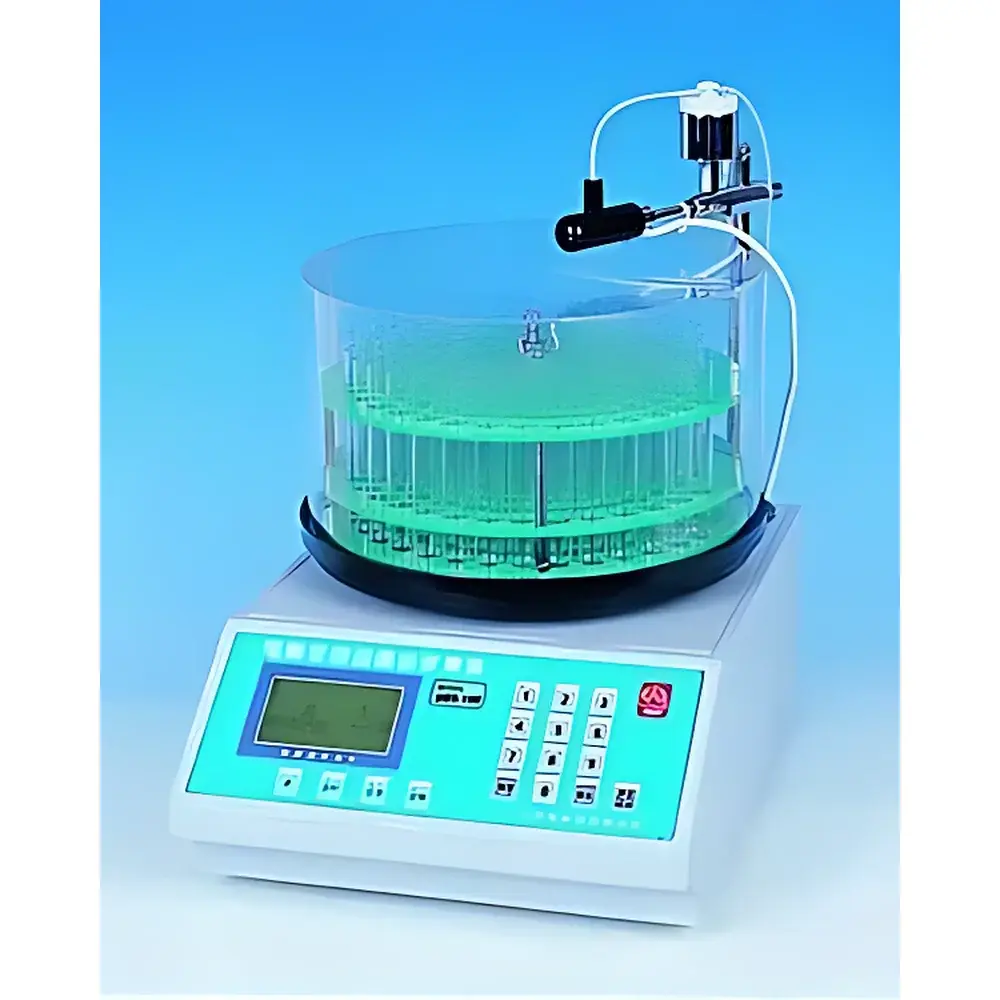
Chu Ding DBS-160 Computer-Controlled Fraction Collector (Time-Programmable & Drop-Counting Mode)
| Brand | Chu Ding |
|---|---|
| Origin | Shanghai, China |
| Model | DBS-160 |
| Tube Capacity | 160 × 5 mL |
| Timing Range | 1 s – 199 h 59 min 59 s |
| Drop Counting Range | 1–9999 drops |
| Peak Trigger Range | 0–100 mV |
| Data Retention (Power Loss) | ≥10 years |
| Control System | Embedded microcontroller with LCD menu interface |
| Dimensions (L×W×H) | 265 × 350 × 360 mm |
Overview
The Chu Ding DBS-160 Computer-Controlled Fraction Collector is an engineered solution for automated, high-precision fractionation of eluent streams in liquid-phase chromatographic separations. Designed specifically for column-based analytical workflows—including gel filtration, ion exchange, affinity, and reversed-phase chromatography—the DBS-160 operates on programmable time-based or drop-counting collection logic, enabling reproducible partitioning of effluent into discrete fractions without manual intervention. Its core architecture integrates a microprocessor-controlled stepper motor-driven rotor, precision tube positioning mechanism, and analog input circuitry for real-time UV/absorbance signal monitoring (0–100 mV range), allowing synchronized peak-triggered collection when paired with compatible detectors. The device complies with fundamental laboratory automation principles defined in ISO/IEC 17025:2017 for measurement traceability and operational consistency in accredited testing environments.
Key Features
- High-capacity tube rack accommodating 160 standard 5 mL collection tubes—optimized for high-throughput fractionation in preparative and analytical-scale chromatography.
- Dual-mode collection logic: user-selectable time-programmed mode (1 second to 199 hours, 59 minutes, 59 seconds) and drop-counting mode (1–9999 drops per fraction), supporting both kinetic and volumetric fractionation strategies.
- Analog peak-triggered collection via 0–100 mV input channel, compatible with most commercial UV-Vis detectors and chart recorders for retention-time-aligned fraction isolation.
- Non-volatile memory with ≥10-year data retention after power loss—ensuring method integrity and audit readiness under GLP-compliant workflows.
- Intuitive LCD interface with hierarchical menu navigation, real-time status feedback, and selectable forward/reverse timing sequences for flexible experimental design.
- Robust mechanical construction with corrosion-resistant housing components; designed for continuous operation in ambient laboratory conditions (15–30 °C, <80% RH).
Sample Compatibility & Compliance
The DBS-160 is compatible with common chromatographic solvents including aqueous buffers, methanol, acetonitrile, and isopropanol—though prolonged exposure to aggressive organics (e.g., chloroform, DMSO) requires verification of tube material compatibility (standard polypropylene tubes supplied). It interfaces seamlessly with Chu Ding HL-series peristaltic pumps and TH-series gradient mixers via TTL-level synchronization signals, and supports standalone operation using internal timing logic. The instrument meets electromagnetic compatibility requirements per IEC 61326-1:2020 for laboratory electrical equipment and adheres to safety standards IEC 61010-1:2010 for electrical equipment for measurement, control, and laboratory use. While not certified for FDA 21 CFR Part 11 compliance out-of-the-box, its deterministic behavior, non-erasable event logging, and parameter lockout functionality support validation pathways for regulated QC/QA applications.
Software & Data Management
The DBS-160 operates autonomously via embedded firmware—no external PC or proprietary software is required for basic operation. All collection parameters (timing intervals, drop thresholds, peak voltage thresholds, sequence direction) are stored in onboard EEPROM and recalled at power-up. For integration into LIMS or ELN ecosystems, the device provides RS-232 serial output (TTL-compatible) carrying timestamped collection event logs (fraction number, start time, trigger type, elapsed time), enabling traceable data export to third-party acquisition platforms. Audit trails—including method changes, power cycle timestamps, and collection completion flags—are retained locally and accessible via service menu for internal quality reviews.
Applications
- Protein purification workflows involving FPLC or ÄKTA-compatible systems where consistent fraction size ensures downstream SDS-PAGE or mass spectrometry sample integrity.
- Metabolite profiling in plant extract analysis, where timed fractionation preserves labile compound stability across solvent gradients.
- Quality control of monoclonal antibody elution profiles during process development, supporting lot-to-lot comparability studies.
- Teaching laboratories performing column chromatography experiments—reducing human error and enabling standardized student protocols.
- Environmental analysis of pesticide residues in water extracts, where drop-counting mode correlates directly with mobile phase volume for precise recovery calculations.
FAQ
Can the DBS-160 be integrated with third-party HPLC or FPLC systems?
Yes—via its analog input (0–100 mV) and TTL synchronization ports, it accepts detector output signals and pump trigger pulses from most commercial chromatography platforms.
What tube formats are supported?
Standard 5 mL round-bottom polypropylene tubes (12 × 75 mm); custom racks may be fabricated for alternative dimensions upon request.
Is calibration required before use?
No routine calibration is needed; however, users should verify drop-sensor sensitivity using a calibrated flow rate and known droplet volume during initial setup.
Does the unit support remote monitoring or network connectivity?
No Ethernet or Wi-Fi capability is built-in; remote access requires external serial-to-Ethernet converters and middleware configuration.
How is method validation performed for regulated environments?
Validation follows IQ/OQ protocols focusing on timing accuracy (±0.1% over 24 h), drop-count repeatability (CV <1.5%), and memory retention under simulated power failure scenarios.



