
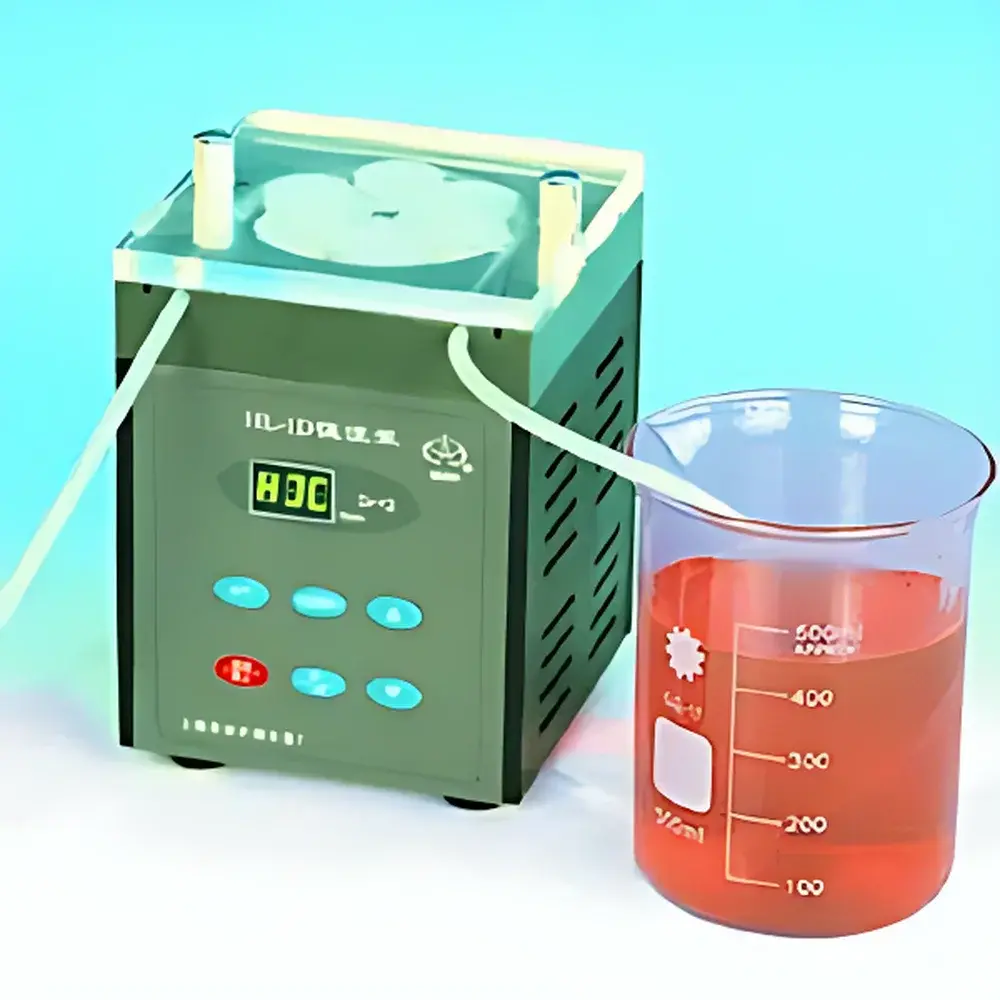
Chu Ding HL-1S Single-Channel Peristaltic Pump with PTFE Pump Head
| Origin | Shanghai, China |
|---|---|
| Manufacturer Type | Authorized Distributor |
| Product Origin | Domestic (China) |
| Model | HL-1S |
| Flow Rate Range | 1–600 mL/h |
| Maximum Rotational Speed | 180 rpm |
| Output Pressure | ≥3 kg/cm² |
| Pump Head Material | PTFE (Chemically Resistant) |
| Dimensions (W×D×H) | 120×120×180 mm |
| Drive Type | Analog Continuous Variable Speed Control |
| Channel Count | Single-Channel |
Overview
The Chu Ding HL-1S is a single-channel peristaltic pump engineered for precise, pulse-free fluid delivery in laboratory and light industrial applications. Operating on the fundamental principle of peristalsis—where rollers compress a flexible tubing against a rigid housing to generate positive displacement—the HL-1S delivers consistent volumetric flow without direct contact between the pump mechanism and the fluid. This design eliminates contamination risk and ensures compatibility with aggressive solvents, acids, bases, and biological media. Its PTFE (polytetrafluoroethylene) pump head provides exceptional chemical resistance, making it suitable for organic solvent handling—including acetone, chloroform, THF, and ethanol—where standard elastomer or acetal pump heads would degrade. Designed for stability under continuous operation, the HL-1S features a robust analog speed control system enabling infinitely variable adjustment from 1 to 180 rpm, directly correlating to its calibrated flow range of 1–600 mL/h. The pump maintains ≥3 kg/cm² (≈294 kPa) backpressure capability, supporting use in gravity-defying or moderately restricted flow paths such as inline filters, packed columns, or small-diameter capillaries.
Key Features
- Single-channel architecture optimized for simplicity, serviceability, and footprint efficiency (120 × 120 × 180 mm)
- PTFE pump head with chemically inert rotor and housing—validated for extended exposure to halogenated hydrocarbons, esters, ketones, and aromatic solvents
- Analog continuous-variable speed control offering smooth, stepless adjustment across full 1–180 rpm range
- Calibrated flow output of 1–600 mL/h using standard silicone or fluorosilicone tubing (ID 1.6 mm recommended)
- Mechanically stable gear-driven transmission ensuring long-term speed reproducibility and minimal drift
- No internal valves, seals, or wetted metal components—reducing maintenance frequency and eliminating cross-contamination pathways
- Compliance-ready mechanical design: no microprocessor or digital interface, simplifying qualification under GLP environments where firmware validation is not required
Sample Compatibility & Compliance
The HL-1S supports a broad spectrum of liquid samples, including aqueous buffers, cell culture media, HPLC mobile phases, environmental wastewater extracts, and pharmaceutical formulations containing organic co-solvents. Its PTFE construction meets ASTM D471 requirements for elastomer resistance to fluids and aligns with ISO 8536-4 (infusion equipment) for material biocompatibility when paired with USP Class VI-certified tubing. While the pump itself does not carry CE, UL, or FDA device registration (as it functions solely as a fluid transfer component), its passive mechanical architecture facilitates integration into ISO/IEC 17025-accredited laboratories and 21 CFR Part 11-compliant workflows when used with validated tubing sets and documented operational protocols. No electrical safety certification is embedded; users must ensure proper grounding and enclosure compliance per local IEC 61010-1 regulations.
Software & Data Management
The HL-1S operates as a standalone analog instrument with no embedded firmware, digital display, or data logging capability. This architecture intentionally omits software dependencies, eliminating cybersecurity concerns, firmware update cycles, or electronic audit trail requirements. Flow calibration is performed manually using gravimetric or volumetric methods per ISO 8655-3, and operational parameters are recorded externally via lab notebooks or LIMS-integrated manual entry. For labs requiring traceable speed documentation, optional external tachometer verification (e.g., handheld optical tachometer, ±0.5% accuracy) can be implemented during IQ/OQ validation. No driver installation, USB connectivity, or API support is provided—ensuring deterministic behavior across decades of use without obsolescence risk.
Applications
- Continuous eluent delivery in preparative chromatography systems (e.g., flash purification, size-exclusion setups)
- Controlled reagent infusion in environmental water analysis (e.g., automated COD digestion, ion chromatography sample introduction)
- Media perfusion in academic cell culture experiments and bioreactor feed loops
- Standardized sample loading in clinical chemistry analyzers and automated immunoassay platforms
- Solvent-resistant dosing in synthetic organic chemistry workflows involving anhydrous conditions or corrosive catalysts
- Calibration reference pump in metrology labs performing volumetric flow rate intercomparisons per ISO/IEC 17025 Clause 6.4
FAQ
Is the HL-1S compatible with chlorinated solvents such as dichloromethane or carbon tetrachloride?
Yes—the PTFE pump head exhibits negligible swelling or degradation when exposed to chlorinated hydrocarbons, provided tubing is also chemically rated (e.g., fluorosilicone or PTFE-lined).
What tubing sizes are recommended for optimal flow accuracy and tube life?
For the specified 1–600 mL/h range, Norprene® LFT-015 (1.6 mm ID) or Cole-Parmer PTFE-lined tubing (1.6 mm ID) is validated. Tube wall thickness must be ≥0.8 mm to withstand 180 rpm compression fatigue.
Does the pump include tubing or require user-supplied tubing?
Tubing is not included; users must select and install application-specific tubing based on chemical compatibility, pressure rating, and flow precision requirements.
Can the HL-1S be integrated into a PLC-controlled system?
No native analog voltage input/output is provided. Speed control is manual only via front-panel knob; external automation requires third-party motor controller retrofitting—not supported by the manufacturer.
What is the expected service life of the PTFE pump head under continuous operation?
With proper tubing selection and routine visual inspection, the PTFE head demonstrates >10,000 hours of functional integrity under typical lab-use duty cycles (≤8 h/day, ambient temperature).



