
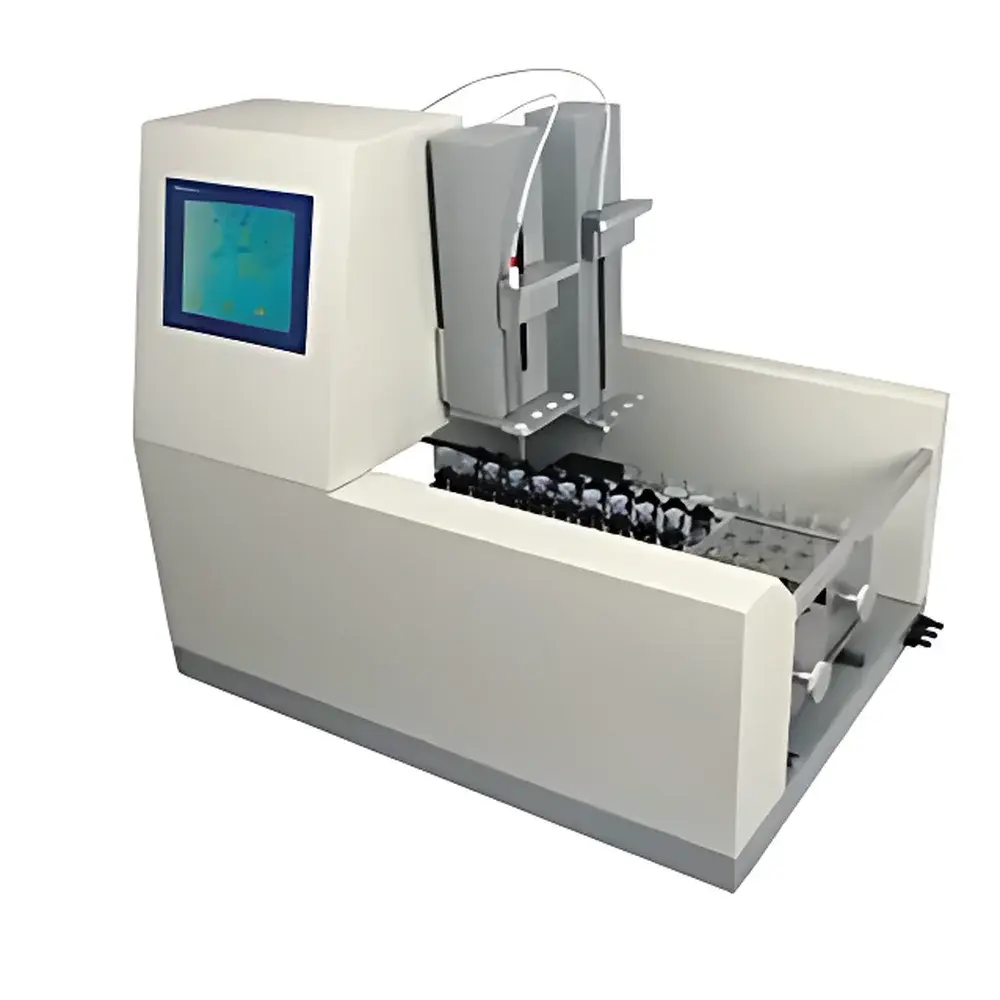
Chu Ding HSE-40A Fully Automated Solid Phase Extraction System
| Brand | Chu Ding Technology |
|---|---|
| Origin | Shanghai, China |
| Model | HSE-40A |
| Automation Level | Fully Automatic |
| Number of Channels | 10-position solvent selection valve with independent fluidic paths |
| Extraction Mode | Column-based SPE |
| Flow Rate Control | 0.1–100 mL/min |
| Solvent Capacity | 7 distinct solvents (programmable ratio mixing) |
| Sample Throughput | Up to 40 samples per batch |
| Sample Loading Volume | 1–25 mL per run |
| Wetted Materials | 316 stainless steel and PTFE |
| Column Compatibility | 1 mL, 3 mL, and 6 mL SPE cartridges |
| Pressure Monitoring | Integrated pressure sensor with 0.2 MPa occlusion threshold and audible/visual alarm |
| Waste Collection | Triple-waste routing (A/B/C streams) |
| Power Supply | 220 V / 50 Hz, 100 W |
| Net Weight | 25 kg |
| Compliance | Designed for GLP/GMP-aligned workflows |
Overview
The Chu Ding HSE-40A Fully Automated Solid Phase Extraction System is an engineered solution for high-throughput, reproducible sample preparation in analytical laboratories performing residue analysis, environmental monitoring, and clinical toxicology. Based on positive-pressure column elution via precision syringe pump actuation, the system executes all core SPE steps—cartridge conditioning, sample loading, washing, and analyte elution—without manual intervention. Unlike vacuum-driven or gravity-fed systems, the HSE-40A applies controlled, programmable pressure directly to the cartridge bed using a vertically actuated plunger mechanism, ensuring consistent flow dynamics across variable sorbent densities and particle sizes. This eliminates dead-volume carryover, minimizes channeling, and delivers superior inter-run reproducibility—critical for multi-residue pesticide screening (e.g., GB/T 19648-2005), veterinary drug quantification (SC/T 3021-2004), and organophosphate residue workflows (NY/T 761-2004). Its architecture supports both reversed-phase and mixed-mode SPE chemistries, enabling robust cleanup of complex matrices including fruit homogenates, fish tissue extracts, wastewater filtrates, and herbal decoctions.
Key Features
- Precision plunger-driven column contact: Eliminates air gaps between piston and sorbent bed, preventing solvent cross-contamination during multi-solvent switching.
- 10-port high-integrity solvent selection valve: Enables seamless transition among seven pre-loaded solvents; supports on-the-fly volumetric ratio mixing (0–10 blending cycles per step).
- Integrated pressure sensing and overload protection: Real-time monitoring up to 0.2 MPa with automatic pump halt and alert upon column blockage.
- Triple-path waste management: Independent routing for aqueous, organic, and biological waste streams to prevent cross-contamination and simplify disposal compliance.
- Modular cartridge handling: Accommodates 1 mL, 3 mL, and 6 mL SPE formats via interchangeable adapters; compatible with commercially available bonded silica, polymer, and ion-exchange media.
- Automated 3-axis liquid handler: Uses imported PTFE-coated stainless-steel syringes and helical lead-screw positioning for ±0.1 mm repeatability in tube-to-cartridge alignment.
- Touchscreen interface with method editor: Supports up to 40 independently configurable methods; each step (conditioning, load, wash, elute) is individually schedulable, pausable, and auditable.
- Full method traceability: Timestamped parameter logs, solvent usage tracking, and electronic signature support align with FDA 21 CFR Part 11 readiness when deployed in validated environments.
Sample Compatibility & Compliance
The HSE-40A processes heterogeneous biological and environmental samples—including ground plant tissues, centrifuged plasma, filtered surface water, and enzymatically digested seafood extracts—without requiring pre-filtration beyond standard 0.45 µm membrane treatment. All fluid-contact surfaces are constructed from electropolished 316 stainless steel and virgin PTFE, ensuring chemical resistance to acetonitrile, methanol, dichloromethane, and acidic/basic eluents. The system meets material compatibility requirements outlined in ISO 17025:2017 for accredited testing laboratories and supports audit-ready documentation for GLP studies. It is routinely deployed in food safety labs complying with GB/T 27404–2008 (Laboratory Quality Control Guidelines) and environmental labs adhering to EPA Method 508.1 and 525.3 for organochlorine and triazine residue analysis.
Software & Data Management
The embedded control software provides a hierarchical method development environment: users define global parameters (flow rate, volume, dwell time), then assign specific solvent sequences and collection logic per cartridge position. Each method stores complete execution metadata—including actual delivered volumes (±0.5% syringe accuracy), elapsed times, pressure profiles, and solvent consumption—exportable as CSV or PDF reports. Audit trails record operator logins, method modifications, and system events with immutable timestamps. When integrated with LIMS platforms via RS232 or Ethernet, the HSE-40A transmits status updates and completion flags, enabling automated downstream workflow triggering (e.g., autosampler injection initiation post-elution). Software validation packages—including IQ/OQ documentation templates—are available upon request for regulated environments.
Applications
- Pesticide multiresidue analysis in fruits, vegetables, tea, and traditional Chinese medicinal herbs per GB/T 19648–2005.
- Malachite green and leucomalachite green quantification in aquaculture products per SC/T 3021–2004.
- Organophosphate and carbamate residue profiling in leafy greens using NY/T 761–2004-compliant SPE protocols.
- Pharmaceutical metabolite enrichment from human plasma or urine in pharmacokinetic studies.
- Illicit drug extraction from forensic blood or hair specimens prior to GC-MS/MS analysis.
- Endocrine-disrupting compound isolation from municipal wastewater influent/effluent for LC-HRMS screening.
FAQ
What column formats does the HSE-40A support?
It accepts standard 1 mL, 3 mL, and 6 mL SPE cartridges using dedicated mechanical adapters; no custom hardware required.
Can the system perform gradient elution with mixed solvents?
Yes—up to seven solvents can be proportionally blended inline with user-defined ratios and mixing cycles (0–10) during any step.
Is the software compliant with FDA 21 CFR Part 11?
The base firmware supports electronic signatures, audit trails, and role-based access control; full Part 11 compliance requires site-specific validation and optional PKI certificate integration.
How is column clogging detected and managed?
An integrated pressure transducer monitors backpressure in real time; if exceeding 0.2 MPa, the pump stops immediately and triggers visual/audible alerts.
What maintenance is required for long-term reliability?
Routine tasks include syringe lubrication every 6 months, PTFE seal inspection quarterly, and valve rotor cleaning after every 200 runs—detailed in the English-language service manual.
Related Products



