
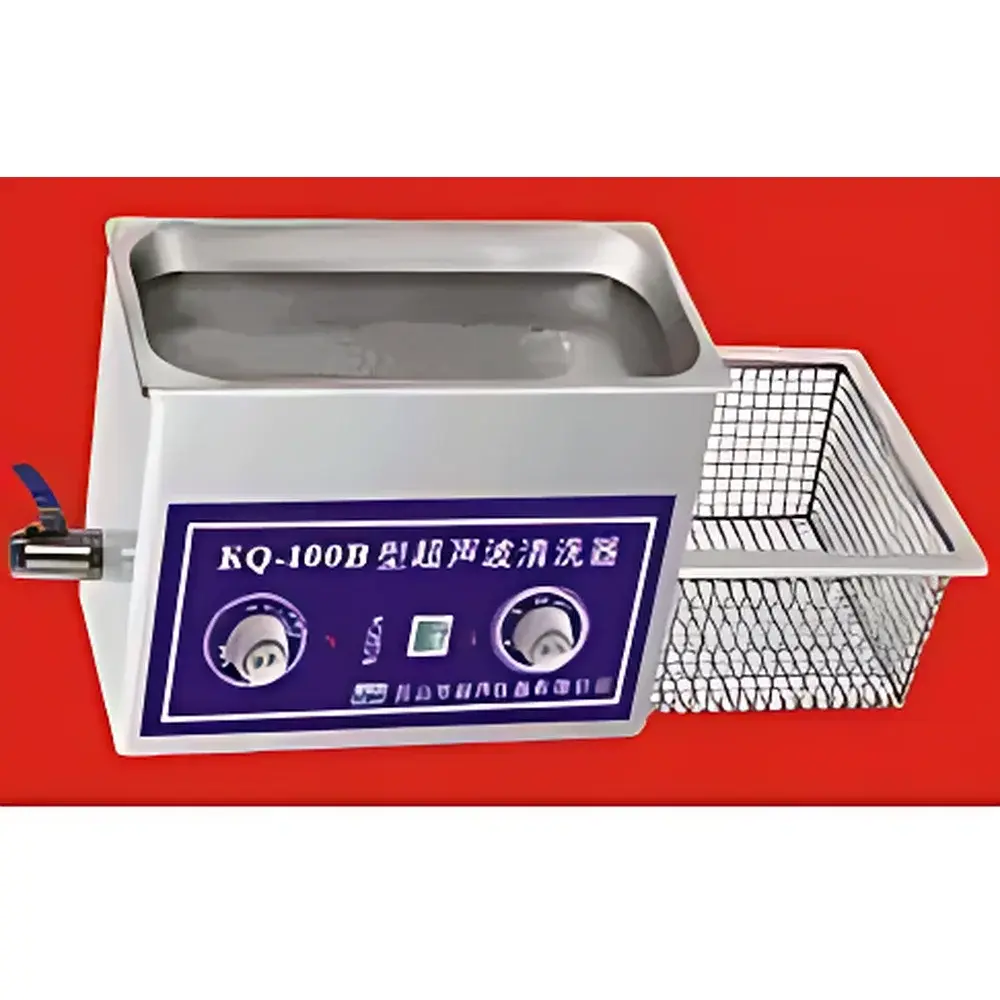
Chu Ding KQ-250B / KQ-250E / KQ-250 / KQ-250V Benchtop Ultrasonic Cleaner
| Brand | Chu Ding |
|---|---|
| Origin | Shanghai, China |
| Model | KQ-250B / KQ-250E / KQ-250 / KQ-250V |
| Tank Dimensions (L×W×H) | 300×240×150 mm (KQ-250/KQ-250B/KQ-250E) / 300×240×180 mm (KQ-250V) |
| Capacity | 10 L (KQ-250/KQ-250B/KQ-250E) / 13 L (KQ-250V) |
| Ultrasonic Frequency | 40 kHz |
| Ultrasonic Power | 250 W |
| Heating Power | 0 W (KQ-250), 800 W (KQ-250B & KQ-250E), 600 W (KQ-250V) |
| Temperature Range | 0–80 °C (heating models only) |
| Timer Range | 1–20 min |
| Construction | Stainless steel tank, lid, and housing |
| Accessories | Removable stainless steel mesh basket, acoustic damping lid, drain outlet (KQ-250B/KQ-250E/KQ-250V), vapor recovery system (KQ-250V only) |
Overview
The Chu Ding KQ-250 series comprises a family of benchtop ultrasonic cleaners engineered for precision cleaning, degassing, dispersion, emulsification, and cell disruption in laboratory and light industrial environments. These units operate on the principle of high-frequency acoustic cavitation: at 40 kHz, transducers bonded to the tank bottom generate controlled pressure waves in the cleaning medium, producing transient microbubbles that collapse with localized energy release—mechanically dislodging contaminants from surfaces and enhancing mass transfer in liquid-phase processes. Unlike immersion-only systems, the KQ-250 variants integrate modular functionality—including optional heating, programmable timing, acoustic attenuation, and, in the V-series, solvent vapor containment—enabling reproducible operation across diverse sample types and procedural requirements. Designed for compliance with general laboratory safety standards, the series supports routine QC/QA workflows in pharmaceutical development, materials science, analytical sample preparation, and academic research.
Key Features
- Stainless steel construction throughout: 304-grade tank interior, reinforced housing, and corrosion-resistant mesh basket ensure long-term durability and chemical compatibility with aqueous and mild organic solvents.
- Integrated digital timer (1–20 min) with automatic shutdown provides precise control over sonication duration—critical for avoiding sample degradation or excessive erosion during delicate cleaning protocols.
- Select models (KQ-250B, KQ-250E, KQ-250V) include PID-controlled heating (0–80 °C range), enabling temperature-assisted cleaning for viscous residues or low-surface-tension formulations.
- Acoustic damping lid reduces ambient noise by >15 dB(A) and minimizes solvent evaporation—improving operator comfort and maintaining bath stability during extended cycles.
- KQ-250V variant incorporates a condensate-recovery manifold and insulated vapor barrier, mitigating emissions of volatile organic compounds (VOCs) and supporting environmentally conscious lab practices per ISO 14001-aligned operational guidelines.
- Drain valve (standard on B/E/V models) facilitates rapid, spill-free solution exchange—reducing downtime between cleaning batches and simplifying maintenance in regulated environments.
Sample Compatibility & Compliance
The KQ-250 platform accommodates a broad spectrum of laboratory components: glassware (vials, cuvettes, pipette tips), metal parts (surgical instruments, calibration standards), ceramic substrates, polymer films, and biological specimens (tissue sections, cultured cells). Its 40 kHz frequency delivers optimal balance between penetration depth and surface shear force—suited for particulate removal without compromising structural integrity of fragile samples. While not certified to IEC 61000-6-3 (EMC) or UL 61010-1 out-of-box, the units are constructed to meet baseline electrical safety and mechanical robustness expectations for Class II laboratory equipment. When used with validated cleaning agents and documented parameters, the system supports adherence to GLP documentation requirements and can be incorporated into SOPs aligned with USP (Cleaning Validation) and ASTM D2603 (Ultrasonic Cleaning Performance Testing).
Software & Data Management
The KQ-250 series operates via an analog-digital hybrid interface: rotary encoder for time/temperature setting and LED display for real-time parameter readout. No embedded firmware or network connectivity is provided; all operational data must be manually recorded. For laboratories requiring audit trails under FDA 21 CFR Part 11 or EU Annex 11, external logging devices (e.g., calibrated thermocouple dataloggers, stopwatch timers with timestamping) are recommended to capture cycle start/end times, setpoints, and observed bath temperatures. The absence of software does not preclude integration into broader quality management systems—users routinely pair these units with LIMS platforms via manual entry or barcode-scanned batch records.
Applications
- Pharmaceutical QC: Removal of residual active pharmaceutical ingredients (APIs) from HPLC vials and syringe filters prior to analysis.
- Materials science: Deburring micro-machined components, dispersing nanomaterial suspensions (e.g., graphene oxide, TiO₂ nanoparticles), and preparing electrode coatings.
- Life sciences: Gentle lysis of bacterial cultures and mammalian cells for protein extraction; cleaning of microfluidic chips and electrophoresis combs.
- Electronics manufacturing: Precision cleaning of PCB stencils, solder paste residues, and MEMS device assemblies.
- Environmental testing: Extraction of PAHs and PCBs from soil/sediment matrices using accelerated solvent-assisted ultrasonication (ASU) protocols.
FAQ
What is the difference between KQ-250, KQ-250B, KQ-250E, and KQ-250V?
The base KQ-250 lacks heating and drainage. KQ-250B adds heating (800 W) and drain capability. KQ-250E includes both features plus an acoustic damping lid. KQ-250V offers heating (600 W), drain, lid, and integrated VOC vapor recovery.
Can this unit be used with flammable solvents?
Only the KQ-250V model is suitable for low-flashpoint solvents due to its sealed vapor recovery system and thermal insulation; standard models require aqueous or high-flashpoint media per NFPA 30 guidelines.
Is calibration required before use?
No factory calibration is provided; users should verify bath temperature uniformity (±2 °C) and timer accuracy (±0.5%) using NIST-traceable instruments as part of initial qualification.
What maintenance is recommended?
Weekly inspection of transducer adhesion, monthly descaling with 5% citric acid solution, and biannual verification of grounding continuity and insulation resistance (>1 MΩ at 500 V DC).
Does the unit comply with CE or RoHS directives?
As a non-EU-manufactured instrument intended for global distribution, CE marking is not applied; however, materials comply with RoHS 2011/65/EU substance restrictions based on supplier declarations.
Related Products



