
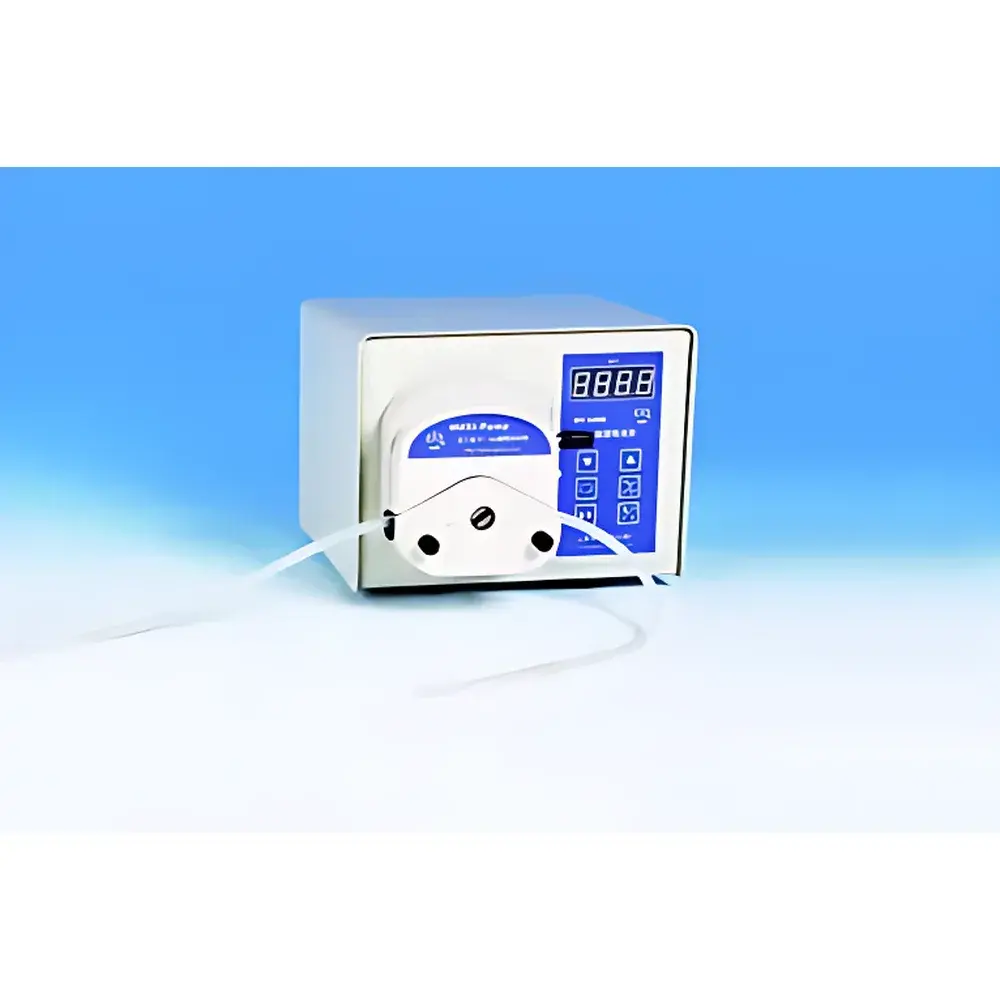
Chu Ding Technology BT-100SD Single-Channel Programmable Precision Peristaltic Pump / BT-200SD Dual-Channel Programmable Precision Peristaltic Pump
| Brand | Chu Ding Technology |
|---|---|
| Origin | Shanghai, China |
| Model | BT-100SD / BT-200SD |
| Flow Rate | 10–14,500 mL/h (per channel) |
| Max Pressure | ≥2 kg/cm² |
| Channel Count | 1 (BT-100SD) / 2 (BT-200SD) |
| Timing Range | 1 s – 9 h 59 min 59 s (run & sleep) |
| Interface | RS232 with PC control software |
| Dimensions (L×W×H) | BT-100SD: 110×290×155 mm |
| BT-200SD | 110×340×155 mm |
| Weight | 6 kg |
| Compliance | CE-marked design principles, compatible with ISO/IEC 17025 laboratory environment requirements |
Overview
The Chu Ding Technology BT-100SD and BT-200SD are microprocessor-controlled peristaltic pumps engineered for precise, repeatable fluid delivery in analytical, bioprocessing, and quality control laboratories. Based on the principle of occlusive peristalsis—where rollers compress flexible tubing to displace fluid without contact between the pump mechanism and the medium—these instruments deliver contamination-free, pulse-dampened flow ideal for sensitive reagents, cell suspensions, and calibration standards. Unlike diaphragm or piston pumps, peristaltic operation eliminates valves, seals, and internal wetted surfaces beyond the tubing itself, minimizing maintenance and enabling rapid fluid path changeover via tube replacement. The BT-100SD serves single-stream applications such as inline sample introduction into HPLC autosamplers or continuous buffer delivery in chromatography systems. The BT-200SD extends functionality with independent dual-channel control, supporting parallel processes including comparative titration, dual-column elution, or simultaneous feed-and-draw operations in small-scale bioreactors.
Key Features
- Programmable timing architecture with independent run and sleep intervals (1 second to 9 hours, 59 minutes, 59 seconds), enabling unattended multi-phase protocols such as cyclic dosing, timed wash sequences, or staggered reagent addition.
- RS232 serial interface with dedicated Windows-compatible control software for remote parameter configuration, real-time status monitoring, and execution logging—supporting integration into LIMS or SCADA environments.
- High-torque stepper motor drive with microstepping electronics ensures smooth, low-pulsation flow across the full 10–14,500 mL/h range; flow linearity is maintained within ±2% of setpoint under constant backpressure conditions (≤2 kg/cm²).
- Modular front-panel layout with intuitive LED indicators for channel status, timing mode, and error codes (e.g., tubing stall, motor overload); no proprietary tools required for roller assembly adjustment or tube loading.
- Standardized 1/4″–3/8″ tubing compatibility (e.g., PharMed BPT, Norprene, Tygon E-3603) with quick-release pump head design permitting tube replacement in <30 seconds without recalibration.
Sample Compatibility & Compliance
These pumps handle aqueous, organic, mildly corrosive, and shear-sensitive fluids—including PBS buffers, enzyme solutions, microbial cultures, and low-viscosity solvents—provided tubing material is chemically matched to the process stream. No metallic wetted parts ensure compliance with USP Class VI and FDA 21 CFR Part 11 data integrity prerequisites when used with audit-trail-enabled software configurations. While not certified to IEC 61000-6-3 EMC or UL 61010-1 out-of-the-box, the BT-series adheres to fundamental safety and electromagnetic compatibility design practices aligned with ISO/IEC 17025 Clause 5.3 (equipment verification) and GLP Annex III (instrument qualification). Users are advised to perform periodic performance verification using gravimetric flow checks traceable to NIST-certified mass standards.
Software & Data Management
The bundled PC application provides a deterministic command protocol (ASCII-based, CR/LF terminated) supporting ASCII command scripting for automated workflows. Logged data includes timestamped start/stop events, elapsed runtime, total dispensed volume (calculated from RPM × tube displacement factor), and system fault records. All logs export to CSV for downstream analysis in Excel or statistical process control platforms. Audit trail functionality—when enabled—records user ID, parameter changes, and execution triggers with immutable timestamps, satisfying basic ALCOA+ (Attributable, Legible, Contemporaneous, Original, Accurate) documentation expectations for regulated QC labs operating under GMP or ISO 13485 frameworks.
Applications
- Automated reagent dispensing in clinical chemistry analyzers and ELISA wash stations.
- Continuous feed of nutrient media or pH-adjusting agents in benchtop bioreactors (0.5–5 L working volume).
- Controlled eluent delivery in preparative chromatography and size-exclusion systems.
- In-line dilution series generation for instrument calibration (e.g., ICP-MS, AAS).
- Environmental sampling—timed collection of water or effluent at fixed intervals over extended periods.
- Pharmaceutical dissolution testing per USP , where consistent flow rate and timing precision directly impact release profile reproducibility.
FAQ
What tubing sizes are supported?
Standard pump heads accommodate inner diameters from 0.5 mm to 4.8 mm (1/4″ OD tubing), with optional high-flow heads available for up to 6.4 mm ID tubing upon request.
Can flow rate be calibrated for specific tubing and fluid viscosity?
Yes—calibration factors are user-definable in the software; recommended procedure includes gravimetric measurement at three flow points (low/mid/high) using a certified balance and stopwatch.
Is the RS232 interface compatible with LabVIEW or Python-based control systems?
Yes—the documented ASCII command set supports direct integration via PySerial or NI-VISA; example scripts are provided in the technical manual.
Does the pump support analog input for external flow modulation?
No—this model operates exclusively via digital timing and speed commands; analog voltage control is not implemented.
What is the expected service life of the pump tubing under continuous operation?
With standard silicone tubing at 50 rpm and ambient temperature, typical lifetime exceeds 200 hours; fluoropolymer tubing (e.g., PharMed) extends service life to >1,000 hours under identical conditions.



