
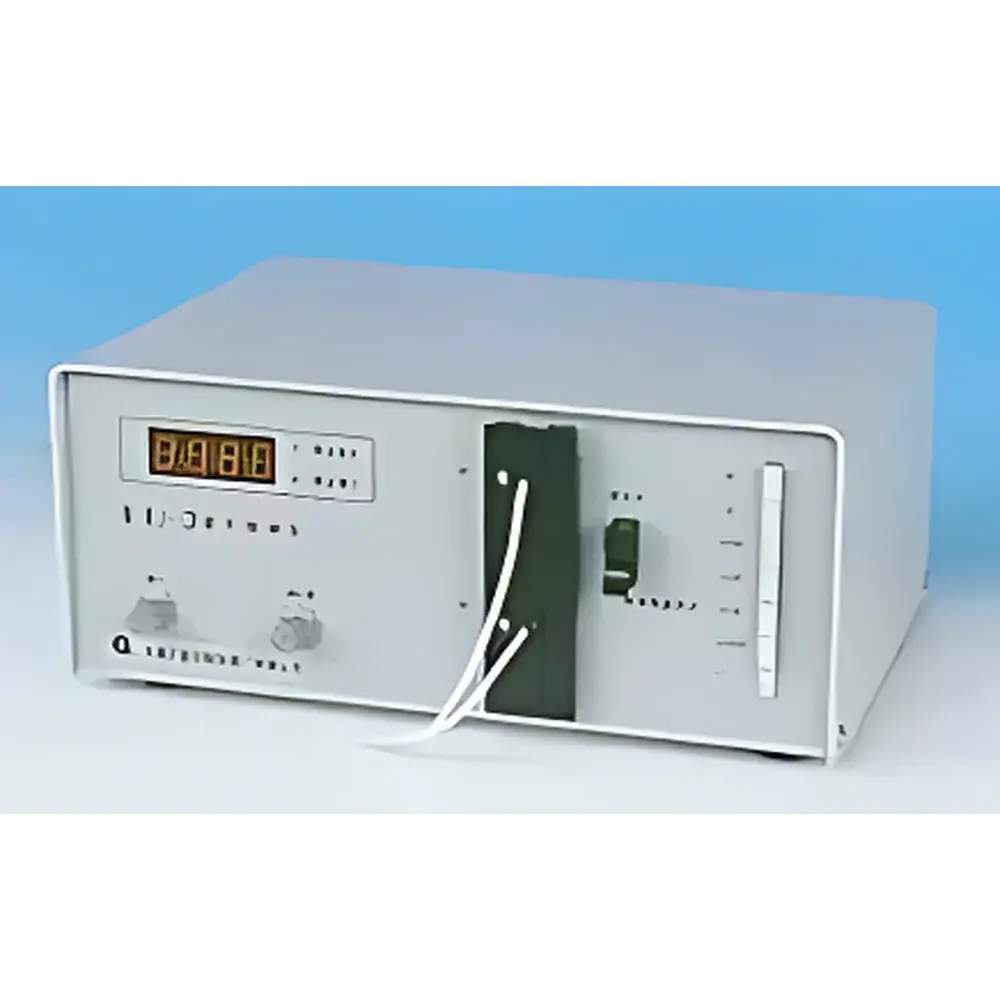
Chu Ding Technology HD-1 UV Absorbance Detector for Nucleic Acid and Protein Quantification
| Brand | Chu Ding Technology |
|---|---|
| Origin | Shanghai, China |
| Manufacturer Type | Authorized Distributor |
| Product Origin | Domestic (China) |
| Model | HD-1 |
| Wavelength | 254 nm & 280 nm (LED digital display) |
| Optical Path Length | 3 mm |
| Sample Cell Volume | 100 µL |
| Transmittance Range | 0–100% T |
| Absorbance Range | 0–2 A |
| Dimensions (W×D×H) | 288 × 185 × 150 mm |
Overview
The Chu Ding Technology HD-1 UV Absorbance Detector is a benchtop optical instrument engineered for real-time quantitative detection of nucleic acids and proteins during liquid chromatography (LC) or fast protein liquid chromatography (FPLC) separations. It operates on the principle of ultraviolet absorbance photometry at two fixed wavelengths—254 nm (optimized for nucleic acid detection via purine/pyrimidine ring absorption) and 280 nm (optimized for aromatic amino acid residues in proteins, particularly tryptophan and tyrosine). The detector integrates a high-stability LED light source, precision quartz flow cell (3 mm path length, 100 µL volume), and analog-to-digital signal processing circuitry to deliver reproducible absorbance (A) and transmittance (%T) measurements across a linear dynamic range of 0–2 A (equivalent to 0–100% T). Designed for compatibility with standard LC systems—including peristaltic or syringe pumps, fraction collectors, and analytical columns—the HD-1 serves as a core component in biomolecule purification workflows used in academic laboratories, biopharmaceutical QC, and molecular biology core facilities.
Key Features
- Fixed-wavelength dual-channel detection at 254 nm and 280 nm, aligned with established biochemical absorbance maxima
- LED-based optical system offering enhanced long-term intensity stability and reduced thermal drift compared to conventional tungsten-halogen or deuterium sources
- Digital LED display providing simultaneous readout of absorbance (A) and transmittance (%T) with unit-agnostic scaling
- Optimized 3 mm path-length flow cell with 100 µL internal volume, balancing sensitivity and minimal sample hold-up for low-flow FPLC applications
- Robust mechanical architecture with compact footprint (288 × 185 × 150 mm) suitable for integration into shared instrumentation benches
- Analog output interface compatible with external chart recorders; optional RS-232 connectivity available on higher-tier models (e.g., HD-2001-B-C, HD-3000 series) for computer-based data acquisition
Sample Compatibility & Compliance
The HD-1 is validated for use with aqueous mobile phases commonly employed in ion-exchange, size-exclusion, and hydrophobic interaction chromatography—including Tris-HCl, phosphate buffers, ammonium acetate, and low-concentration denaturants (e.g., urea ≤6 M). It supports detection of native and denatured proteins, ds/ssDNA, RNA, oligonucleotides, and nucleotide cofactors (e.g., NADH, ATP) within defined absorbance linearity limits. While not certified to ISO/IEC 17025 or FDA 21 CFR Part 11 out-of-the-box, the instrument’s analog signal output and stable baseline performance enable implementation within GLP-compliant workflows when paired with validated data logging hardware and documented operational procedures. Its design adheres to IEC 61010-1 safety standards for laboratory electrical equipment.
Software & Data Management
The HD-1 operates as a standalone analog detector and does not include embedded firmware or proprietary software. However, its 0–1 V or 0–5 V analog output (configurable per user manual) enables seamless integration with third-party data acquisition systems—including LabChart (ADInstruments), WinDaq (DATAQ), or custom Python/Matlab scripts using USB DAQ modules (e.g., National Instruments USB-6009). For laboratories requiring audit-ready electronic records, the HD-1 may be coupled with compliant chromatography data systems (CDS) that support external analog input channels and enforce 21 CFR Part 11 controls (e.g., electronic signatures, audit trails, data integrity validation). Raw signal outputs are compatible with peak integration algorithms in commercial packages such as OriginLab or GraphPad Prism for post-run quantification and kinetic analysis.
Applications
- Real-time monitoring of elution profiles during affinity chromatography purification of His-tagged recombinant proteins
- Quantitative tracking of DNA fragments in gel filtration chromatography following restriction digestion or PCR cleanup
- Monitoring of column equilibration and gradient formation in ion-exchange purification of monoclonal antibodies
- Validation of buffer exchange efficiency in desalting steps prior to mass spectrometry analysis
- Educational use in undergraduate biochemistry labs for teaching Beer-Lambert law principles and chromatographic resolution concepts
- Supporting QC release testing of plasmid DNA preps in non-GMP research settings
FAQ
What is the minimum detectable absorbance for the HD-1 at 280 nm?
The instrument’s specified linear range begins at 0 A; practical lower detection limit depends on noise floor and flow cell cleanliness, typically ~0.005 A under optimized conditions with low-noise electronics and stabilized flow.
Can the HD-1 be used with HPLC systems operating above 1 mL/min?
It is designed for low-pressure, low-flow applications (≤2 mL/min); use with high-pressure HPLC requires an external flow splitter or pressure-regulated flow cell adapter to avoid cell damage.
Is the flow cell removable and autoclavable?
The standard quartz flow cell is removable for cleaning but is not rated for autoclaving; recommended cleaning involves sequential rinses with 70% ethanol, water, and 0.1 M NaOH followed by thorough water flushing.
Does the HD-1 support wavelength calibration verification?
No built-in calibration routine exists; users should verify wavelength accuracy periodically using NIST-traceable holmium oxide or didymium filters, or by referencing known absorbance peaks of standard compounds (e.g., potassium dichromate at 257 nm).
What documentation is provided for IQ/OQ protocol development?
Factory test reports and electrical safety certificates are supplied; full qualification documentation (including sensor linearity, wavelength accuracy, and baseline stability protocols) must be developed in-house per ISO/IEC 17025 or internal SOP requirements.



