
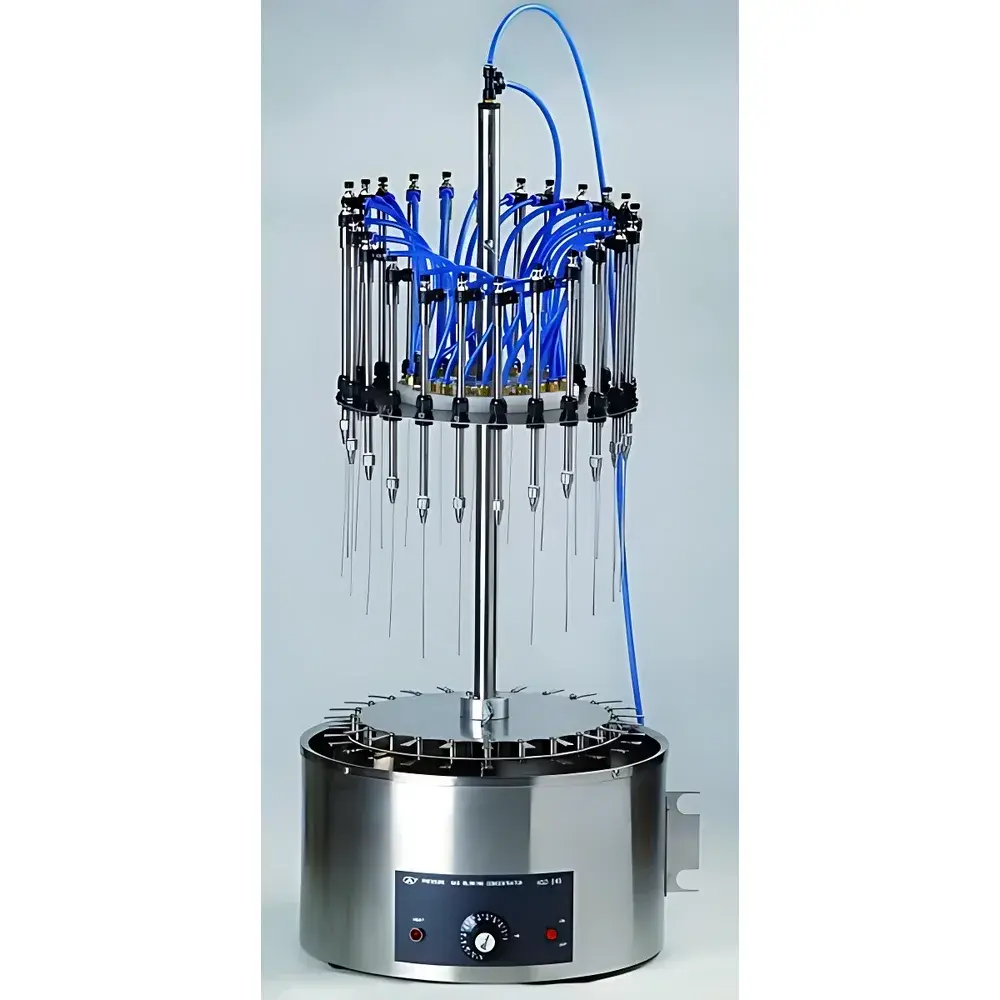
Chu Ding Technology HSC-24B Circular Water-Bath Nitrogen Evaporator
| Brand | Chu Ding Technology |
|---|---|
| Origin | Shanghai, China |
| Model | HSC-24B |
| Heating Method | Water-Bath Heating |
| Sample Capacity | 24 positions |
| Gas Flow Range | 0–10 L/min |
| Power Consumption | 200 W |
| Construction Materials | 316 Stainless Steel (gas channels), Anodized Aluminum (heating block), Plastic-Coated Housing |
| Temperature Control | Digital PID Controller with Dual LED Display & Over-Temperature Alarm |
Overview
The Chu Ding Technology HSC-24B Circular Water-Bath Nitrogen Evaporator is an engineered solution for controlled, gentle solvent removal in analytical sample preparation workflows. It operates on the principle of nitrogen gas displacement—directing a stream of inert nitrogen across the surface of heated liquid samples in test tubes or vials to accelerate evaporation while minimizing thermal degradation and analyte loss. Unlike dry-block evaporators, the water-bath design ensures uniform, stable temperature distribution (±0.5 °C typical) across all 24 sample positions, eliminating hot spots and supporting reproducible concentration kinetics—critical for quantitative applications in regulated environments such as clinical toxicology, environmental residue analysis, and pharmaceutical stability testing.
Key Features
- Circular water-bath heating system with stainless-steel tank and precision-machined aluminum heating block, optimized for thermal homogeneity and corrosion resistance.
- Digital PID temperature controller featuring dual LED display (setpoint & actual bath temperature), adjustable ramp rate, and programmable over-temperature cutoff (configurable threshold ≥100 °C).
- Independent gas flow regulation per channel via integrated needle valves; total flow range 0–10 L/min with calibrated rotameter for visual monitoring and repeatable method transfer.
- Height-adjustable gas manifold accommodates vials from 10 mL to 100 mL; vertical travel range: 80–160 mm, secured with locking collar for vibration-free operation.
- Modular tube holder system with interchangeable aperture inserts (standard: Ø15 mm, Ø17 mm, Ø21 mm); custom apertures available upon request to support non-standard vessel geometries (e.g., GC vials, culture tubes).
- Chemically resistant construction: all wetted gas-path components fabricated from ASTM F899-certified 316 stainless steel; housing coated with epoxy-polyester hybrid finish for solvent splash protection and long-term durability.
Sample Compatibility & Compliance
The HSC-24B supports common laboratory vessels including borosilicate glass test tubes (10–25 mL), 12 mL and 15 mL conical-bottom centrifuge tubes, and standard 1.5–2.0 mL autosampler vials. Its water-bath geometry enables compatibility with low-boiling solvents (e.g., dichloromethane, ethyl acetate, hexane) and thermally labile compounds (e.g., pesticides, steroids, oligonucleotides). The instrument meets general safety requirements per IEC 61010-1:2010 for laboratory electrical equipment. While not certified for Class I Div 1 hazardous locations, it is routinely deployed in ISO/IEC 17025-accredited labs where SOPs define nitrogen purity (>99.995%), flow calibration frequency (recommended: quarterly), and temperature verification (per ASTM E2251-22 using traceable RTD probes).
Software & Data Management
The HSC-24B operates as a standalone analog-digital hybrid instrument with no embedded microprocessor or network interface. All operational parameters—including set temperature, actual bath temperature, and gas flow—are monitored locally via front-panel displays and mechanical controls. For GLP/GMP-compliant environments, users integrate the unit into validated workflows by documenting temperature profiles using external data loggers (e.g., Omega OM-DAQPRO-5300) and maintaining calibration records per internal SOPs aligned with ISO/IEC 17025 Clause 6.5. No software validation package is provided; however, the device’s deterministic analog control architecture eliminates concerns related to firmware versioning, cybersecurity, or 21 CFR Part 11 electronic record integrity—making it suitable for legacy-compliant laboratories prioritizing audit simplicity and operational transparency.
Applications
- Concentration of extracts prior to GC-MS or LC-MS/MS analysis in food safety and environmental monitoring (e.g., EPA Method 525.3, EN 15662).
- Preparative cleanup of biological matrices (plasma, urine, tissue homogenates) in forensic toxicology and doping control laboratories.
- Routine solvent exchange in solid-phase extraction (SPE) eluate processing for pharmaceutical impurity profiling.
- Parallel evaporation of calibration standards and QC samples in clinical chemistry reference labs adhering to CLIA and CAP requirements.
- High-throughput sample prep in academic research settings requiring cost-effective, low-maintenance evaporation without proprietary consumables or service contracts.
FAQ
What is the maximum operating temperature of the water bath?
The HSC-24B is rated for continuous operation up to 99 °C. Operation above 95 °C requires distilled or deionized water to prevent scale buildup and ensure sensor accuracy.
Can the unit be used with flammable solvents?
Yes—provided the laboratory ventilation system complies with NFPA 45 and local fire codes. Nitrogen blanketing reduces vapor-phase oxygen concentration; however, static discharge mitigation (grounded gas lines, anti-static tubing) remains the user’s responsibility.
Is calibration documentation included?
A factory calibration certificate for temperature sensor and flow meter is supplied with each unit. Users must perform periodic in-house verification using NIST-traceable references per their quality management system.
Does the instrument support external temperature probe input?
No. Temperature feedback is derived solely from the built-in PT100 sensor embedded in the bath. External probe integration requires third-party data acquisition hardware.
What maintenance is required?
Monthly cleaning of the water bath with mild detergent and soft brush; biannual descaling with 5% citric acid solution; annual inspection of gas manifold O-rings and needle valve seats for wear.



