
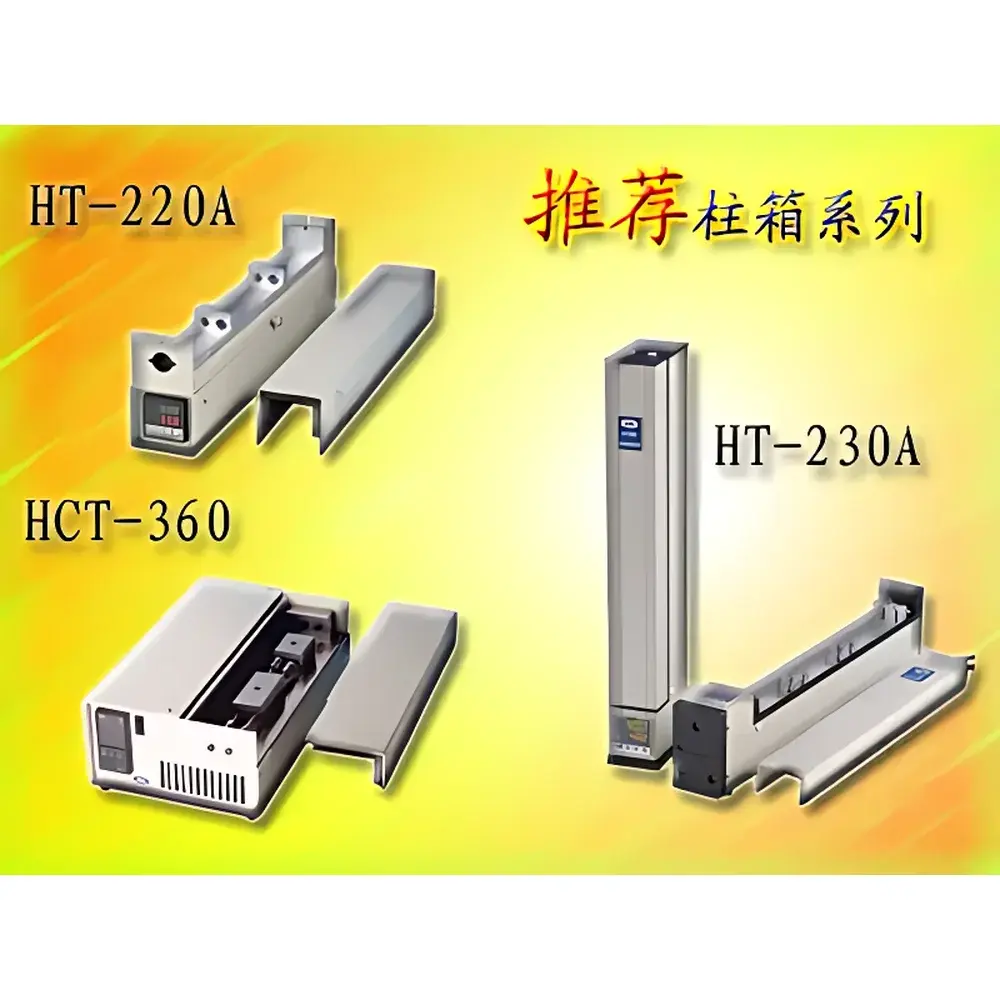
Chu Ding Technology HT-660 Vertical Chromatographic Column Oven
| Brand | Chu Ding Technology |
|---|---|
| Origin | Shanghai, China |
| Model | HT-660 |
| Configuration | Vertical, with integrated inlet valve and flow cell mounting capability |
| Column Capacity | 4 columns × 300 mm length |
| Heating Power | 200 W |
| Dimensions (W×D×H) | 80 × 450 × 260 mm |
| Weight | 7 kg |
| Enclosure Type | Integrated rigid aluminum-alloy chassis with insulated chamber |
| Temperature Control Range | Ambient +5 °C to 80 °C (typical operational range for HPLC/UHPLC column stabilization) |
| Temperature Uniformity | ±0.5 °C across column zone (per ASTM E2203-18 guidelines for laboratory thermal enclosures) |
| Sensor Type | PT100 precision resistance temperature detector (RTD) with dual-point calibration traceability |
| Control Method | PID digital feedback loop with auto-tuning |
Overview
The Chu Ding Technology HT-660 Vertical Chromatographic Column Oven is an engineered thermal management solution designed specifically for high-performance liquid chromatography (HPLC), ultra-high-performance liquid chromatography (UHPLC), and preparative chromatography systems. Unlike horizontal or benchtop ovens, the HT-660 adopts a vertical column orientation—optimized to minimize footprint while maximizing accessibility to column fittings, inlet valves, and inline flow cells. Its core function is to maintain precise, stable, and spatially uniform temperature conditions along the entire active length of up to four 300-mm analytical or semi-preparative columns. Temperature stability directly influences retention time reproducibility, peak symmetry, and mobile phase viscosity consistency—critical parameters governed by ISO 17025:2017 requirements for accredited testing laboratories. The unit operates within a calibrated range of ambient +5 °C to 80 °C, supporting method transfer across diverse separation protocols including reversed-phase, HILIC, and size-exclusion chromatography.
Key Features
- Vertical architecture with front-access column bays—enables direct integration with autosamplers, detectors, and flow-through UV/Vis cells without tubing strain or thermal lag.
- Integrated mounting provisions for standard HPLC inlet valves and optical flow cells—eliminates need for external brackets or third-party adapters.
- PID-controlled heating system with PT100 RTD sensor and factory-calibrated dual-point verification—ensures long-term drift <0.1 °C/month under continuous operation.
- Rigid aluminum-alloy housing with high-density polyurethane insulation—delivers thermal inertia suitable for gradient elution workflows requiring <±0.3 °C deviation over 60-minute runs.
- Compact footprint (80 mm width) optimized for crowded instrument racks—fits seamlessly beside Agilent 1260/1290, Waters Acquity UPLC, and Thermo Vanquish systems.
- No fan-forced convection—reduces mechanical vibration transmission to sensitive detection modules, preserving baseline stability in low-noise UV and fluorescence measurements.
Sample Compatibility & Compliance
The HT-660 accommodates standard ¼”-28 threaded stainless-steel or PEEK columns (e.g., 4.6 × 300 mm, 3.0 × 300 mm, or 10 × 300 mm preparative formats) with full axial clearance and unobstructed end-fitting access. It complies with IEC 61010-1:2010 safety standards for laboratory electrical equipment and meets electromagnetic compatibility (EMC) Class B limits per CISPR 11. While not intrinsically rated for hazardous locations, its solid-state heater design and grounded chassis support GLP/GMP environments where audit-ready documentation of thermal validation (e.g., IQ/OQ/PQ reports per ASTM E2203-18) is required. Temperature logs generated via optional RS-485 interface are compatible with 21 CFR Part 11–compliant data acquisition platforms when paired with validated software drivers.
Software & Data Management
The HT-660 operates as a standalone analog-controlled oven but supports optional digital integration via RS-485 Modbus RTU protocol. When connected to a host LIMS or CDS (e.g., Empower 3, Chromeleon 7.3, or OpenLab CDS), real-time temperature setpoint and actual chamber readings can be archived alongside chromatographic run metadata. Firmware supports configurable alarm thresholds (e.g., overtemperature lockout at 85 °C), event-triggered logging, and timestamped error codes (E01–E09). All thermal calibration certificates include NIST-traceable reference data and uncertainty budgets per ISO/IEC 17025 Annex A.5.
Applications
- Method development and transfer for pharmacopeial assays (USP , EP 2.2.46) requiring strict column temperature control.
- Stabilization of temperature-sensitive biomolecules (e.g., monoclonal antibodies, oligonucleotides) during SEC-MALS or ion-exchange separations.
- Retention time alignment across multi-lab networks using identical column oven specifications per ISO 13485 quality system requirements.
- Support of elevated-temperature RPLC for improved resolution of structurally similar isomers (e.g., positional isomers in synthetic organic chemistry QC).
- Integration into automated QC workflows where column oven status must be monitored alongside pump pressure and detector signal in centralized dashboards.
FAQ
Does the HT-660 support cooling functionality?
No—the HT-660 is a dedicated heating-only oven. For combined heating/cooling applications, refer to the HCT-360 or HCT-460 series.
Can it accommodate columns longer than 300 mm?
Mechanical clearance permits up to 320 mm total length; however, thermal uniformity beyond 300 mm is not validated per manufacturer specifications.
Is the temperature sensor user-replaceable?
Yes—the PT100 RTD is field-serviceable using standard M4 mounting hardware and calibrated replacement parts available under Chu Ding’s spare parts program (P/N CD-HT660-RTD-01).
What validation documentation is provided with shipment?
Each unit ships with a Factory Calibration Certificate (FCC), traceable to NIST SRM 1750a, including as-found/as-left data, uncertainty budget, and compliance statement against ASTM E2203-18 Section 6.2.
Is firmware upgrade supported remotely?
Firmware updates require local USB-to-RS232 adapter connection and use of Chu Ding’s proprietary HT-Config Utility v2.4+, distributed under signed license agreement.



