
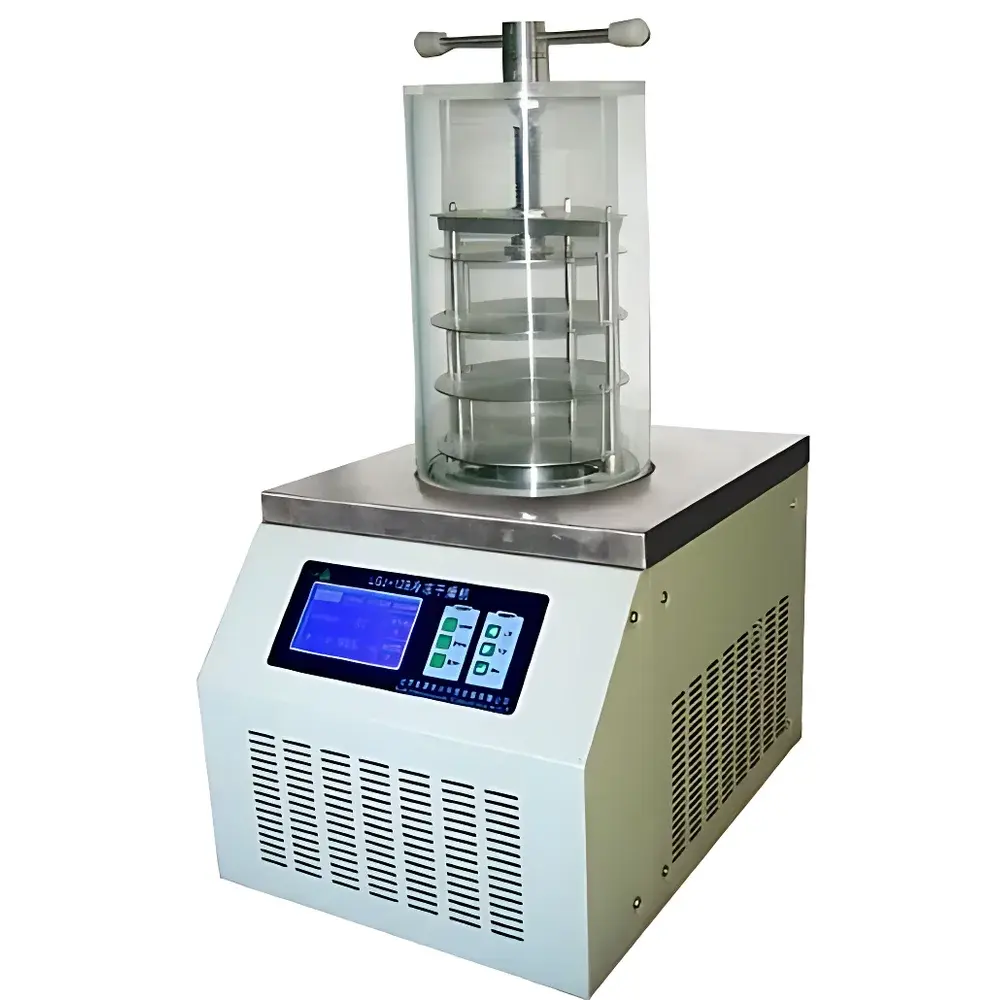
Chu Ding Technology LGJ-10 Benchtop Vacuum Freeze Dryer (Vacuum Lyophilizer) with Hydraulic Stoppering
| Brand | Chu Ding Technology |
|---|---|
| Origin | Shanghai, China |
| Model | LGJ-10 |
| Cold Trap Temperature | ≤ −55 °C (optional −80 °C) |
| Ultimate Vacuum | < 10 Pa |
| Freeze-Drying Area | 0.07–0.1 m² |
| Water Capture Capacity | 3 kg/24 h |
| Shelf Load Volume (bulk) | 0.7–1.2 L |
| Dimensions (W×D×H) | 565 × 420 × (360 + 340) mm |
| Tray Configuration | 4 stainless steel trays (Ø200 mm) for bulk loading |
| Bottle Configuration | 3 stainless steel trays (Ø180 mm) with manual hydraulic stoppering mechanism (supports up to 135 × Ø22 mm vials) |
Overview
The Chu Ding Technology LGJ-10 is a compact, benchtop vacuum freeze dryer engineered for laboratory-scale lyophilization of heat-sensitive biologicals, pharmaceuticals, diagnostics, and research-grade samples. It operates on the principle of sublimation under deep vacuum and cryogenic conditions: frozen water is removed directly from the solid phase to vapor without passing through the liquid state—preserving structural integrity, bioactivity, and chemical stability of labile compounds. Designed for R&D validation, small-batch process development, and quality control testing, the LGJ-10 integrates primary drying (sublimation), secondary drying (desorption), and post-drying inert gas backfilling (optional N₂ purge) within a single, self-contained architecture. Its modular configuration supports multiple operational modes—including bulk tray drying, vial drying with manual stoppering, and multi-port manifold drying—making it adaptable to diverse sample formats while maintaining compliance with fundamental lyophilization process requirements.
Key Features
- Stainless steel cold trap chamber (≥ Ø220 mm opening) with external coil design—no internal盘管—enabling rapid pre-freezing of samples directly on the shelf prior to vacuum initiation;
- High-efficiency imported compressor system delivering stable cooling performance at ≤ −55 °C (−80 °C optional), ensuring consistent ice condensation and low ultimate pressure (< 10 Pa);
- Large-diameter transparent acrylic bell jar with safety interlock—provides full visual monitoring of drying progress while maintaining Class I containment integrity;
- Hydraulic stoppering mechanism integrated into the top plate assembly—enables precise, repeatable sealing of glass vials (up to Ø22 mm) post-primary drying, minimizing moisture re-entry during chamber venting;
- Intuitive 4.3-inch color LCD interface with Chinese-language menu and real-time graphical display of shelf temperature, cold trap temperature, and chamber pressure profiles;
- Pre-cooling rack doubles as a convection-enhancing airflow guide—accelerating vapor migration from sample surface to cold trap during primary drying;
- Corrosion-resistant 304 stainless steel construction throughout critical wetted surfaces (cold trap, shelves, door gasket, and interior housing), supporting routine cleaning and long-term reliability;
- Compact footprint (565 × 420 mm base area) optimized for standard laboratory bench space—requires no external chiller or compressed air supply.
Sample Compatibility & Compliance
The LGJ-10 accommodates a broad range of sample types including aqueous protein solutions, microbial cultures, enzyme preparations, vaccine candidates, and botanical extracts. Its configurable tray system supports both loose powder drying (0.7–1.2 L capacity across four Ø200 mm trays) and sterile vial processing (up to 135 × 22 mm vials across three Ø180 mm trays). While not certified for GMP manufacturing, the unit’s design aligns with foundational principles outlined in USP , ISO 20988:2007 (Biotechnology — Lyophilization), and ASTM F2375-04 (Standard Guide for Lyophilization Process Development). The optional nitrogen purge valve facilitates inert atmosphere backfilling—critical for oxygen-sensitive formulations—and supports GLP-compliant documentation when paired with external data loggers.
Software & Data Management
The built-in controller records time-stamped temperature and pressure data at user-defined intervals (1–60 sec), storing up to 10 complete drying cycles internally. Export is supported via USB flash drive in CSV format for offline analysis in Excel, MATLAB, or process modeling software (e.g., PharmaModel, LyoTools). Although the LGJ-10 does not feature Ethernet connectivity or FDA 21 CFR Part 11-compliant electronic signatures, its traceable cycle logs meet minimum audit requirements for academic labs, contract research organizations (CROs), and early-phase formulation units operating under basic quality assurance protocols.
Applications
- Stabilization of monoclonal antibodies, recombinant proteins, and plasmid DNA for analytical reference standards;
- Preparation of lyophilized bacterial and fungal cultures for strain banking and proficiency testing;
- Drying of tissue homogenates and cell lysates for metabolomics and proteomics workflows;
- Development of prototype lyophilized dosage forms (e.g., nasal sprays, oral disintegrating tablets) prior to pilot-scale transfer;
- Rapid dehydration of calibration standards and certified reference materials requiring long-term ambient storage stability.
FAQ
What is the maximum sample volume per batch?
For bulk material loaded on Ø200 mm trays: 0.7–1.2 L total (4 trays). For vials: up to 135 × Ø22 mm vials (3 trays, 10 mm fill depth).
Can the LGJ-10 achieve sterile processing conditions?
No—it lacks steam-in-place (SIP), vaporized hydrogen peroxide (VHP) compatibility, or ISO Class 5 cleanroom integration. Sterility must be ensured upstream via aseptic filling prior to loading.
Is the cold trap temperature actively controlled or fixed?
The cold trap operates at a fixed setpoint (≤ −55 °C standard; −80 °C optional), regulated by the compressor’s thermal load—not programmable ramping.
Does the unit include vacuum pump oil and accessories?
A two-stage rotary vane vacuum pump (oil-lubricated, 4 m³/h) is supplied with initial oil charge and spare filter elements; no additional consumables are included.
How is shelf temperature managed during drying?
Shelf temperature is passively coupled to the cold trap via conduction—no independent heating/cooling elements are present. Sample pre-freezing occurs directly on the shelf prior to vacuum application.



