
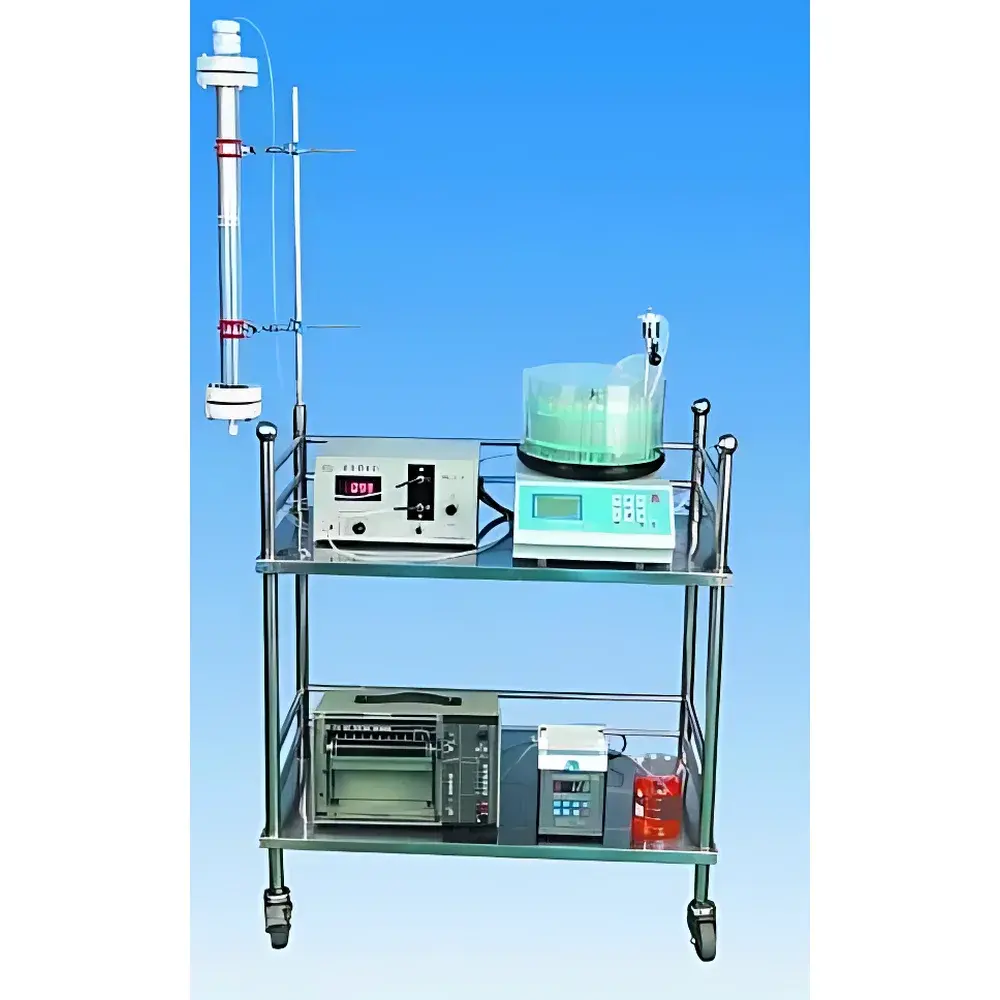
Chu Ding Technology MA99-1 Automated Nucleic Acid & Protein Chromatography System
| Brand | Chu Ding Technology |
|---|---|
| Origin | Shanghai, China |
| Model | MA99-1 |
| Wavelength | 254 nm & 280 nm |
| Flow Rate | 0.1–10 mL/min |
| Timer Range | 1 min–24 h |
| Fraction Collection Capacity | 12 mL × 100 |
| Column Set | Φ1.0×40 cm, Φ1.6×50 cm, Φ2.5×60 cm |
| Detection Principle | UV Absorbance (A) & Transmittance (T%) |
| Data Acquisition | Real-time spectral plotting, parameter calculation, and report export via PC-based software |
Overview
The Chu Ding Technology MA99-1 Automated Nucleic Acid & Protein Chromatography System is a benchtop liquid chromatography platform engineered for reproducible, semi-automated purification and analytical separation of biomolecules—including nucleic acids, proteins, enzymes, and peptides—using standard column-based techniques such as ion exchange, gel filtration, and affinity chromatography. The system operates on the principle of UV absorbance detection at two fixed wavelengths (254 nm and 280 nm), enabling simultaneous monitoring of nucleic acid (260 nm equivalent, approximated by 254 nm) and aromatic amino acid–containing proteins (280 nm). Integrated analog-to-digital signal acquisition allows real-time plotting of absorbance (A) and transmittance (T%) profiles directly to a Windows-based host computer, supporting traceable, audit-ready chromatographic analysis in academic, core facility, and quality control environments.
Key Features
- Fixed-wavelength dual-channel UV detection (254 nm / 280 nm) with analog output for compatibility with legacy chart recorders or modern DAQ systems
- Programmable timer-controlled fraction collection with adjustable interval from 1 minute to 24 hours, supporting consistent elution-based fractionation
- Constant-flow peristaltic pumping (HL-2 type) delivering stable flow rates between 0.1 and 10 mL/min across variable backpressure conditions
- Modular five-component configuration including HD-1 UV detector, XWT-S strip-chart recorder, HL-2 pump, BSZ-100 electronic timer-controlled fraction collector, and three standardized glass columns (Φ1.0×40 cm, Φ1.6×50 cm, Φ2.5×60 cm)
- PC-integrated data acquisition software enabling real-time spectral visualization, baseline correction, peak integration, retention time annotation, and export of CSV/PDF reports
- Open architecture design facilitating integration with third-party instruments (e.g., external gradient mixers or pH monitors) via analog voltage inputs/outputs
Sample Compatibility & Compliance
The MA99-1 system is validated for use with aqueous mobile phases commonly employed in biomolecule purification—including Tris-HCl, phosphate buffers, NaCl gradients, and imidazole elution systems. Its glass column set supports sample volumes ranging from 0.5 mL to 50 mL and accommodates both analytical-scale screening and preparative-scale isolation (up to ~10 mg protein per run). While not certified under ISO 13485 or FDA 21 CFR Part 11 out-of-the-box, the system’s analog signal chain and deterministic timing logic support GLP-aligned documentation workflows when paired with validated software and procedural SOPs. It complies with IEC 61010-1 safety standards for laboratory electrical equipment and meets CE marking requirements for electromagnetic compatibility (EMC) and low-voltage directive conformity.
Software & Data Management
Data acquisition is performed via proprietary Windows-compatible software that interfaces with the system’s analog output ports using standard USB-to-serial or USB-to-analog DAQ adapters (not included). The software provides synchronized dual-channel waveform display (A₂₅₄ and A₂₈₀), automatic zero-point calibration, user-defined baseline subtraction, and integrated peak detection algorithms based on first-derivative thresholding. All chromatograms are saved in native binary format with embedded metadata (date/time stamp, instrument ID, operator ID, method name), and can be exported to CSV for statistical analysis or PDF for regulatory submission. Audit trails are manually generated through file versioning and timestamped log entries; full 21 CFR Part 11 compliance requires supplemental validation of the host PC environment and electronic signature implementation.
Applications
- Purification of plasmid DNA and PCR products using anion-exchange or silica-membrane–based columns
- Desalting and buffer exchange of purified antibodies and recombinant proteins via size-exclusion chromatography
- Monitoring enzymatic digestion kinetics by tracking substrate depletion or product formation in real time
- Quality assessment of oligonucleotide synthesis batches via retention time consistency and peak symmetry analysis
- Teaching laboratory implementation of classical chromatographic theory—including resolution, selectivity, and column efficiency calculations (N, Rs, α)
- Preparative isolation of His-tagged proteins using immobilized metal affinity chromatography (IMAC) with Ni²⁺-NTA resin
FAQ
Is the MA99-1 compatible with HPLC-grade solvents or organic modifiers?
No—the system is designed exclusively for aqueous-based separations. Peristaltic tubing and detector flow cells are not chemically resistant to acetonitrile, methanol, or other organic solvents.
Can the system perform gradient elution without additional hardware?
No—gradient capability requires optional accessories such as the TH-500 gradient mixer (available in MA99-2A configuration); the MA99-1 supports only isocratic runs.
What is the minimum detectable absorbance change?
The HD-1 detector provides a full-scale analog output of 0–100 mV corresponding to 0–2 AU; typical noise floor is ≤0.002 AU, enabling reliable detection of sub-microgram quantities under optimized conditions.
Are replacement columns and consumables supplied by Chu Ding Technology?
Yes—standard glass columns, quartz flow cells, and silicone peristaltic tubing kits are available directly from authorized distributors with documented lot traceability.
Does the software support multi-user login or role-based access control?
No—the current software version operates in single-user mode without authentication layers; user accountability must be enforced externally via Windows account policies and file permissions.





