
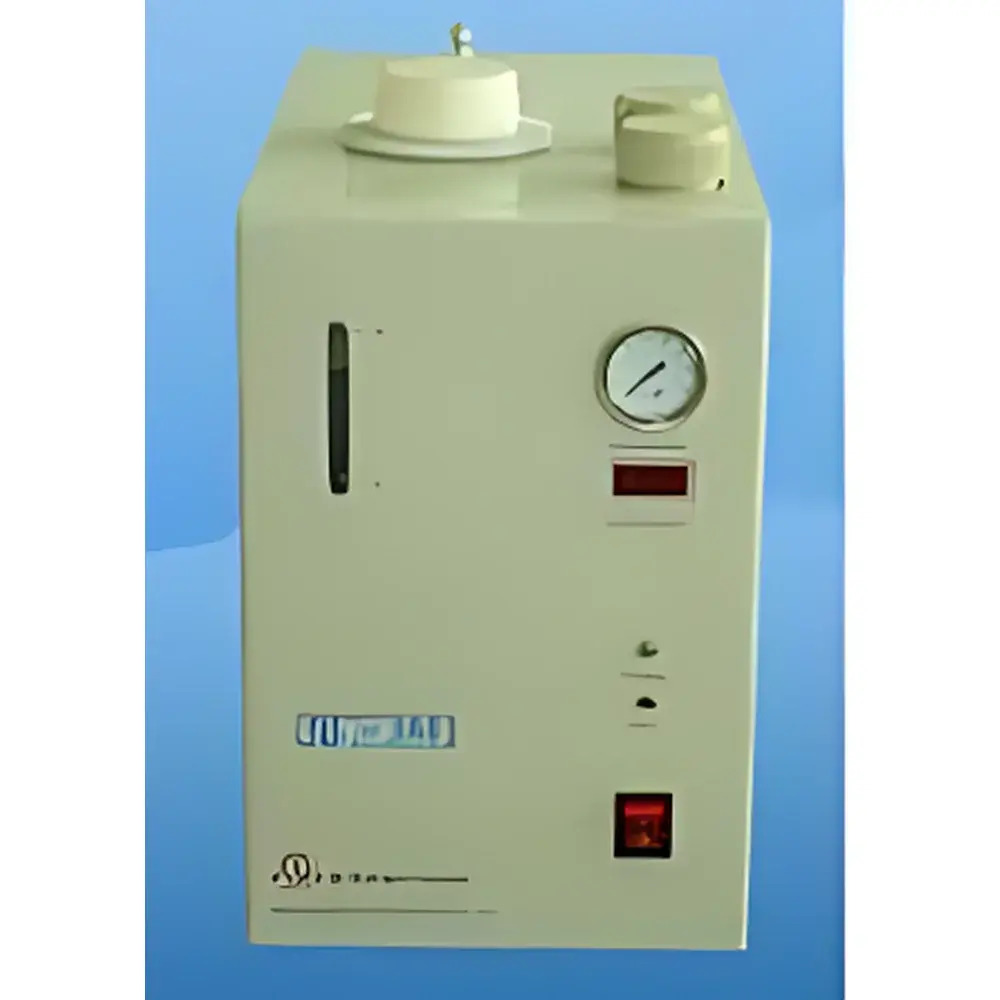
Chu Ding Technology QL-150 SPE Electrolytic High-Purity Hydrogen Generator
| Brand | Chu Ding Technology |
|---|---|
| Origin | Shanghai, China |
| Manufacturer Type | Authorized Distributor |
| Region Category | Domestic (China) |
| Model | QL-150 |
| Price | USD 950 (FOB Shanghai) |
| Purity | >99.999% H₂ |
| Flow Rate | 0–150 mL/min |
| Output Pressure | 0.02–0.4 MPa |
| Power Supply | 220 V ±15%, 50–60 Hz |
| Max. Power Consumption | 90 W |
| Dimensions (W×D×H) | 431 × 246 × 398 mm |
| Water Reservoir Capacity | 3.2 L |
| Water Consumption | 7.23 g/h |
| Feed Water Resistivity Requirement | ≥1 MΩ·cm |
Overview
The Chu Ding Technology QL-150 SPE Electrolytic High-Purity Hydrogen Generator is a compact, laboratory-grade hydrogen supply system engineered for continuous, on-demand generation of ultra-high-purity hydrogen gas (≥99.999%) via solid polymer electrolyte (SPE) membrane electrolysis of deionized water. Unlike traditional alkaline electrolyzers, the QL-150 eliminates the need for caustic KOH or NaOH solutions—removing corrosion risks, maintenance complexity, and operator exposure hazards. Its core electrochemical architecture employs a zero-gap catalytic electrode assembly, where platinum-group catalysts are integrally bonded to a perfluorosulfonic acid (PFSA) proton exchange membrane. Under applied DC voltage, water molecules dissociate at the anode (2H₂O → O₂ + 4H⁺ + 4e⁻), while protons migrate through the hydrated membrane to the cathode, where they recombine into molecular hydrogen (4H⁺ + 4e⁻ → 2H₂). This mechanism ensures high Faradaic efficiency (>92%), minimal heat generation, and intrinsic gas separation—enabling direct delivery of dry, particle-free H₂ suitable for sensitive analytical applications.
Key Features
- SPE-based electrolysis with integrated Pt/C composite electrodes and Nafion®-type membrane—no liquid electrolyte, no alkali handling, no neutralization waste.
- Intelligent pressure- and flow-regulated output: maintains stable 0–150 mL/min delivery across variable load conditions via closed-loop feedback control.
- Multi-stage gas purification: integrated water separator followed by desiccant-based drying (indicating silica gel cartridge) yields ≤1 ppm H₂O and ≤0.1 ppm total hydrocarbons.
- Low thermal signature design: cell stack operates below 45 °C under full load; no active cooling required.
- Comprehensive safety architecture: over-pressure shutoff (0.45 MPa threshold), leak detection via differential pressure monitoring, automatic shutdown on low-water or open-circuit fault.
- Front-panel digital interface with real-time display of output pressure, flow rate, operating hours, and reservoir level.
Sample Compatibility & Compliance
The QL-150 is designed exclusively for use with ultrapure water meeting ASTM D1193 Type I or ISO 3696 Grade 1 specifications (resistivity ≥1 MΩ·cm at 25 °C, TOC < 50 ppb). It is compatible with all standard GC carrier gas inlets, including split/splitless injectors, micro-ECD, TCD, and FID systems requiring hydrogen fuel or makeup gas. The unit complies with IEC 61010-1:2010 for electrical safety in laboratory equipment and incorporates fail-safe grounding, reinforced insulation, and double-pole circuit interruption. While not certified to UL/CSA standards, its design aligns with GLP and ISO/IEC 17025 environmental controls for analytical gas supply integrity. Documentation supports audit readiness for FDA 21 CFR Part 11–governed laboratories when paired with validated logbook procedures.
Software & Data Management
The QL-150 operates as a standalone instrument without proprietary software dependency. All operational parameters—including cumulative runtime, total gas output (L), and service interval counters—are stored in non-volatile memory and accessible via front-panel navigation. Optional RS-232 or USB-to-serial interface (available upon request) enables integration into centralized lab infrastructure for remote status polling and event logging. Raw data exports (CSV format) support traceability requirements under ISO 17025 Clause 7.7 and internal QA protocols. No cloud connectivity or firmware update capability is implemented—ensuring data sovereignty and minimizing cybersecurity surface area.
Applications
- Carrier gas for capillary gas chromatography (GC), especially in methods requiring high-resolution separation of volatile organic compounds (VOCs), residual solvents (ICH Q3C), or petrochemical fractions.
- Fuel gas for flame ionization detectors (FID), offering superior signal-to-noise ratio versus bottled hydrogen due to consistent composition and absence of trace impurities.
- Makeup gas for electron capture detectors (ECD) and nitrogen-phosphorus detectors (NPD), where oxygen or moisture contamination degrades baseline stability.
- Hydrogen supply for small-scale catalytic hydrogenation screening in synthetic chemistry labs.
- Calibration gas generator for portable hydrogen sensors and leak detection systems requiring traceable, low-flow sources.
FAQ
What feed water quality is mandatory for optimal performance?
Deionized water with resistivity ≥1 MΩ·cm (25 °C), TOC < 50 ppb, and silica < 10 ppb is required. Tap water, distilled water, or low-resistivity RO water will cause rapid membrane fouling and irreversible performance loss.
How often must the desiccant be replaced?
Under typical GC usage (10–30 mL/min, 8 h/day), the silica gel cartridge lasts 6–9 months. Replacement is indicated by visible color change (blue → pink) or observed baseline drift in FID response.
Can the QL-150 supply multiple GC instruments simultaneously?
No. It is rated for single-instrument operation at up to 150 mL/min. Parallel distribution requires external manifolding with individual pressure regulators and flow meters—and voids warranty due to uncontrolled backpressure effects.
Is the unit compatible with hydrogen-sensitive detectors such as pulsed discharge helium ionization (PDHID)?
Yes—provided downstream filtration includes a 0.1 µm particulate filter and optional palladium diffuser (sold separately) to reduce residual O₂ to <10 ppb.
Does the QL-150 require annual recalibration?
No. As a gas generation device—not a measurement instrument—it has no calibrated sensor. Performance verification is conducted via periodic purity analysis (e.g., GC-TCD or residual gas analyzer) per laboratory SOP.





