
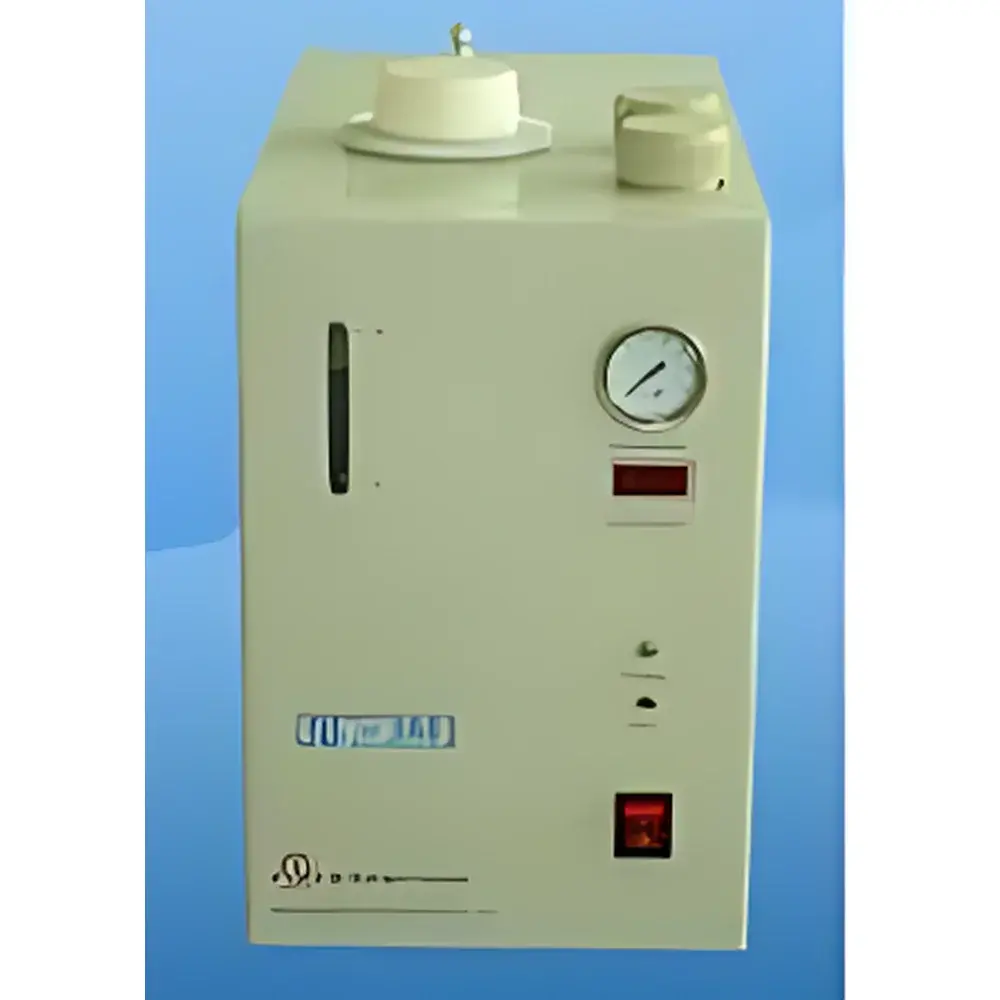
Chu Ding Technology QL-500 SPE Electrolytic High-Purity Hydrogen Generator (Pure Water Feed)
| Brand | Chu Ding Technology |
|---|---|
| Origin | Shanghai, China |
| Manufacturer Type | Authorized Distributor |
| Regional Category | Domestic (China) |
| Model | QL-500 |
| Price | USD 1,500 (FOB Shanghai) |
| Purity | >99.999% H₂ |
| Output Flow | 0–510 mL/min |
| Output Pressure | 0.02–0.4 MPa |
| Power Supply | 220 V ±15%, 50–60 Hz |
| Max. Power Consumption | 200 W |
| Dimensions (W×D×H) | 400 × 300 × 710 mm |
| Water Reservoir Volume | 3.2 L |
| Water Consumption | 24.1 g/h |
| Feed Water Resistivity Requirement | ≥1 MΩ·cm |
Overview
The Chu Ding Technology QL-500 SPE Electrolytic High-Purity Hydrogen Generator is a compact, fully automated laboratory-grade hydrogen source engineered for continuous, on-demand supply of ultra-high-purity hydrogen gas (≥99.999%) to gas chromatography (GC) systems, fuel cell test benches, and other analytical or research applications requiring clean, stable H₂. Unlike traditional alkaline electrolysis generators, the QL-500 employs solid polymer electrolyte (SPE) membrane technology—eliminating the need for caustic KOH or NaOH electrolytes. This zero-alkali design ensures corrosion-free operation, minimal maintenance, and intrinsic safety in enclosed laboratory environments. The core electrochemical process relies on proton exchange membrane (PEM) electrolysis: deionized water (resistivity ≥1 MΩ·cm) is fed into the anode chamber, where it undergoes catalytic decomposition under DC current. Oxygen evolves at the anode and is vented safely, while protons migrate through the Nafion®-type ion-conductive membrane to the cathode, where they combine with electrons to generate high-purity hydrogen gas. Integrated gas–water separation and dual-stage desiccant drying ensure consistent delivery of dry, particle-free H₂ meeting ASTM D1946 and ISO 8573-1 Class 2 compressed air purity equivalency for trace gas analysis.
Key Features
- SPE-based PEM electrolysis: No liquid electrolyte—no corrosion, no neutralization waste, no operator exposure risk
- Automated pressure and flow regulation: Maintains stable output across variable demand (0–510 mL/min) with real-time load-following response
- Intelligent thermal management: Low-cell-voltage design (<1.8 V per cell) minimizes resistive heating; electrolyzer stack operates near ambient temperature
- Self-diagnostic control system: Monitors water level, membrane hydration status, pressure integrity, and power stability; triggers audible/visual alerts and automatic shutdown on fault detection
- Modular desiccant dryer: Twin-tower configuration with color-indicating silica gel allows visual moisture saturation monitoring and extended replacement intervals (typically ≥6 months under continuous GC use)
- Compact footprint & quiet operation: 400 × 300 × 710 mm chassis fits standard lab benches; acoustic noise <45 dB(A) at 1 m
Sample Compatibility & Compliance
The QL-500 is validated for compatibility with all major GC manufacturers’ hydrogen-dependent detectors—including flame ionization (FID), thermal conductivity (TCD), and pulsed discharge helium ionization (PDHID)—and meets baseline stability requirements per ASTM D3612 (hydrocarbon analysis in insulating oils) and USP (chromatographic system suitability). It complies with IEC 61010-1:2010 for electrical safety in laboratory equipment and incorporates redundant over-pressure protection (mechanical relief valve + electronic cut-off at 0.42 MPa). While not certified to UL/CSA standards, its design adheres to GLP-relevant operational controls: full audit trail logging (via optional RS-232/USB interface), password-protected parameter settings, and non-volatile memory retention of runtime statistics (total operating hours, cumulative H₂ volume, alarm history). Feed water must conform to ASTM D1193 Type II or ISO 3696 Grade 2 specifications (resistivity ≥1 MΩ·cm at 25 °C).
Software & Data Management
The QL-500 operates autonomously without external software but supports optional PC connectivity via RS-232 or USB virtual COM port. A Windows-compatible utility (provided on secure download portal) enables remote monitoring of real-time parameters—including output pressure, flow rate, cell voltage, reservoir level, and internal temperature—as well as historical trend export in CSV format. All logged data include ISO 8601 timestamps and are stored with SHA-256 checksum integrity verification. For regulated environments, the firmware implements configurable user access levels (Operator, Technician, Administrator) and supports 21 CFR Part 11-compliant electronic signatures when paired with validated third-party LIMS platforms. Audit trails record every parameter change, login/logout event, and system reset with immutable timestamps and user ID attribution.
Applications
- Primary carrier and detector fuel gas for capillary and packed-column GC systems
- Hydrogenation reaction feed in bench-scale catalytic screening (e.g., nitroarene reduction, alkyne semi-hydrogenation)
- Calibration gas generation for hydrogen sensors (electrochemical, MOS, TCD-based)
- Blank gas supply in residual gas analyzers (RGA) and quadrupole mass spectrometers (QMS)
- On-site hydrogen source for portable FTIR gas cells requiring inert, moisture-free purge
- Replacement for high-pressure H₂ cylinders in ISO 17025-accredited testing labs seeking improved safety, traceability, and cost-per-liter economics
FAQ
What feed water quality is required for optimal performance?
Deionized water with resistivity ≥1 MΩ·cm (ASTM D1193 Type II or better) is mandatory. Tap water, distilled water without post-treatment, or low-resistivity DI water will cause rapid membrane fouling and irreversible performance loss.
Can the QL-500 be integrated into a GC auto-sampler sequence?
Yes—via TTL-level dry-contact trigger output (configurable as start/stop signal), enabling synchronized H₂ delivery with injection events in Agilent, Shimadzu, and Thermo GC platforms.
How often must the desiccant be replaced?
Under typical GC-FID usage (30 mL/min, 8 h/day), replacement is required every 5–7 months. Visual indicator beads transition from orange to green at saturation; replacement kits include pre-conditioned molecular sieve and indicating silica gel.
Is the unit suitable for Class 1 Division 1 hazardous locations?
No—the QL-500 is rated for general laboratory use only (non-explosion-proof enclosure). It must be installed in ventilated, non-classified areas per NEC Article 500.
Does the generator require annual calibration?
No flow or pressure transducers require scheduled recalibration; however, users should verify output purity annually using GC-TCD or laser-based H₂ analyzers per ISO 8573-5 Annex B protocols.
Related Products





