
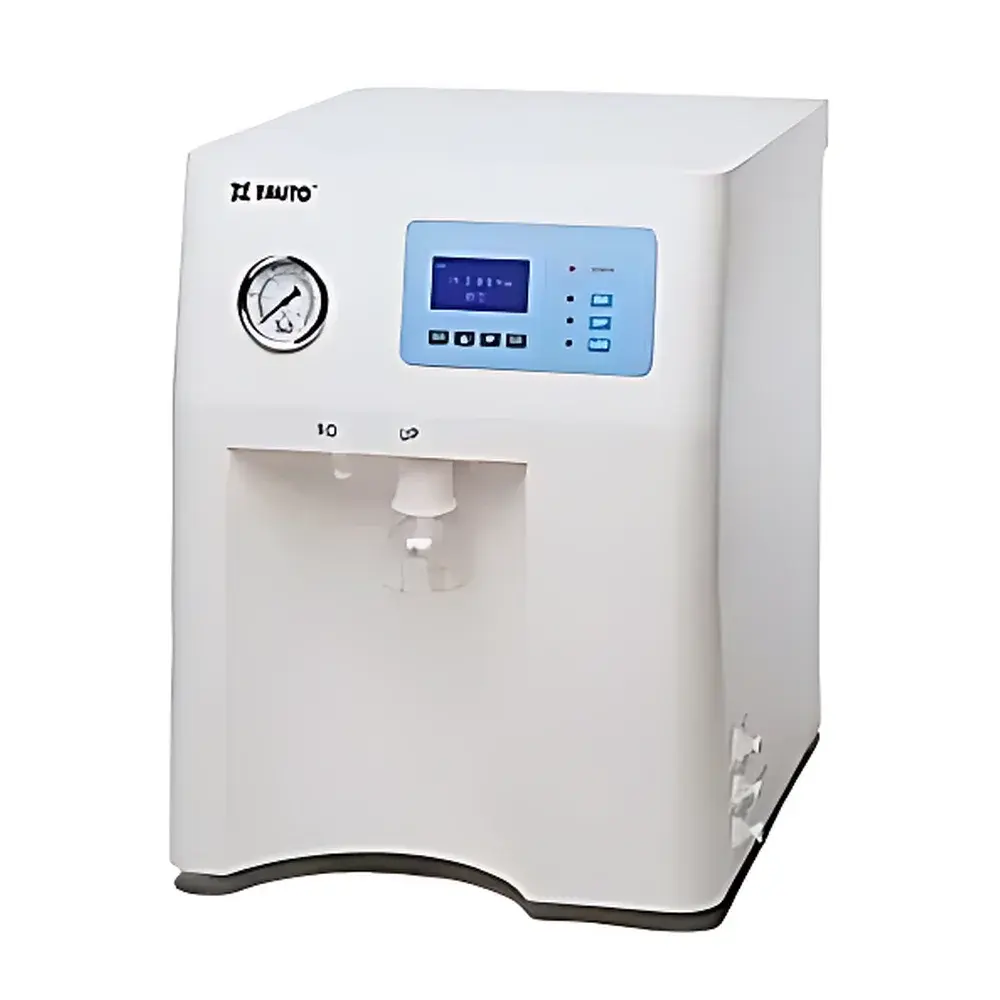
Chu Ding Technology RU-T-40 Low-TOC Ultra-Pure Water System
| Brand | Chu Ding Technology |
|---|---|
| Origin | Shanghai, China |
| Manufacturer Type | Authorized Distributor |
| Region of Manufacture | Domestic (China) |
| Model | RU-T-40 |
| Pricing | Upon Request |
| Feed Water | Municipal tap water (0.5–4.0 bar) |
| Power Supply | AC 220 V / 50 Hz |
| Pure Water Flow Rate (25 °C) | 40 L/h |
| Instantaneous Dispense Rate | ≥2.0 L/min |
| RO Pure Water Conductivity | 1–5 µS/cm |
| UP Ultra-Pure Water Resistivity | 18.2 MΩ·cm |
| TOC | <5 ppb |
| Particles (>0.2 µm) | <1 particle/mL |
| Microbial Count | <1 CFU/mL |
| Total Silica | <1.0 µg/L |
| Dimensions (L×W×H) | 400 × 460 × 500 mm |
| Operating Temperature | 0–45 °C |
| Relative Humidity | ≤85% RH |
| Compliance | GB/T 6682–1992 (Grade I), GB/T 11446.1–1997 (Electronic Grade I) |
Overview
The Chu Ding Technology RU-T-40 Low-TOC Ultra-Pure Water System is an integrated dual-stage laboratory water purification platform engineered for applications demanding ultra-low organic contamination, microbial integrity, and particle-free output. It employs a multi-stage purification architecture combining pretreatment, reverse osmosis (RO), electrodeionization (EDI) or mixed-bed deionization, dual-wavelength ultraviolet (UV) oxidation (185 nm + 254 nm), and terminal 0.2 µm sterile filtration. The system is designed to convert municipal tap water directly into two distinct quality streams: Type III pure water (conductivity 1–5 µS/cm, per GB/T 6682–1992) and Type I ultra-pure water (resistivity ≥18.2 MΩ·cm at 25 °C, TOC <5 ppb, <1 CFU/mL, 0.2 µm, endotoxin <0.001 EU/mL). Its core innovation lies in the integration of a U.S.-sourced dual-UV TOC destruction module and a German-manufactured terminal sterilizing filter—features that collectively reduce total organic carbon to sub-5-ppb levels and eliminate viable microorganisms without chemical sanitization.
Key Features
- Dual-wavelength UV oxidation (185 nm + 254 nm) for catalytic mineralization of non-volatile organic compounds, ensuring consistent TOC reduction to <5 ppb in ultra-pure water output
- Terminal 0.2 µm hydrophilic polyethersulfone (PES) sterilizing filter, certified for bacterial retention (log reduction value ≥7), validated to deliver microbiologically sterile effluent (<1 CFU/mL)
- Integrated particle removal stage targeting colloids and sub-micron particulates, verified to maintain particle counts below 1 particle/mL for particles >0.2 µm
- Real-time resistivity and TOC monitoring with data logging capability; optional analog/digital output interfaces for integration into centralized lab monitoring systems
- Modular cartridge design enabling rapid replacement of RO membranes, ion exchange resins, and UV lamps with minimal downtime and traceable service history
- Touchscreen HMI with multilingual UI (English default), password-protected user/admin modes, and configurable alarm thresholds for conductivity, pressure, and flow anomalies
Sample Compatibility & Compliance
The RU-T-40 is validated for continuous production of water meeting or exceeding national and international specifications for analytical and life science applications. Its ultra-pure water output complies with GB/T 6682–1992 (Grade I), GB/T 11446.1–1997 (Electronic Grade I), and aligns with ASTM D1193–2020 (Type I) for resistivity and particle limits. While not inherently FDA 21 CFR Part 11 compliant out-of-the-box, the system supports audit-trail-enabled software upgrades and electronic signature modules for GLP/GMP-regulated environments. All wetted materials—including stainless steel 316L housings, PTFE tubing, and pharmaceutical-grade elastomers—meet USP Class VI biocompatibility requirements. The system is routinely deployed in laboratories requiring ISO/IEC 17025-accredited water validation protocols and supports IQ/OQ/PQ documentation packages upon request.
Software & Data Management
The embedded control firmware records timestamped operational parameters—including feed pressure, RO rejection rate, UP resistivity, TOC concentration, UV lamp intensity, and filter service intervals—at 1-minute resolution. Data export is supported via USB 2.0 or RS-485 Modbus RTU protocol for integration with LIMS or SCADA platforms. Optional cloud-based remote monitoring (via secure TLS 1.2 connection) enables real-time alerts for parameter excursions, consumable exhaustion, or maintenance scheduling. All stored data are write-protected and include immutable metadata (operator ID, event type, system clock hash), satisfying traceability requirements under ISO/IEC 17025 Clause 7.7 and EU Annex 11 principles for computerized systems.
Applications
This system serves as a primary water source for high-sensitivity analytical instrumentation where background interference must be minimized. Typical use cases include mobile phase preparation and instrument rinsing for HPLC, UHPLC, GC-MS, LC-MS/MS, and ICP-MS; calibration standard dilution in trace metal analysis; reagent preparation for ELISA, PCR, and cell culture media; final rinse water for semiconductor wafer cleaning and optical component fabrication; and feed water for TOC analyzers requiring ultra-low blank contribution. Its sub-5-ppb TOC performance makes it particularly suitable for UV-Vis spectroscopy below 220 nm, fluorescence detection, and low-background radiochemical assays.
FAQ
What is the maximum allowable feed water hardness for stable RO membrane operation?
Feed water hardness should not exceed 200 ppm CaCO₃ equivalent; pre-treatment with softening or antiscalant dosing is recommended for harder sources.
Can the RU-T-40 be connected to a central purified water loop?
Yes—its recirculation-ready design includes a dedicated return port and variable-speed booster pump compatible with closed-loop distribution systems up to 50 m head.
How often must the dual-UV lamp assembly be replaced?
Lamp lifetime is rated at 9,000 hours under continuous operation; system firmware tracks cumulative UV exposure and triggers maintenance alerts at 8,500 hours.
Is third-party certification available for TOC performance verification?
Chu Ding Technology provides factory-issued test reports per ISO 8573-1:2010 Annex B; independent certification by accredited labs (e.g., SGS, TÜV) is available upon order specification.
Does the system support automated sanitization cycles?
No built-in thermal or ozone sanitization is included; however, the modular design permits integration of external hot water or ozone generators via dry-contact relay outputs.



