
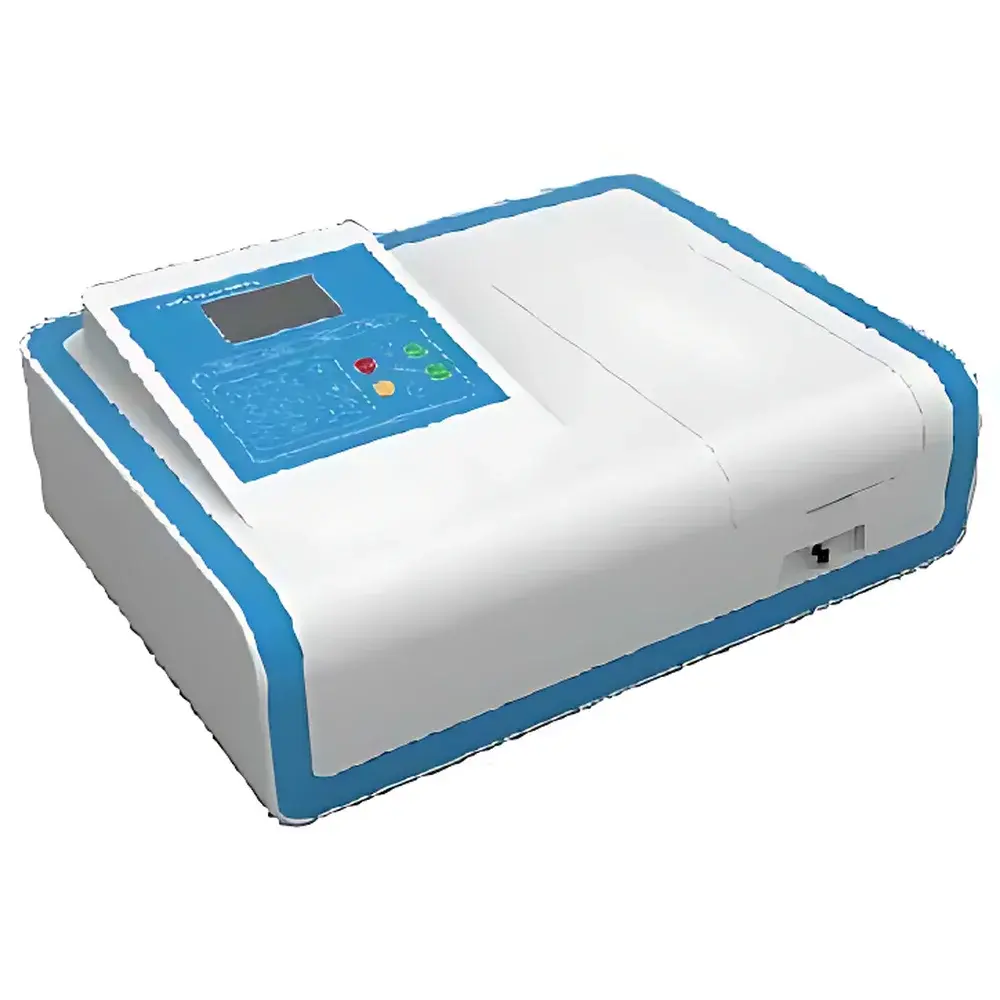
Chu Ding Technology UV759CRT UV-Vis Spectrophotometer
| Brand | Chu Ding Technology |
|---|---|
| Origin | Shanghai, China |
| Model | UV759CRT / UV759 |
| Wavelength Range | 190–1100 nm |
| Spectral Bandwidth | 1.8 nm |
| Wavelength Accuracy | ±0.3 nm |
| Wavelength Repeatability | ≤0.2 nm |
| Photometric Accuracy | ±0.3% T (0–100% T), ±0.002 A (0–0.5 A), ±0.004 A (0.5–1 A) |
| Photometric Repeatability | ≤0.2% T (0–100% T), ±0.001 A (0–0.5 A), ±0.002 A (0.5–1 A) |
| Stray Light | ≤0.05% T @ 220 nm and 360 nm |
| Baseline Flatness | ±0.002 A |
| Drift | ±0.002 A/h @ 500 nm |
| Noise | ±0.001 A |
| Detector | Imported silicon photodiode |
| Light Sources | Long-life imported deuterium lamp and tungsten-halogen lamp |
| Display | 128 × 64 dot-matrix LCD |
| Measurement Modes | Transmittance (T), Absorbance (A), Concentration (C) |
| Wavelength Setting | Automatic |
| Optical Path | Single-beam with automatic source switching |
| Data Interface | USB port |
| Print Interface | Parallel port |
| Power Supply | AC 220 V / 50 Hz or AC 110 V / 60 Hz |
| Net Weight | 14 kg |
Overview
The Chu Ding Technology UV759CRT UV-Vis Spectrophotometer is a single-beam, microprocessor-controlled analytical instrument engineered for routine quantitative analysis and method development across academic, industrial, and quality control laboratories. It operates on the fundamental principle of Beer–Lambert law-based absorption spectroscopy, measuring the attenuation of ultraviolet and visible light as it passes through a sample solution in a quartz or glass cuvette. With a spectral coverage from 190 nm to 1100 nm—spanning deep UV through near-infrared—the instrument supports applications ranging from nucleic acid and protein quantification at 260/280 nm to colorimetric assays (e.g., Bradford, BCA), pharmaceutical dissolution testing, and environmental contaminant screening (e.g., nitrate, phosphate, heavy metal complexes). Its 1.8 nm spectral bandwidth ensures sufficient resolution for most standard absorbance measurements while maintaining signal-to-noise performance suitable for routine QC environments. The optical architecture integrates a high-efficiency 1200 lines/mm holographic grating, precision stepper-motor-driven monochromator, and dual-source management (automated deuterium/tungsten lamp switching), enabling stable, low-drift operation over extended acquisition periods.
Key Features
- Automated wavelength calibration and lamp selection—eliminates manual intervention and reduces operator-induced error
- 128 × 64 dot-matrix LCD display with real-time graphical rendering of spectra, standard curves, and numerical results
- Onboard data storage capacity for up to 200 measurement sets and 100 user-named calibration curves
- Integrated USB interface compliant with USB 2.0 standards for direct data export to Windows-based PCs without proprietary drivers
- Optimized optical path design accommodating cuvettes from 5 mm to 100 mm pathlength—including semi-micro, standard, and long-path cells
- Robust mechanical construction with thermally stabilized lamp housing and shock-absorbing base to minimize vibrational artifacts
- Self-diagnostic startup sequence verifying lamp status, monochromator positioning, and detector linearity prior to measurement
Sample Compatibility & Compliance
The UV759CRT accommodates standard 10 mm square cuvettes (quartz, fused silica, or optical-grade glass), as well as rectangular cells with pathlengths from 5 mm to 100 mm—enabling both high-sensitivity trace analysis and low-absorbance dilute solutions. It supports liquid-phase measurements only; solid or turbid samples require filtration or centrifugation prior to analysis. While not certified to ISO/IEC 17025 or ASTM E275 for metrological traceability out-of-the-box, its performance specifications align with key requirements of ASTM E387 (spectrophotometer verification), USP (UV-Vis spectrophotometric analysis), and ISO 6059 (water quality—determination of nitrate by UV spectrophotometry). When operated under documented SOPs with regular verification using NIST-traceable reference materials (e.g., potassium dichromate in 0.005 M H₂SO₄), the instrument meets GLP and basic GMP data integrity expectations for non-regulated research and internal QC use.
Software & Data Management
The optional YOKE3.0 Professional Analysis Software provides a Windows-native platform supporting full instrument control, kinetic time-scan acquisition, multi-wavelength quantitation, and multi-point standard curve generation with linear, quadratic, or cubic regression models. All operations—including curve naming, sample ID entry, and result export—are timestamped and logged locally. While YOKE3.0 does not implement FDA 21 CFR Part 11-compliant electronic signatures or audit trail encryption by default, raw data files (.txt, .csv) retain complete metadata (wavelength, absorbance, date/time, operator ID if entered), facilitating retrospective review and integration into LIMS or ELN systems via standardized import protocols. Instrument firmware supports firmware updates via USB memory stick, ensuring long-term compatibility with evolving software releases.
Applications
- Quantitative determination of biomolecules (DNA, RNA, proteins) using extinction coefficients at defined wavelengths
- Pharmaceutical assay validation per USP chapters and , including content uniformity and dissolution profile analysis
- Environmental monitoring: detection of NO₃⁻ (220 nm), NO₂⁻ (540 nm), Cr(VI) (540 nm), and organic dyes in wastewater
- Food & beverage quality control: measurement of anthocyanins, carotenoids, and preservative concentrations (e.g., sulfites)
- Chemical kinetics studies via time-resolved absorbance tracking at fixed or scanned wavelengths
- Educational laboratory instruction for teaching spectroscopic theory, calibration methodology, and analytical uncertainty propagation
FAQ
Is the UV759CRT compliant with FDA 21 CFR Part 11?
No—the instrument and its YOKE3.0 software do not provide electronic signature capability, role-based access control, or immutable audit trails required for Part 11 compliance. It is suitable for research and internal QC but not for regulated submissions.
Can I use quartz cuvettes below 200 nm?
Yes—fused silica or synthetic quartz cuvettes are required for measurements between 190–200 nm; standard optical glass absorbs strongly below ~350 nm.
What is the typical warm-up time before achieving photometric stability?
Deuterium lamp stabilization requires approximately 20–30 minutes; tungsten lamp reaches thermal equilibrium within 5–10 minutes. Drift specification (±0.002 A/h) assumes pre-warmed operation.
Does the instrument support RS-232 or Ethernet connectivity?
No—only USB 2.0 and parallel printer ports are provided. No network interface is available in this model.
How often should wavelength accuracy be verified?
Per ASTM E275, verification using holmium oxide or didymium filters is recommended before each analytical session or at least daily when used for regulatory testing.



