
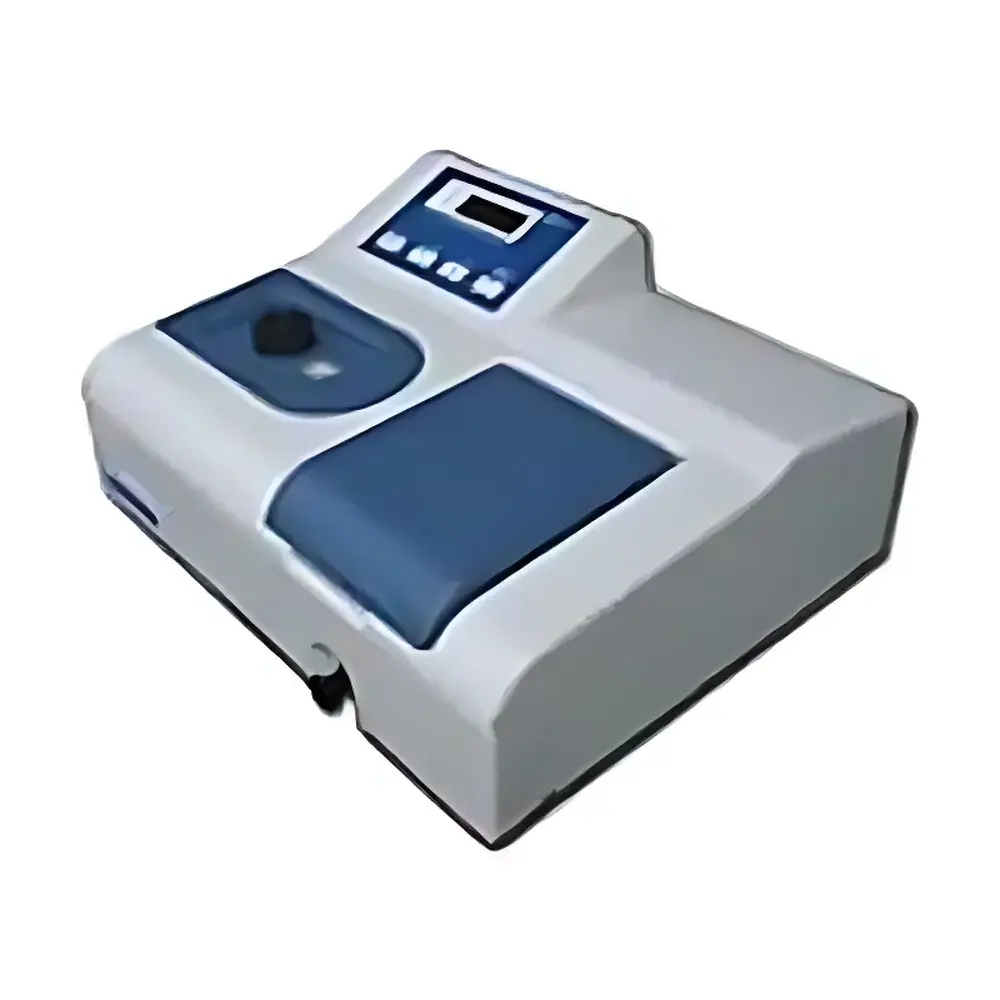
Chu Ding UV752 Advanced UV-Vis Spectrophotometer
| Key | Optical System: Czerny-Turner monochromator with 1200 lines/mm grating |
|---|---|
| Wavelength Range | 195–1020 nm |
| Spectral Bandwidth | 5 nm |
| Wavelength Accuracy | ±2 nm |
| Wavelength Repeatability | ±1.0 nm |
| Photometric Range | 0–199.0% T, 0–1.999 A, 0–1999 C |
| Photometric Accuracy | ±0.5% T |
| Photometric Repeatability | ±0.3% T |
| Stray Light | ≤0.3% T at 220 nm |
| Baseline Stability | ±0.004 A/h at 500 nm (after 60-min warm-up) |
| Display | 4-digit LCD |
| Output Interface | RS-232C |
| Light Sources | 6 V / 10 W halogen lamp and deuterium lamp |
| Power Supply | 110–220 V AC, 50–60 Hz |
| Standard Cuvette Pathlength | 10 mm (100 mm optional) |
Overview
The Chu Ding UV752 Advanced UV-Vis Spectrophotometer is a single-beam, fixed-slit spectrophotometric instrument engineered for routine quantitative and qualitative analysis in regulated and research laboratory environments. It operates on the principle of Beer-Lambert law-based absorbance measurement across the ultraviolet and visible spectral regions (195–1020 nm), utilizing a Czerny-Turner optical architecture with a 1200 lines/mm holographic grating for reliable wavelength dispersion. Designed for robustness and operational consistency, the system integrates dual light sources — a long-life deuterium lamp for UV output (195–350 nm) and a precision halogen lamp for visible and near-IR coverage (350–1020 nm) — enabling broad-spectrum applications without manual lamp switching. Its 5 nm spectral bandwidth ensures adequate resolution for standard pharmaceutical assays, water quality testing, enzyme kinetics, and dye concentration determinations while maintaining high signal-to-noise ratio under ambient lab conditions.
Key Features
- Optically stable Czerny-Turner monochromator with 1200 lines/mm grating for consistent spectral fidelity and minimal drift over extended operation.
- Dual-source illumination system: imported deuterium lamp (UV) and PHILIPS 6 V / 10 W halogen lamp (VIS-NIR), both rated for extended service life and low-output fluctuation.
- High-precision wavelength calibration traceable to NIST-traceable standards; factory-aligned accuracy of ±2 nm with repeatability within ±1.0 nm.
- Photometric performance validated per ISO 8579 and ASTM E275: ±0.5% T accuracy and ±0.3% T repeatability across 0–199.0% transmittance range.
- Low stray light design (<0.3% T at 220 nm) minimizes spectral interference in high-absorbance measurements (e.g., nucleic acid quantification at 260 nm).
- Thermally stabilized optical bench and pre-warmed lamp housing contribute to baseline stability of ±0.004 A/h at 500 nm after one hour of thermal equilibration.
- RS-232C serial interface enables direct connection to external PCs or LIMS for automated data capture and report generation.
Sample Compatibility & Compliance
The UV752 accommodates standard 10 mm square quartz or glass cuvettes (pathlength: 10 mm); optional 100 mm pathlength cells are available for low-concentration samples in industrial settings such as sugar refining or metallurgical process control. All optical components comply with RoHS Directive 2011/65/EU. The instrument meets essential requirements of IEC 61010-1 for electrical safety and electromagnetic compatibility (EMC Class B). While not inherently 21 CFR Part 11 compliant, its RS-232 output supports integration with validated third-party software platforms that provide audit trails, electronic signatures, and user access controls required under GLP and GMP frameworks. Routine verification protocols align with USP and EP 2.2.25 for spectrophotometer qualification.
Software & Data Management
The UV752 operates in standalone mode via its integrated 4-digit LCD display and membrane keypad, supporting direct %T, A, and concentration (C) readouts. When connected to a host PC via RS-232C, it interfaces with industry-standard terminal emulation or custom-developed acquisition software. Data export is supported in ASCII-delimited format (.csv or .txt), facilitating import into Excel, MATLAB, or LIMS databases. No proprietary driver installation is required — standard Windows COM port configuration suffices. For laboratories requiring full compliance documentation, optional IQ/OQ/PQ validation packages are available upon request, including test scripts, acceptance criteria, and raw data templates aligned with ISO/IEC 17025 and FDA guidance.
Applications
This spectrophotometer serves as a foundational analytical tool across multiple regulated sectors. In pharmaceutical QC labs, it performs assay validation, dissolution testing, and excipient purity checks per USP chapters , , and . Clinical laboratories use it for serum bilirubin, total protein, and creatinine assays following CLIA and CAP guidelines. Environmental labs apply it to COD, nitrate, phosphate, and heavy metal speciation (e.g., Cr(VI) by diphenylcarbazide method). Food safety applications include detection of Sudan dyes, melamine, and pesticide residues using AOAC-approved colorimetric protocols. Additional use cases span polymer degradation studies, photocatalyst characterization, and educational curricula in analytical chemistry and instrumentation courses.
FAQ
What is the recommended warm-up time before measurement?
A minimum 60-minute warm-up period is required to achieve thermal equilibrium and ensure photometric stability within ±0.004 A/h.
Can the UV752 be used for kinetic measurements?
No — it lacks time-scan or multi-wavelength kinetic acquisition capability; it is optimized for endpoint absorbance or transmittance readings.
Is a 100 mm cuvette holder included by default?
No — the standard configuration supports only 10 mm pathlength cells; the 100 mm adapter is an optional accessory for specialized low-absorbance applications.
Does the instrument support wavelength scanning?
No — the UV752 is a fixed-wavelength or manually tuned single-point instrument; continuous scanning requires models such as the UV756CRT or UV1900 series.
How often should wavelength and photometric calibration be performed?
Wavelength calibration should be verified quarterly using holmium oxide or didymium filters; photometric calibration is recommended before each analytical session using neutral density filters or certified reference materials.





