
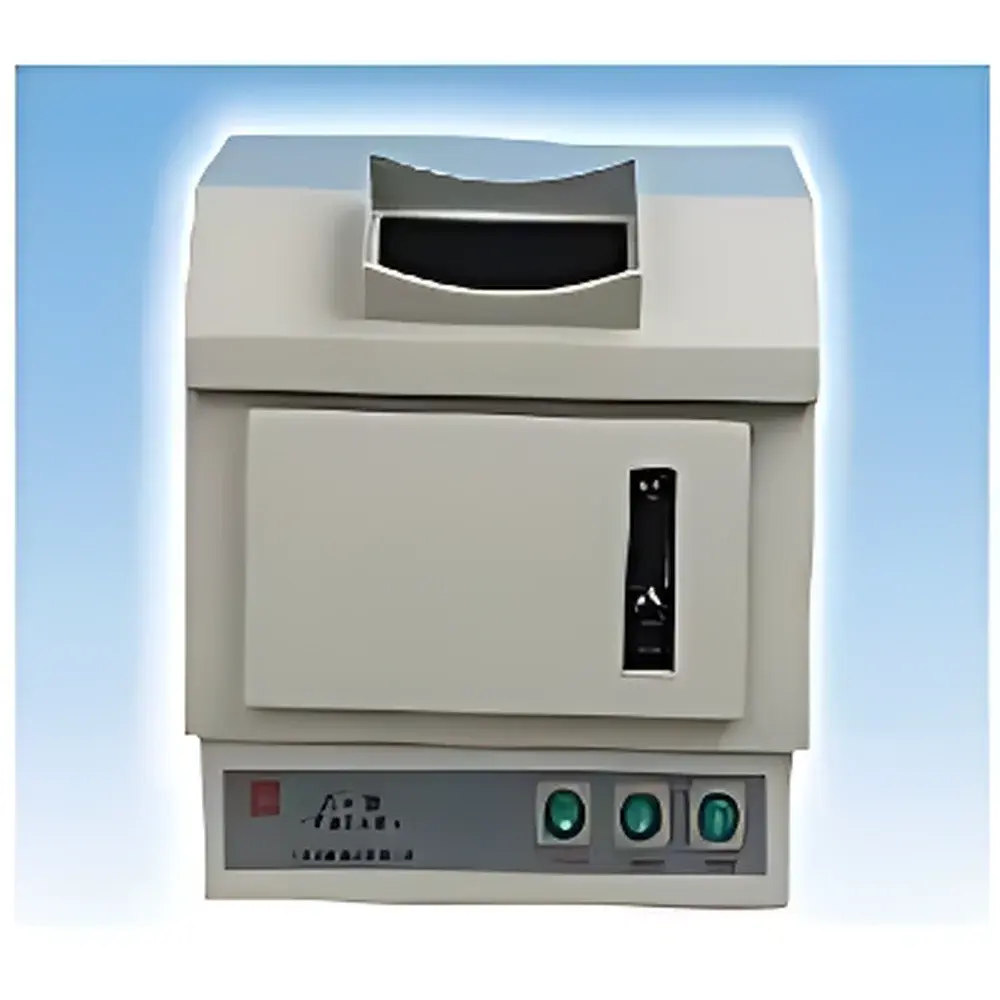
Chu Ding ZF-7 Darkroom-Style Tri-Wavelength UV Transilluminator
| Brand | Chu Ding |
|---|---|
| Model | ZF-7 |
| UV Wavelengths | 254 nm & 365 nm |
| Optional UV | 302 nm |
| Visible Light | Yes |
| UV Power | 6 W (each band) |
| Visible Light Power | 4 W |
| Filter Glass Size | 200 × 50 mm |
| Dimensions (L×W×H) | 310 × 220 × 300 mm |
| Input | AC 220 V ±10%, 50 Hz |
| Compliance | CE-marked design principles, GLP-aligned operational architecture |
Overview
The Chu Ding ZF-7 Darkroom-Style Tri-Wavelength UV Transilluminator is a benchtop analytical instrument engineered for reliable, ambient-light-independent visualization and documentation of fluorescently labeled biomolecules and chemical compounds. It operates on the principle of ultraviolet-induced fluorescence excitation—where nucleic acids (e.g., ethidium bromide–stained DNA/RNA), proteins, metabolites, or synthetic fluorophores absorb UV photons at discrete wavelengths (254 nm and 365 nm) and re-emit visible light—enabling qualitative detection and spatial localization within gels, TLC plates, or blot membranes. Unlike open-frame transilluminators requiring dedicated darkrooms, the ZF-7 integrates a fully enclosed, light-tight observation chamber with integrated UV shielding. Its front-facing viewing window incorporates specialized UV-blocking glass that attenuates >95% of incident 254 nm and 365 nm radiation, ensuring operator safety during real-time gel inspection, band excision, or sample documentation without external enclosures or PPE beyond standard lab gloves.
Key Features
- Triple illumination modes: independently switchable short-wave UV (254 nm), long-wave UV (365 nm), and white visible light—optimized for diverse fluorophore excitation profiles and visual contrast enhancement.
- Integrated darkroom enclosure: eliminates need for external blackout curtains or dedicated darkroom facilities; enables consistent imaging conditions across varying ambient lighting environments.
- High-stability UV output: dual 6 W UV lamps (254 nm and 365 nm) with thermally stabilized ballasts ensure uniform irradiance distribution across the 200 × 50 mm filter area—critical for reproducible band intensity assessment and quantitative comparison.
- Optical-grade UV-transmission filter glass: precisely cut and coated to maximize spectral transmission at target wavelengths while suppressing stray light and harmonic emissions.
- Ergonomic design: compact footprint (310 × 220 × 300 mm) with front-accessible sample stage and hinged lid facilitates rapid loading/unloading of gels, TLC plates, or Petri dishes.
- Compliance-ready construction: electrical design conforms to IEC 61010-1 safety standards; mechanical layout supports integration into GLP- and ISO/IEC 17025-aligned laboratory workflows.
Sample Compatibility & Compliance
The ZF-7 accommodates standard electrophoretic formats including agarose and polyacrylamide gels (up to 15 cm × 15 cm), silica gel or aluminum-backed TLC plates (up to 20 × 20 cm), and nitrocellulose or PVDF membranes post-transfer. Its 254 nm mode provides high-sensitivity detection of nucleic acids stained with ethidium bromide, SYBR Safe, GelRed, or similar intercalating dyes. The 365 nm mode is ideal for native fluorescence applications—including tryptophan-containing proteins, chlorophyll, riboflavin, and many pharmaceutical intermediates—without inducing significant photodamage. Optional 302 nm configuration (upon request) extends compatibility with UV-sensitive dyes such as DAPI and Hoechst derivatives. All operational parameters align with common regulatory expectations for analytical instrumentation used in QC/QA laboratories, including traceable lamp calibration intervals, documented exposure time protocols, and adherence to ASTM D7213 (for UV-based forensic document examination) and USP (fluorescence detection guidelines).
Software & Data Management
While the ZF-7 operates as a standalone hardware platform without embedded digital imaging, its optical design is fully compatible with third-party documentation systems—including USB-connected scientific CMOS cameras, DSLRs equipped with UV-pass filters, and dedicated gel documentation stations. The uniform illumination field and stable spectral output support consistent image acquisition across sessions, enabling semi-quantitative densitometry when paired with validated software (e.g., ImageLab, Quantity One, or open-source tools like Fiji/ImageJ). Audit trails for exposure settings, lamp usage hours, and maintenance logs can be maintained externally in accordance with FDA 21 CFR Part 11 requirements when integrated into validated laboratory information management systems (LIMS).
Applications
- Molecular biology: visualization and excision of DNA/RNA bands from agarose and PAGE gels; verification of PCR product size and purity; monitoring of restriction digests and ligation efficiency.
- Pharmaceutical quality control: thin-layer chromatography (TLC) analysis of active pharmaceutical ingredients (APIs), degradation products, and excipients; identity testing of fluorescent-labeled reference standards per USP monographs.
- Forensic science: detection of latent biological fluids (e.g., semen, saliva) on fabrics or surfaces using alternative light source (ALS) principles; examination of counterfeit currency, documents, and security inks.
- Food safety testing: screening for mycotoxins (e.g., aflatoxin B1), food adulterants, and fluorescent additives in raw and processed commodities.
- Materials science: characterization of fluorescent polymers, quantum dots, and nanomaterials under controlled UV excitation; evaluation of UV stability in coatings and packaging films.
FAQ
Is the ZF-7 compliant with international electrical safety standards?
Yes—the instrument follows IEC 61010-1 design principles for laboratory electrical equipment, including reinforced insulation, overcurrent protection, and grounded chassis construction.
Can the 254 nm and 365 nm lamps be operated simultaneously?
No—lamp selection is manual and mutually exclusive to prevent spectral interference and thermal overload; users select one mode at a time via front-panel toggle switches.
What is the expected service life of the UV lamps?
Typical rated lifetime is 1,000–1,500 hours under continuous operation; lamp output decay should be monitored periodically using a calibrated UV radiometer to maintain detection sensitivity.
Does the unit include a camera or imaging system?
No—the ZF-7 is a pure illumination platform; digital capture requires external camera systems with appropriate UV-transmissive optics and filters.
Is ozone generation a concern during operation?
Minimal—254 nm UV lamps in this configuration operate below the 185 nm threshold required for significant ozone production; no ventilation ducting is required under normal use conditions.





