
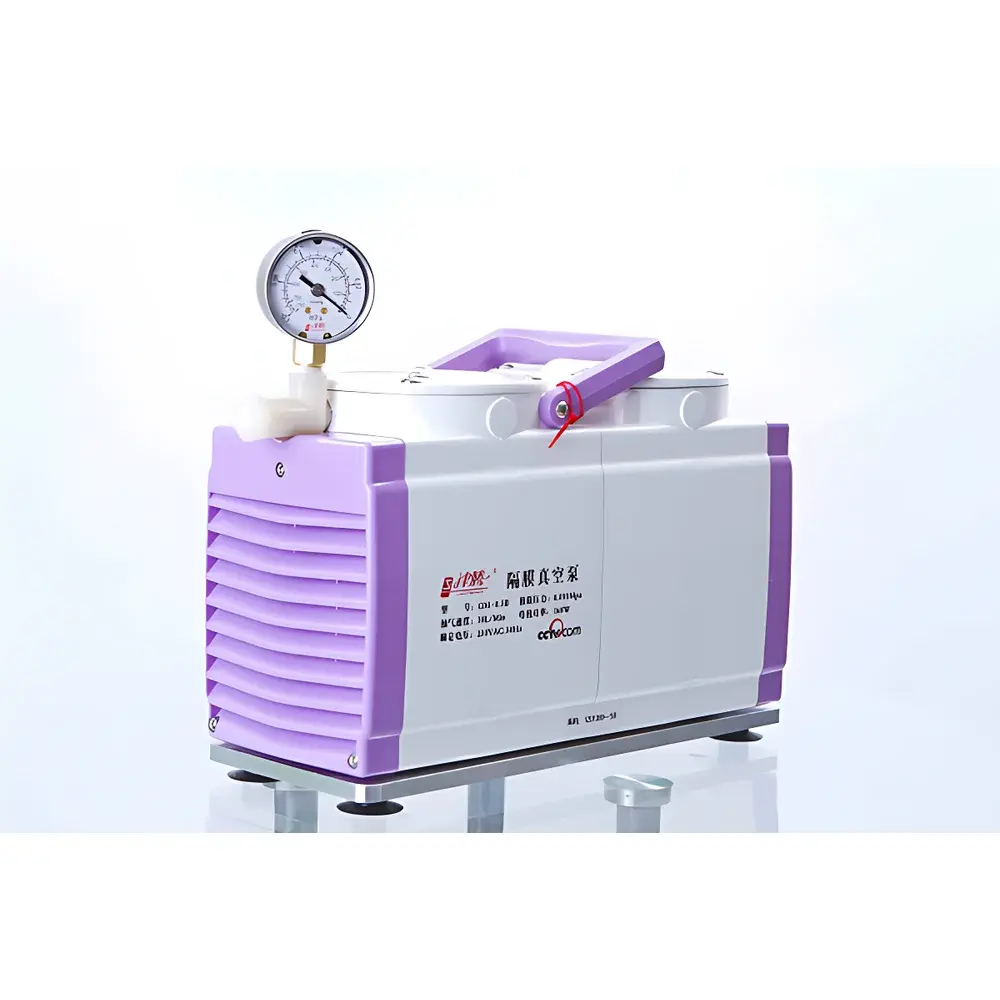
Chunding GM-0.5B Dual-Head Oil-Free Diaphragm Vacuum Pump
| Brand | Chunding |
|---|---|
| Origin | Shanghai, China |
| Pump Type | Diaphragm Vacuum Pump |
| Drive Type | Oil-Free |
| Motor Power | 160 W |
| Ultimate Vacuum | ≤ 50 mbar (≤ 0.095 MPa) |
| Flow Rate | 30 L/min |
| Noise Level | < 50 dB(A) |
| Operating Temperature Range | 7–40 °C |
| Pump Head Configuration | Dual-Head Negative Pressure |
| Inlet/Outlet Port Diameter | Ø6 mm |
| Dimensions (L×W×H) | 300 × 120 × 235 mm |
| Weight | 10 kg |
| Pump Body Material | Aluminum Alloy with Corrosion-Resistant Coating |
| Max. Continuous Duty | 24 h |
| Ambient Humidity | ≤ 80% RH (non-condensing) |
Overview
The Chunding GM-0.5B Dual-Head Oil-Free Diaphragm Vacuum Pump is engineered for precision vacuum generation in analytical and preparative laboratory workflows where contamination-free operation is non-negotiable. Unlike oil-lubricated rotary vane pumps, this unit operates on a dry, positive-displacement principle: two synchronized elastomeric diaphragms oscillate within sealed chambers, alternately expanding and contracting to draw in and expel gas without mechanical contact or lubricant involvement. This eliminates hydrocarbon vapor backstreaming, oil mist carryover, and maintenance-related downtime—critical advantages when interfacing with sensitive instrumentation such as HPLC, GC, and LC-MS systems. Designed specifically to meet the stringent vacuum stability and cleanliness requirements of chromatographic sample preparation, the GM-0.5B delivers consistent ultimate vacuum performance at ≤ 50 mbar while maintaining thermal stability (<55 °C pump body temperature) under continuous load.
Key Features
- Dual-head architecture enables enhanced flow redundancy and improved pressure regulation linearity across variable load conditions.
- Oil-free operation ensures zero risk of sample or instrument contamination—fully compliant with ISO 8573-1 Class 0 air purity requirements for critical vacuum applications.
- Aluminum alloy housing with electrophoretic corrosion-resistant coating provides structural rigidity, thermal dissipation efficiency, and compatibility with organic solvents and mild acids commonly used in SPE and filtration protocols.
- Adjustable vacuum pressure control via integrated bypass valve allows fine-tuning between ~50–500 mbar—ideal for gradient-sensitive filtration (e.g., membrane-based protein concentration) and controlled solvent evaporation.
- Low-noise design (<50 dB[A] at 1 m) supports integration into shared lab spaces, cleanrooms, and QA/QC environments where acoustic emissions are regulated per ISO 7779 and ANSI S12.55 standards.
- 24-hour continuous duty rating validated under ambient temperatures from 7–40 °C and relative humidity ≤80% (non-condensing), meeting IEC 61000-6-3 EMC emission limits.
Sample Compatibility & Compliance
The GM-0.5B is routinely deployed in workflows requiring inert, particle-free vacuum sources—including but not limited to solid-phase extraction (SPE), vacuum-assisted filtration (e.g., 0.22 µm PVDF membranes), mobile phase degassing, and lyophilizer primary condenser evacuation. Its chemically resistant diaphragm material (EPDM or FKM, depending on configuration) maintains integrity against common HPLC solvents (acetonitrile, methanol, aqueous buffers), dilute acids/bases, and ethanol-based extracts. The pump conforms to GB/T 26571–2011 (Chinese national standard for diaphragm vacuum pumps) and meets functional equivalency benchmarks referenced in ASTM D3924 (vacuum system performance for analytical chemistry) and USP (analytical instrument qualification). No internal lubricants or seals require replacement during normal service intervals, supporting GLP-compliant audit trails and reducing total cost of ownership.
Software & Data Management
While the GM-0.5B is a standalone analog device with manual pressure adjustment, its operational parameters are fully documentable within laboratory information management systems (LIMS) and electronic lab notebooks (ELN). Vacuum output stability can be monitored externally using calibrated digital pressure transducers (e.g., Validyne DP15 or MKS Baratron series), enabling integration into 21 CFR Part 11–compliant validation packages. Optional analog voltage output (0–5 V DC proportional to vacuum level) is available upon request for third-party data acquisition systems. All units ship with CE-marked power supplies, RoHS-compliant PCBs, and traceable serial-numbered calibration records aligned with ISO/IEC 17025 metrological guidelines.
Applications
- HPLC and UHPLC mobile phase degassing prior to column injection to prevent bubble formation and baseline noise.
- High-throughput SPE cartridge manifold evacuation for pesticide residue analysis (AOAC 2007.01), pharmaceutical impurity profiling (ICH Q5C), and forensic toxicology screening.
- Vacuum filtration of cell lysates, antibody-containing supernatants, and nanoparticle suspensions where endotoxin-free vacuum is mandated (USP ).
- Support vacuum drying of hygroscopic reference standards and certified reference materials (CRMs) under controlled dew point conditions.
- Primary vacuum source for benchtop freeze dryers in academic proteomics labs performing gel-based protein fractionation.
FAQ
Is the GM-0.5B compatible with aggressive solvents such as chloroform or THF?
Yes—when equipped with FKM diaphragms (standard on export-configured units), it demonstrates acceptable resistance to halogenated and ether-based solvents per ASTM D1418 elastomer compatibility guidelines. Prolonged exposure requires inline cold traps and solvent recovery scrubbers.
Can this pump be used for vacuum distillation?
It is not recommended for high-vacuum distillation (i.e., <1 mbar), as its ultimate vacuum limit is 50 mbar. It is suitable for rough vacuum applications such as rotary evaporation pre-concentration or solvent removal from heat-labile compounds.
Does the dual-head design improve ultimate vacuum or only flow rate?
The dual-head configuration primarily enhances volumetric throughput and pressure stability under dynamic load changes; ultimate vacuum is governed by single-stage diaphragm geometry and valve timing—not head count.
What maintenance is required over a 5-year service life?
Diaphragm replacement every 12–18 months under continuous operation; inlet filter cleaning every 3 months; no oil changes, bearing greasing, or seal replacements are necessary.
Is there a CE Declaration of Conformity available for EU shipment?
Yes—each unit ships with a manufacturer-issued DoC referencing EN 61000-6-2 (immunity) and EN 61000-6-3 (emissions), plus Machinery Directive 2006/42/EC compliance documentation.



