
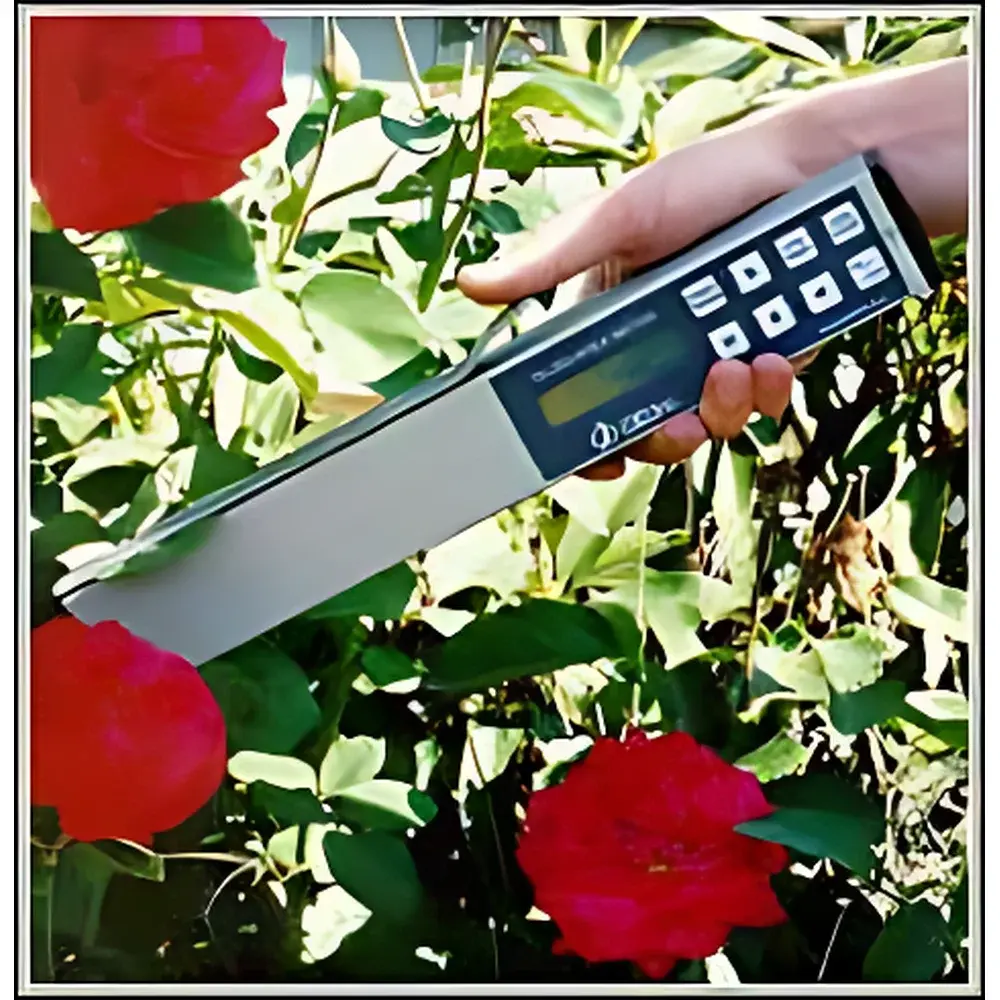
CI-203 Handheld Laser Leaf Area Meter
| Origin | USA |
|---|---|
| Manufacturer Type | Authorized Distributor |
| Origin Category | Imported |
| Model | CI-203 |
| Pricing | Upon Request |
Overview
The CI-203 Handheld Laser Leaf Area Meter is a field-deployable, precision optical instrument engineered for non-destructive, real-time quantification of leaf morphometric parameters in plant physiology and ecological research. Operating on the principle of laser line-scanning triangulation, the device projects a collimated 650 nm red laser beam across the leaf surface while a high-resolution linear photodiode array captures reflected intensity profiles. Through proprietary edge-detection algorithms and pixel-to-metric calibration, it computes six biologically relevant metrics—leaf area, length, width, perimeter, length-to-width ratio, and shape factor—without physical contact or tissue excision. Its integrated architecture consolidates laser optics, signal processing unit, 64 KB flash memory, dual-line LCD display, and rechargeable NiCd battery into a single ergonomic housing (355 × 45 × 50 mm, 1.0 kg), enabling rapid measurements under variable ambient light and field conditions. Designed for longitudinal monitoring in greenhouse, nursery, and natural habitat studies, the CI-203 meets the operational requirements of ISO 11727:2019 (Plant phenotyping instrumentation) and supports GLP-compliant data acquisition protocols when paired with traceable calibration verification.
Key Features
- Non-destructive, in vivo leaf measurement without clipping, pressing, or solvent treatment
- Self-contained handheld design with no external power supply or PC dependency during acquisition
- High spatial resolution of 0.1 mm² for area calculation (±1% accuracy for samples >10 cm²)
- Integrated 64 KB memory storing up to 15,000 complete measurement records with timestamping
- Real-time on-device display via 16-character × 2-line LCD; no software installation required for basic operation
- RS232 serial interface compliant with EIA/TIA-232-F standard for bidirectional data transfer to Windows/Linux workstations or thermal printers
- Scanning velocity of 400 mm/s enables sub-second capture per leaf (typical scan time: 0.8–1.2 s for 150 mm leaves)
- Operational temperature range: 0–50 °C; IP54-rated enclosure for dust and splash resistance in outdoor environments
Sample Compatibility & Compliance
The CI-203 accommodates intact living leaves up to 25 mm thickness, 150 mm width, and 32 m total scanned length—sufficient for monocot blades, broad dicot foliage, and fern fronds. Its laser-based geometry avoids parallax error inherent in flatbed scanners and eliminates shadow artifacts common in RGB image-based systems. When used with the optional CI-203CA Conveyor Attachment, throughput increases to >200 detached leaves/hour, with enhanced resolution (0.01 mm²) and improved accuracy (±0.5% for >10 cm²). The CI-203RL Root Length Module extends functionality to root system architecture analysis, supporting standardized root phenotyping workflows aligned with USDA ARS Root Phenotyping Consortium guidelines. All configurations comply with ASTM E2917-22 (Standard Practice for Calibration of Optical Measurement Systems) and support audit-ready metadata logging for FDA 21 CFR Part 11–governed agricultural biotechnology trials.
Software & Data Management
Data export is performed via ASCII-formatted text files (.txt) through the RS232 interface, preserving raw measurement values, derived indices, and acquisition timestamps. No proprietary drivers are required; standard terminal emulators (e.g., PuTTY, Tera Term) or custom Python/Perl scripts can parse output using documented delimiter conventions (tab-separated fields). While the instrument itself does not include onboard statistical computation, exported datasets integrate natively with R (via readr), MATLAB (textscan), or commercial platforms including SAS JMP, GraphPad Prism, and ArcGIS for spatial trait mapping. Firmware updates are delivered as HEX binaries via serial upload, ensuring long-term maintainability without hardware modification. Audit trails—including operator ID, instrument serial number, and firmware revision—are embedded in header rows for regulatory traceability.
Applications
- Leaf area index (LAI) estimation in canopy radiation modeling and crop growth simulation (e.g., APSIM, DSSAT)
- Phenotypic screening of drought-tolerant or shade-adapted genotypes in breeding programs
- Quantitative assessment of herbicide phytotoxicity or nutrient deficiency symptoms
- In situ validation of hyperspectral or UAV-based vegetation indices (e.g., NDVI, PRI)
- Root architectural traits (total length, branching density) in rhizotron or soil-core studies
- Educational laboratory exercises in plant morphology, ecophysiology, and environmental botany
FAQ
Does the CI-203 require routine calibration?
No. The laser-optical path and photodiode array are factory-calibrated using NIST-traceable reference standards. Field recalibration is unnecessary under normal operating conditions.
Can the CI-203 measure overlapping or folded leaves?
It is optimized for single-layer, planar specimens. Overlaps or severe folding introduce edge-detection ambiguity; users should manually separate or flatten such samples prior to scanning.
Is the RS232 interface compatible with modern laptops lacking serial ports?
Yes—standard USB-to-RS232 adapters (FTDI chipset-based) are fully supported. Device drivers are OS-agnostic and require no administrative privileges.
What is the expected service life of the NiCd battery?
Rated for ≥500 charge/discharge cycles at 80% capacity retention. Battery replacement kits (part #CI-BAT-72) are available with full RoHS-compliant documentation.
Are firmware updates provided free of charge?
Yes. All functional and compliance-related firmware revisions are distributed at no cost to registered end-users via the manufacturer’s secure portal.





