
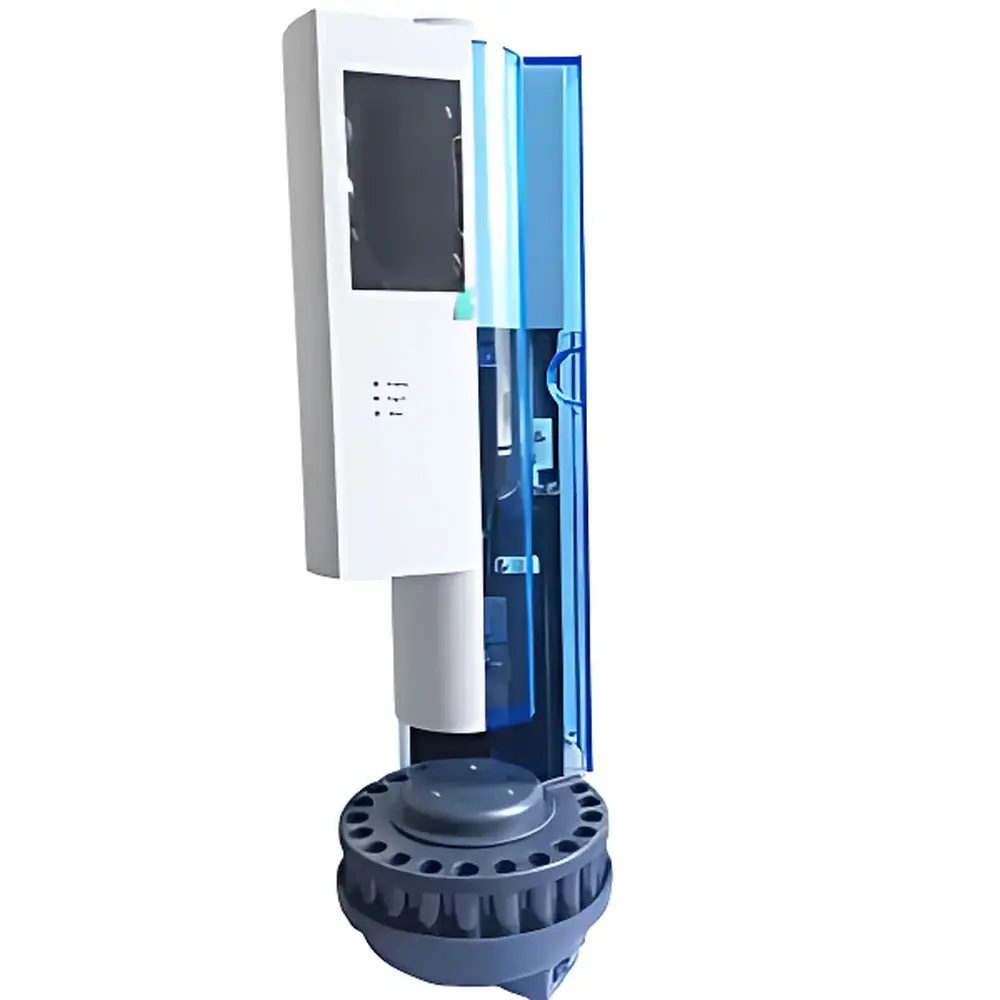
Clarete AS-2912-16 Multifunctional Liquid Autosampler for Gas Chromatography
| Brand | Clarete |
|---|---|
| Origin | Henan, China |
| Manufacturer Type | Direct Manufacturer |
| Product Category | Domestic |
| Model | AS-2912-16 |
| Instrument Type | Gas Chromatography Autosampler |
| Max Sample Capacity | 16 vials |
| Minimum Injection Volume | 0.1 µL |
| Selectable Loop Volumes | 1, 5, 10, 25, 50, 100, 250, 500 µL |
| Positioning Accuracy | 0.1 mm |
| Motion Mechanism | Rotary Carousel |
| Needle Wash Mode | Internal & External Wall Cleaning, User-Configurable |
| Repeat Injection Count | User-Defined, No Hard Limit |
Overview
The Clarete AS-2912-16 is a fixed-tower, rotary-carousel liquid autosampler engineered for precise, reproducible, and unattended sample introduction in gas chromatography (GC) workflows. Designed around core principles of volumetric precision and mechanical repeatability, it employs a high-resolution stepper motor coupled with real-time encoder feedback to ensure consistent syringe positioning and plunger actuation. Unlike linear or robotic-arm architectures, the AS-2912-16’s vertical tower configuration minimizes footprint while maintaining rigid alignment between the injection needle, sample vial, and GC inlet—critical for minimizing carryover and ensuring injection-to-injection volume fidelity. Its architecture supports both conventional split/splitless injections and programmed temperature vaporizing (PTV) inlet operation, with configurable pre- and post-injection dwell times, viscosity delay compensation, and dual-stage solvent rinsing protocols.
Key Features
- Fixed-tower mechanical design with 16-position rotary carousel for compact benchtop integration and reduced vibration-induced variability.
- Precision micro-syringe drive system with selectable injection speeds (fast/slow) and programmable aspiration/injection rates—optimized for low-viscosity aqueous solutions through high-boiling organic solvents.
- User-configurable needle wash protocol: independent control of internal and external needle rinsing cycles using up to two dedicated solvent reservoirs and one waste vial.
- Encoder-based closed-loop positioning ensures ±0.1 mm repeatability across all axes—essential for long-term method robustness and regulatory compliance.
- Modular I/O interface (TTL/RS-232) with documented communication protocol for seamless integration into third-party GC control software or LIMS environments.
- Support for up to 16 user-defined methods, each with independent parameters including loop volume selection, repeat injection count (1–99), PTV timing intervals (0–300 s), and pump draw cycles (up to 20).
- 24/7 unattended operation enabled by thermal-stable motor drivers, non-volatile method storage, and automatic error logging with status flag output.
Sample Compatibility & Compliance
The AS-2912-16 accommodates standard 12 × 32 mm or 16 × 32 mm GC vials (including crimp-top and screw-cap formats) on its indexed 16-position tray. Two dedicated solvent ports support sequential or alternating rinse solvents (e.g., methanol followed by dichloromethane), while the integrated waste management system prevents cross-contamination during high-throughput sequences. The device complies with fundamental mechanical safety standards per IEC 61010-1 for laboratory equipment. While not certified to FDA 21 CFR Part 11 out-of-the-box, its audit-trail-capable firmware (with timestamped method changes, injection logs, and error events) provides a foundation for GLP/GMP validation when deployed within controlled analytical environments. It meets typical requirements for ISO/IEC 17025-compliant labs performing residual solvent analysis, purity testing, or environmental VOC quantification by GC-FID or GC-MS.
Software & Data Management
The AS-2912-16 operates via an embedded ARM-based controller running real-time firmware with a 7-inch capacitive touchscreen HMI. All operational parameters—including loop volume, injection volume, wash sequence depth, dwell times, and PTV trigger logic—are stored in non-volatile memory with versioned method recall. Raw event logs (timestamp, vial ID, loop used, wash count, error code) are exportable via USB mass storage in CSV format. For enterprise integration, the open RS-232/TTL command set enables bidirectional handshake with Agilent, Shimadzu, Thermo Fisher, and PerkinElmer GC hosts. Optional Python SDK and LabVIEW driver packages are available under NDA for custom automation scripting and electronic lab notebook (ELN) synchronization.
Applications
- Residual solvent analysis in pharmaceutical APIs per USP and ICH Q3C guidelines.
- Environmental monitoring of volatile organic compounds (VOCs) in water and soil extracts (EPA Methods 502.2, 524.4, 8260D).
- Quality control of petrochemical fractions, including BTEX and naphthalene homologs.
- Flavor and fragrance profiling in food matrices requiring high sensitivity and low carryover.
- Method development studies requiring variable injection volumes, multi-solvent rinsing, or PTV inlet synchronization.
FAQ
What GC systems is the AS-2912-16 compatible with?
It interfaces natively with major GC platforms via TTL-level start/stop triggers and RS-232 command sets; hardware adapters are available for legacy analog signal inputs.
Can the autosampler handle viscous samples such as silicone oils or polymer solutions?
Yes—viscosity delay (0–120 s) and adjustable aspiration speed allow reliable handling of samples up to ~500 cP when paired with appropriate syringe selection (e.g., 250 µL or 500 µL loop).
Is remote monitoring or network connectivity supported?
The base model does not include Ethernet or Wi-Fi; however, the RS-232 port supports connection to serial-to-Ethernet converters for centralized lab monitoring.
How is calibration verified and maintained?
Calibration is performed using gravimetric verification of delivered volume per ASTM D7097 and traceable NIST-certified syringes; encoder position offsets are field-adjustable via service menu.
Does the system support dual-column or multi-inlet configurations?
No—the AS-2912-16 is designed for single-inlet GC systems; simultaneous multi-inlet operation requires external valve switching modules.




