
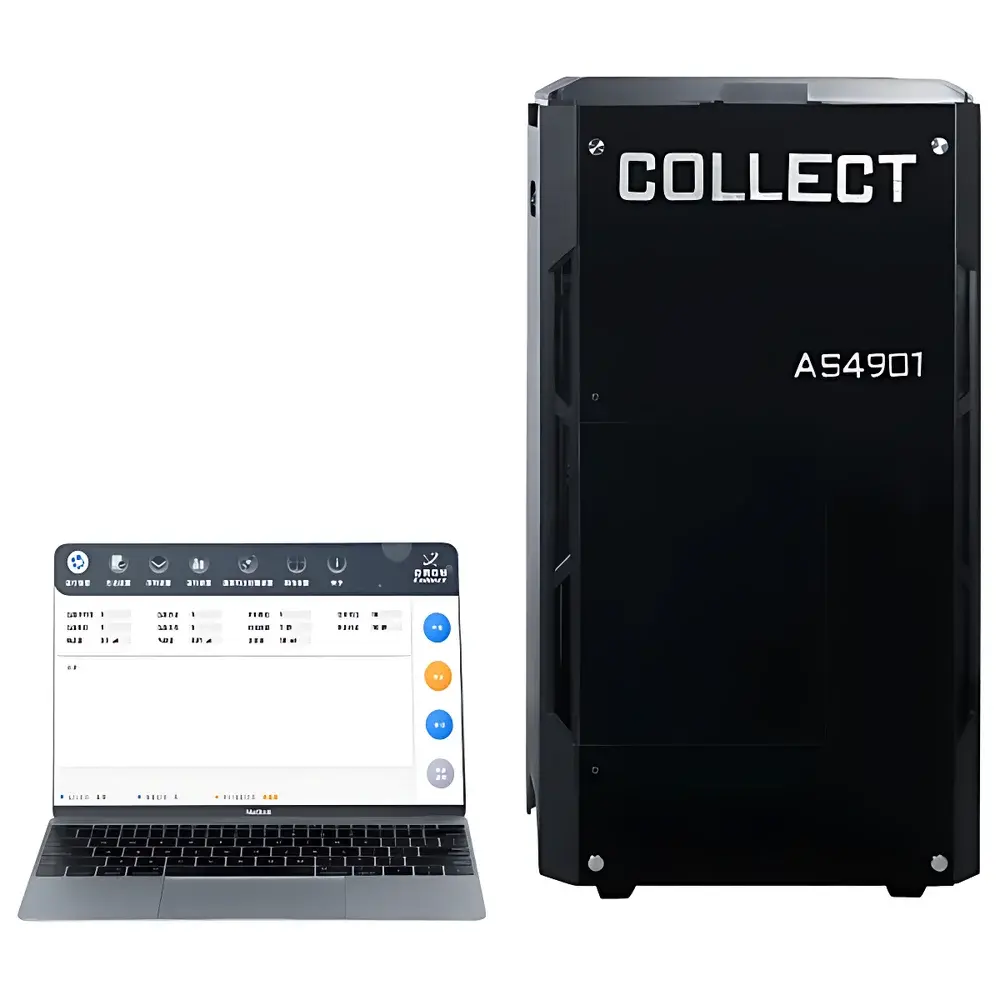
Clarete AS-4901 Multifunctional HPLC Autosampler
| Brand | Clarete |
|---|---|
| Origin | Henan, China |
| Manufacturer Type | OEM Manufacturer |
| Instrument Type | HPLC Autosampler |
| Max Injection Volume | 500 µL |
| Min Injection Volume | 0.1 µL |
| Standard Loop Volume | 20 µL (optional: 10, 50, 100, 500 µL) |
| Positioning Accuracy | <0.3 mm |
| Motion Mechanism | Rotary Carousel |
| Needle Wash | Internal & External Wall Cleaning, Unlimited Cycles |
| Repeat Injection Count | 1–99 |
Overview
The Clarete AS-4901 Multifunctional HPLC Autosampler is an engineered solution for high-precision, unattended liquid chromatography sample introduction. Designed around a rotary carousel architecture with closed-loop encoder feedback, it delivers deterministic positioning and repeatable fluidic actuation essential for regulated analytical workflows. Its core functionality centers on volumetric injection control via selectable fixed-loop or variable-volume aspiration modes—including full-loop, partial-loop, and zero-dead-volume (ZDV) injection—enabling method flexibility across reversed-phase, ion-exchange, size-exclusion, and hydrophilic interaction chromatography (HILIC). The system operates under dual control paradigms: host-instrument reverse communication (e.g., Agilent ChemStation, Waters Empower, Shimadzu LabSolutions) and standalone timed interval triggering, ensuring compatibility with legacy and modern HPLC/UHPLC platforms regardless of vendor origin.
Key Features
- Rotary carousel design with <0.3 mm positional repeatability and real-time encoder-based motion validation for long-term mechanical stability
- High-accuracy syringe-driven sampling mechanism with programmable aspiration, injection, and wash speeds—each independently adjustable to accommodate viscous or volatile matrices
- Dual-wall needle cleaning (internal + external) with user-defined cycles (0–20) or unlimited execution, minimizing carryover to <0.01% as verified per USP carryover test protocols
- Configurable loop volumes (10–500 µL) and syringe sizes (10–500 µL), supporting trace-level quantitation and preparative-scale injections within a single platform
- 20-method method storage with full parameter retention—including viscosity delay (0–120 s), PTV timing (up to 300 s, extendable), and multi-step pump-suck sequences
- Open I/O interface (TTL, RS-232, Ethernet) and documented communication protocol for integration into custom LIMS or automated lab systems compliant with ASTM E1578 and ISO/IEC 17025 requirements
- Robust aluminum alloy chassis with compact footprint (W×D×H: 320 × 450 × 380 mm), facilitating benchtop deployment in GLP-compliant QC laboratories and research facilities
Sample Compatibility & Compliance
The AS-4901 accommodates standard 2.0 mL vials across 16- or 20-position trays; optional 4.0 mL vial support is available upon request. Sample temperature is ambient—no active cooling—but the sealed needle path and low-dead-volume flow path (<1.2 µL from needle tip to loop) reduce solvent evaporation and adsorption artifacts during extended runs. All fluidic components contact surfaces are chemically resistant (PEEK, stainless steel, fused silica), validated for compatibility with acetonitrile, methanol, aqueous buffers (pH 2–10), and 0.1% TFA. The system supports 21 CFR Part 11-compliant audit trails when operated under validated third-party chromatography data systems (CDS); electronic signatures, user access controls, and immutable method logs are enforced at the host-software layer.
Software & Data Management
Control is executed via Windows-based Clarete AutoSampler Manager (ASM) v3.x, featuring real-time status monitoring, step-by-step error logging with diagnostic codes (e.g., “Valve timeout,” “Needle blockage detected”), and automatic recovery from minor faults. Method files (.asm) embed complete instrument state parameters—including injection mode (conventional, sandwich, PTV), dwell times, and wash sequence logic—and are exportable for cross-platform method transfer. Raw injection event timestamps, loop fill pressure traces, and valve actuation durations are logged in CSV format for post-run forensic analysis. ASM integrates natively with major CDS vendors via standardized AIA/ANDI interfaces and provides DLL-based API hooks for Python- or LabVIEW-driven automation frameworks.
Applications
The AS-4901 is routinely deployed in pharmaceutical stability-indicating assays (ICH Q5C), environmental pesticide residue screening (EPA Method 531.1), clinical therapeutic drug monitoring (TDM), and food safety testing (AOAC 2012.01). Its ZDV injection mode eliminates sample loss during loop overfilling—critical for limited-volume biological matrices such as cerebrospinal fluid or microdialysate. The PTV (Programmed Temperature Vaporization) injection capability enables direct large-volume injection (LVI) of dilute environmental extracts without pre-concentration, reducing solvent consumption and procedural variability. In QC environments, its RSD ≤0.3% precision at 1 µL injections meets USP system suitability criteria for assay validation.
FAQ
Is the AS-4901 compatible with non-Clarete HPLC systems?
Yes—it supports reverse control via industry-standard hardware triggers and software protocols (Agilent, Waters, Shimadzu, Thermo Fisher, and国产 systems with TTL/RS-232/Ethernet interfaces).
What validation documentation is provided?
Factory calibration reports, IQ/OQ templates aligned with ASTM E2500, and material compliance certificates (RoHS, REACH) are included. PQ support is available through authorized service partners.
Can the system perform sequential injections from multiple vials without manual intervention?
Yes—up to 99 repeat injections per vial, with programmable inter-injection delays (1–65535 seconds), enabling kinetic time-course studies and automated calibration curve generation.
Does it support low-volume injections below 1 µL?
Yes—minimum 0.1 µL injection volume is achievable using 10 µL syringes and 10 µL loops under ZDV mode, with demonstrated RSD <0.8% at 0.5 µL in methanol/water (90:10) matrix.
How is carryover mitigated during high-concentration sample analysis?
Triple-stage wash protocol (solvent A → solvent B → air dry) with configurable internal/external needle flushes ensures residual mass reduction to <100 pg across diverse analytes, verified by blank injection testing per ISO 17025 clause 7.7.
Related Products





