
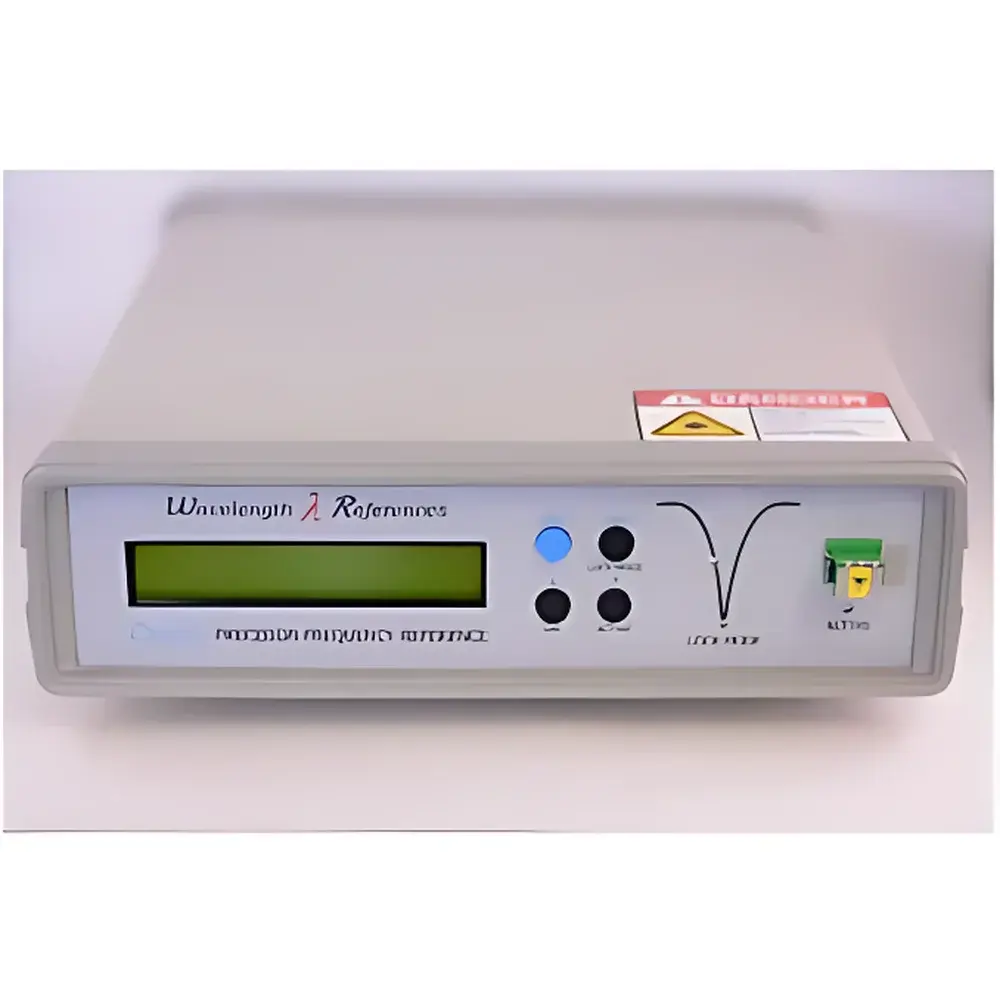
ClarityPlus C-Band Tunable Stabilized Laser System
| Origin | Imported |
|---|---|
| Manufacturer Type | Authorized Distributor |
| Key Components | Semiconductor Laser Module |
| Model | ClarityPlus |
| Wavelength Range | 1528–1567 nm |
| Absolute Accuracy (Reference Mode) | ±0.1 pm |
| Absolute Accuracy (ITU Grid Mode) | ±1 pm |
| Allan Deviation (100 s) | <1×10⁻⁹ |
| Laser Linewidth | <500 kHz |
| ITU Channel Spacing Options | 100 / 50 / 25 GHz |
| ITU Frequency Offset Range | 0–50 GHz |
| Operating Temperature | 15–45 °C |
| Side Mode Suppression Ratio | >35 dB |
| Relative Intensity Noise | <−140 dB/Hz |
| Output Power | +10 dBm |
| Power Stability | ±0.025 dB over 24 h |
| Polarization | Polarization-Maintaining (PM) Fiber Output |
| Connector | SC/APC |
| Internal Reference | NIST-Traceable H¹³C¹⁴N Molecular Absorption Cell |
Overview
The ClarityPlus C-Band Tunable Stabilized Laser System is a precision semiconductor-based laser source engineered for metrology-grade wavelength accuracy and long-term frequency stability in optical test, sensing, and coherent communication applications. Operating across the full ITU-defined C-band (1528–1567 nm), it employs a dual-reference architecture: an internal, thermally stabilized H¹³C¹⁴N molecular absorption cell—NIST-traceable to primary frequency standards—and a programmable ITU grid synthesizer with selectable channel spacing (100/50/25 GHz) and continuous frequency offset capability up to ±50 GHz. This hybrid referencing enables both absolute wavelength calibration and grid-aligned operation without external instrumentation. The system’s narrow intrinsic linewidth (<500 kHz) supports high-resolution spectroscopy and low-phase-noise coherent detection, while its robust thermal and mechanical design ensures sub-picometer wavelength drift (<1 pm) over ambient temperature excursions of ±10 °C and maintains power stability within ±0.025 dB over 24 hours—critical for insertion loss mapping, interferometric sensing, and photonic integrated circuit characterization.
Key Features
- NIST-traceable wavelength calibration via integrated H¹³C¹⁴N reference cell, enabling direct traceability to SI second without external wavemeters or gas cells
- Simultaneous support for absolute reference locking (50+ absorption lines) and ITU grid alignment with user-selectable channel spacing and continuous offset tuning
- Sub-0.1 pm absolute wavelength accuracy in reference mode; ±1 pm in ITU grid mode
- Low phase noise performance: Allan deviation <1×10⁻⁹ at 100 s integration time, suitable for heterodyne and self-heterodyne linewidth measurement
- Polarization-maintaining fiber output (SC/APC connector) with >35 dB side-mode suppression ratio and −140 dB/Hz relative intensity noise floor
- Thermally compensated cavity design ensuring <1 pm wavelength drift over 10 °C ambient variation and stable output across 15–45 °C operating range
Sample Compatibility & Compliance
The ClarityPlus is designed for use with standard single-mode and polarization-maintaining fiber systems compliant with IEC 61300-3-2 (fiber optic connector durability) and Telcordia GR-1209-CORE (optical component reliability). Its wavelength accuracy and stability meet requirements for Tier-1 optical component testing per ITU-T G.694.1 (DWDM grid specification) and support GLP-compliant calibration workflows when paired with validated SOPs. While not certified as a medical or safety-critical device, its output adheres to Class 1M laser safety limits per IEC 60825-1:2014 when used with specified PM fiber delivery. Traceability documentation—including NIST calibration certificates for the onboard reference cell—is provided with each unit to satisfy ISO/IEC 17025 audit requirements for accredited laboratories.
Software & Data Management
The ClarityPlus includes a vendor-provided Windows/Linux-compatible SDK (C/C++, Python, LabVIEW APIs) supporting remote control via USB or Ethernet (TCP/IP). All wavelength setpoints, lock statuses, power readings, and environmental sensor data (TEC current, diode temperature, photodiode feedback) are timestamped and logged in HDF5 format, enabling full experimental reproducibility. Audit trails include operator ID, parameter change history, and lock acquisition timestamps—supporting 21 CFR Part 11 compliance when deployed in regulated environments with appropriate IT governance. Firmware updates preserve calibration coefficients and retain factory NIST traceability metadata, ensuring continuity across maintenance cycles.
Applications
- Coherent optical receiver testing and local oscillator sourcing for QPSK/QAM modulation analysis
- Fiber Bragg grating (FBG) and microresonator sensor interrogation requiring sub-pm resolution and long-term drift compensation
- Calibration of optical spectrum analyzers (OSAs), wavelength meters, and tunable filters against primary standards
- Photonic integrated circuit (PIC) characterization including ring resonator resonance mapping and Mach–Zehnder interferometer bias control
- Quantum optics experiments requiring phase-stable, narrow-linewidth sources for homodyne detection and optical frequency comb stabilization
- Optical time-domain reflectometry (OTDR) source validation and dispersion measurement reference generation
FAQ
Is the H¹³C¹⁴N reference cell replaceable or recalibratable in the field?
No—the sealed, thermally stabilized reference cell is factory-aligned and permanently integrated; recalibration requires return to the manufacturer’s metrology lab with NIST-traceable transfer standards.
Can the laser operate in open-loop current-tuning mode without active wavelength locking?
Yes—manual current tuning is supported, but wavelength accuracy degrades to ±5 pm typical; closed-loop reference or ITU locking is required for metrological applications.
Does the system support external RF modulation for sideband generation?
The base model provides analog current modulation input (0–1 V, bandwidth DC–10 MHz); optional EOM driver modules enable high-fidelity phase or amplitude modulation for coherent synthesis.
What is the warm-up time to achieve full spectral stability?
Full thermal equilibrium and sub-pm stability are achieved within 30 minutes of power-on under nominal lab conditions (23±2 °C, no drafts).
Are firmware updates provided free of charge during the warranty period?
Yes—lifetime firmware updates, including new ITU grid definitions and enhanced lock algorithms, are included with registration and valid support contract.




