
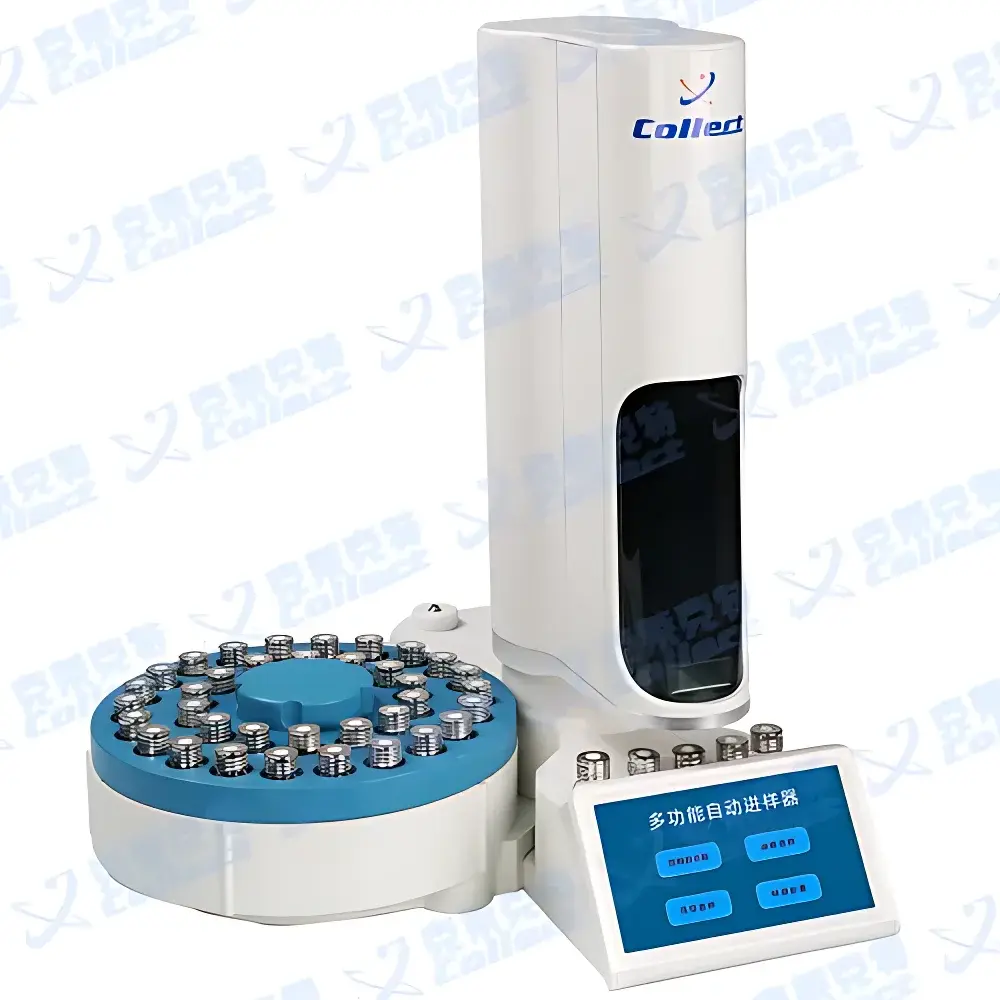
Cleket AS-3901ASH Automated Multifunctional Autosampler with SPME Capability
| Brand | Cleket |
|---|---|
| Origin | Henan, China |
| Manufacturer Type | Manufacturer |
| Product Category | Domestic |
| Model | AS-3901ASH |
| Instrument Type | Multifunctional Autosampler |
| Max Sample Capacity | 160 positions |
| Minimum Injection Volume | 0.1 µL |
| Loop Volume | 500 µL |
| Positioning Accuracy | 0.1 mm |
| Motion Mechanism | Turret-style rotary motion |
| Needle Wash Mode | Internal and external wall wash, programmable cycles |
| Repeat Injection Capability | Unlimited |
Overview
The Cleket AS-3901ASH is an engineered multifunctional autosampler designed for high-throughput, reproducible sample introduction into gas chromatography (GC) and GC–mass spectrometry (GC–MS) systems. Built upon a precision turret-based rotary architecture, it integrates three core sample introduction modalities—liquid-phase injection, solid-phase microextraction (SPME), and headspace analysis—within a single platform. Its operational principle leverages programmable stepper-motor-driven positioning (±0.1 mm repeatability) combined with thermally controlled, modular sample handling modules. Unlike conventional fixed-function autosamplers, the AS-3901ASH decouples functionality from hardware via interchangeable sample trays and tooling heads—enabling seamless transition between analytical workflows without mechanical reconfiguration or instrument relocation. This design supports GLP-compliant laboratories requiring trace-level sensitivity (e.g., sub-ppb benzene detection in aqueous matrices) and robust batch processing across heterogeneous sample types (liquids, solids, volatiles).
Key Features
- Turret-style rotary motion system ensures low-vibration, high-stability positioning across all operational modes
- Modular tray interface: one base unit accommodates 160-position liquid vial trays (2 mL), 36-position SPME vial trays (10/20 mL), and 36-position headspace vial trays (20 mL)
- Triple-mode operation: fully automated liquid injection, SPME extraction/desorption, and pressurized headspace sampling—all controllable via unified software interface
- Dual-injection-port support: enables concurrent use of split/splitless and PTV inlets on a single GC system without port conflict
- Programmable needle depth adjustment (2–40 mm) and customizable injection speed profiles (fast/medium/slow/user-defined) for viscosity-adaptive liquid handling
- Integrated SPME aging module with nitrogen purge and temperature control (RT–350 °C, ±1 °C); independent heating/stirring of sample vials (RT–150 °C, 0–1500 rpm)
- Heated headspace syringe (RT–200 °C, ±1 °C) with adjustable equilibrium time (0–1440 min), pressurization control, and inert-gas purging pre/post-injection to eliminate carryover
Sample Compatibility & Compliance
The AS-3901ASH supports diverse sample formats including aqueous solutions, organic solvents, suspensions, soils, polymers, and biological tissues. Its SPME and headspace configurations comply with ASTM D7622 (standard test method for determination of volatile organic compounds in water by SPME–GC–MS) and ISO 11843-7 (capability of detection—part 7: methodology for comparing two methods). Liquid injection performance meets USP and ICH Q2(R2) requirements for precision (RSD < 0.5% for repeated injections) and accuracy. All thermal modules are calibrated per ISO/IEC 17025 traceable procedures. The system supports 21 CFR Part 11–compliant audit trails when operated with validated third-party chromatography data systems (CDS), including Thermo Fisher Chromeleon, Agilent OpenLab CDS, and Waters Empower.
Software & Data Management
Control is executed through Cleket’s proprietary AS-3901ASH Control Suite—a Windows-based application supporting method development, sequence building, real-time monitoring, and event logging. The software provides full bidirectional communication with GC/GC–MS instruments via RS-232, Ethernet, or USB, enabling full instrument parameter synchronization (oven ramp, inlet pressure, detector settings). Each run generates timestamped metadata including vial position, injection volume, temperature setpoints, stir speed, purge cycles, and error flags. Raw log files export in CSV/ASCII format for integration into LIMS environments. Optional API access allows custom scripting for automated report generation and QC flagging based on user-defined thresholds.
Applications
- Environmental analysis: quantification of VOCs (BTEX, chlorinated hydrocarbons) in groundwater and soil extracts using SPME–GC–MS
- Food & flavor profiling: headspace analysis of esters, aldehydes, and terpenes in beverages and dairy products
- Pharmaceutical residual solvent testing: ICH Q3C-compliant determination of Class 2 solvents in APIs via static headspace–GC–FID
- Clinical toxicology: rapid screening of ethanol, methanol, and isopropanol in whole blood using dual-headspace calibration
- Polymer additive migration studies: SPME-based extraction of plasticizers (e.g., phthalates) from food-contact materials
- Forensic chemistry: simultaneous liquid injection and SPME for confirmation analysis of seized drug samples
FAQ
Can the AS-3901ASH be integrated with non-Cleket GC systems?
Yes—it features universal hardware interfaces (RS-232, Ethernet) and supports standard GC command protocols used by Agilent, Thermo Fisher, Shimadzu, and PerkinElmer instruments.
Is SPME fiber conditioning automated?
Yes—the built-in aging module performs temperature-programmed conditioning under nitrogen flow, with configurable time/temperature profiles and automatic cooldown before insertion.
Does the system support unattended overnight operation?
Yes—full sequence execution, including multi-step SPME protocols (extraction → desorption → cleaning), is supported with power-fail recovery and hardware interlock monitoring.
What maintenance is required for long-term reliability?
Routine tasks include syringe lubrication every 5000 injections, septum replacement per 2000 injections, and quarterly verification of thermal calibration against NIST-traceable references.
How is cross-contamination prevented during high-sensitivity analysis?
The system employs dual-stage needle washing (internal flush + external rinse), programmable inert-gas purging between samples, and SPME fiber thermal desorption at up to 350 °C with post-desorption bake-out cycles.




