
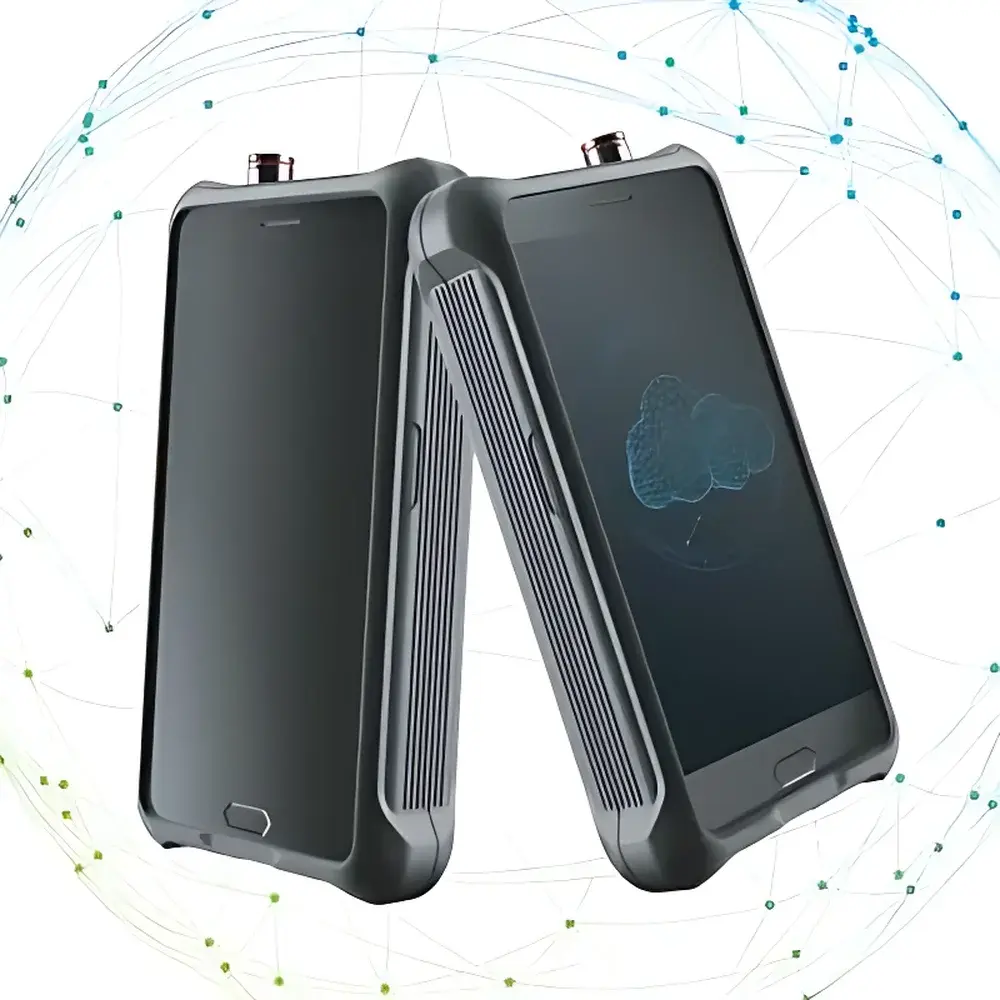
CloudOptek M1/M2 Cloud-Intelligent Handheld Raman Spectrometer
| Brand | CloudOptek |
|---|---|
| Origin | Beijing, China |
| Model | M1/M2 |
| Instrument Type | Portable/Handheld Raman Spectrometer |
| Spectral Range | 200–1800 cm⁻¹ |
| Spectral Resolution | 8–11 cm⁻¹ |
| Spatial Resolution | 1 µm (lateral), 1 µm (axial) |
| Minimum Wavenumber | 200 cm⁻¹ |
| Spectral Reproducibility | <1 cm⁻¹ |
| Laser Wavelength | 785 nm / 830 nm |
| Laser Power | 1–500 mW (adjustable) |
| Detection Time | <3 s (e.g., ethanol) |
| Display | 5.7″, 2560×1440 |
| Camera System | 8 MP + 16 MP + 2 MP (iris recognition) |
| Connectivity | 4G, Wi-Fi, Bluetooth, NFC |
| GNSS Support | A-GPS, GLONASS, BeiDou |
| Battery Capacity | 5700 mAh |
| Dimensions | 159 × 78.9 × 27 mm |
| Weight | 410 g |
| Database | Cloud-synced base library, expandable library, user-defined library |
| AI Capabilities | Deep learning–based compound identification, mixture quantification (<5% error), real-time spectral classification |
Overview
The CloudOptek M1/M2 is a next-generation handheld Raman spectrometer engineered for field-deployable, lab-grade molecular identification and quantitative analysis. Built upon a true cloud-edge-device architecture, it integrates high-fidelity Raman acquisition hardware with edge-AI inference and centralized cloud intelligence—enabling real-time spectral interpretation without reliance on local computational resources. The instrument operates on the principle of inelastic light scattering, where monochromatic laser excitation (785 nm or 830 nm) induces vibrational mode shifts in chemical bonds, generating characteristic fingerprint spectra between 200 cm⁻¹ and 1800 cm⁻¹. Its optical design delivers consistent spectral reproducibility (<1 cm⁻¹ wavenumber drift over 8-hour operation) and supports both solid and liquid sample interrogation under ambient conditions. Unlike legacy portable systems constrained by offline libraries or static algorithms, the M1/M2 leverages continuous cloud-based model retraining and federated learning to adapt to evolving threat profiles and regulatory requirements—making it suitable for rapid-response applications in hazardous material screening, pharmaceutical verification, and food authenticity testing.
Key Features
- Sub-3-second spectral acquisition and AI-assisted identification for common analytes (e.g., ethanol, acetone, paracetamol), enabled by adaptive signal-to-noise optimization and real-time baseline correction.
- Dual-domain operational architecture: a secure “Inspection Domain” for calibrated spectroscopic measurement (NIST-traceable wavelength calibration, laser power monitoring) and a segregated “Personal Domain” for device management and user interface—ensuring separation of critical analytical functions from general-purpose computing.
- Multi-spectral imaging suite including visible-light, macro, and iris-recognition cameras (8 MP + 16 MP + 2 MP), supporting spatially registered Raman mapping and operator authentication per GLP-compliant workflows.
- Adjustable laser output (1–500 mW) with automatic power regulation based on sample thermal sensitivity and ambient light conditions—minimizing fluorescence interference and photodegradation risk during repeated measurements.
- Integrated multi-constellation GNSS (A-GPS, GLONASS, BeiDou) with timestamped geolocation tagging for audit-ready field reports compliant with ISO/IEC 17025 documentation requirements.
Sample Compatibility & Compliance
The M1/M2 accommodates direct analysis of opaque solids, translucent powders, viscous liquids, and sealed transparent containers without sample preparation. Its 1 µm lateral and axial spatial resolution enables micro-domain targeting—critical for heterogeneous mixtures or layered pharmaceutical tablets. All spectral data are captured in vendor-neutral .spc and .jdx formats, ensuring interoperability with third-party chemometric software (e.g., Unscrambler®, MATLAB®). The system adheres to IEC 61000-4 electromagnetic compatibility standards and meets Class 3B laser safety requirements per IEC 60825-1:2014. Firmware and cloud platform operations support audit trails, electronic signatures, and role-based access control—facilitating alignment with FDA 21 CFR Part 11 and EU Annex 11 for regulated environments.
Software & Data Management
The CloudOptek Intelligence Platform provides a zero-client, browser-accessible interface for spectral library curation, model versioning, and multi-tenant deployment. Base spectral libraries (e.g., USP Reference Standards, NIST Chemistry WebBook derivatives) are updated automatically via encrypted OTA channels; custom libraries undergo differential synchronization to minimize bandwidth usage. Quantitative mixture analysis employs constrained non-negative least squares (NNLS) regression trained on >12,000 reference spectra across 380+ compounds—achieving <5% relative error in binary and ternary blend estimation under controlled illumination. All processing logs, spectral metadata, and operator actions are retained for ≥36 months with SHA-256 hashing integrity verification.
Applications
- Hazardous material identification in emergency response scenarios, including explosives precursors, illicit drugs, and industrial solvents.
- Pharmaceutical supply chain verification: counterfeit detection, excipient profiling, and dosage uniformity assessment of intact blister packs.
- Food safety surveillance: adulterant screening (e.g., melamine in milk powder, Sudan dyes in spices), origin authentication (geographic marker detection), and spoilage indicator quantification.
- Forensic trace evidence analysis: fiber, paint chip, and ink differentiation without destructive sampling.
- Academic and industrial R&D: rapid reaction monitoring, polymorph screening, and catalyst surface characterization in situ.
FAQ
Does the M1/M2 support regulatory-compliant data archiving?
Yes—the system generates immutable audit trails with cryptographic timestamps and supports export to LIMS-compatible formats (ASTM E1384, ASTM E2500) for long-term archival per 21 CFR Part 11 Subpart B requirements.
Can users deploy custom spectral models without cloud dependency?
No. The M1/M2 requires active cloud connectivity for model inference and library validation; however, edge-cached models remain functional for up to 72 hours during intermittent connectivity.
Is laser calibration traceable to national standards?
Yes—each unit ships with a factory certificate of calibration referencing NIST SRM 2241 (polystyrene), and field recalibration is supported via integrated neon-argon emission lamp reference.
What is the maximum allowable ambient temperature for continuous operation?
The device is rated for sustained use between −10 °C and +50 °C, with active thermal stabilization maintaining detector dark current within ±5% of nominal across this range.
How frequently are cloud libraries updated?
Base libraries receive biweekly updates; user-submitted spectra undergo automated QC review and integration within 72 business hours post-approval.





