
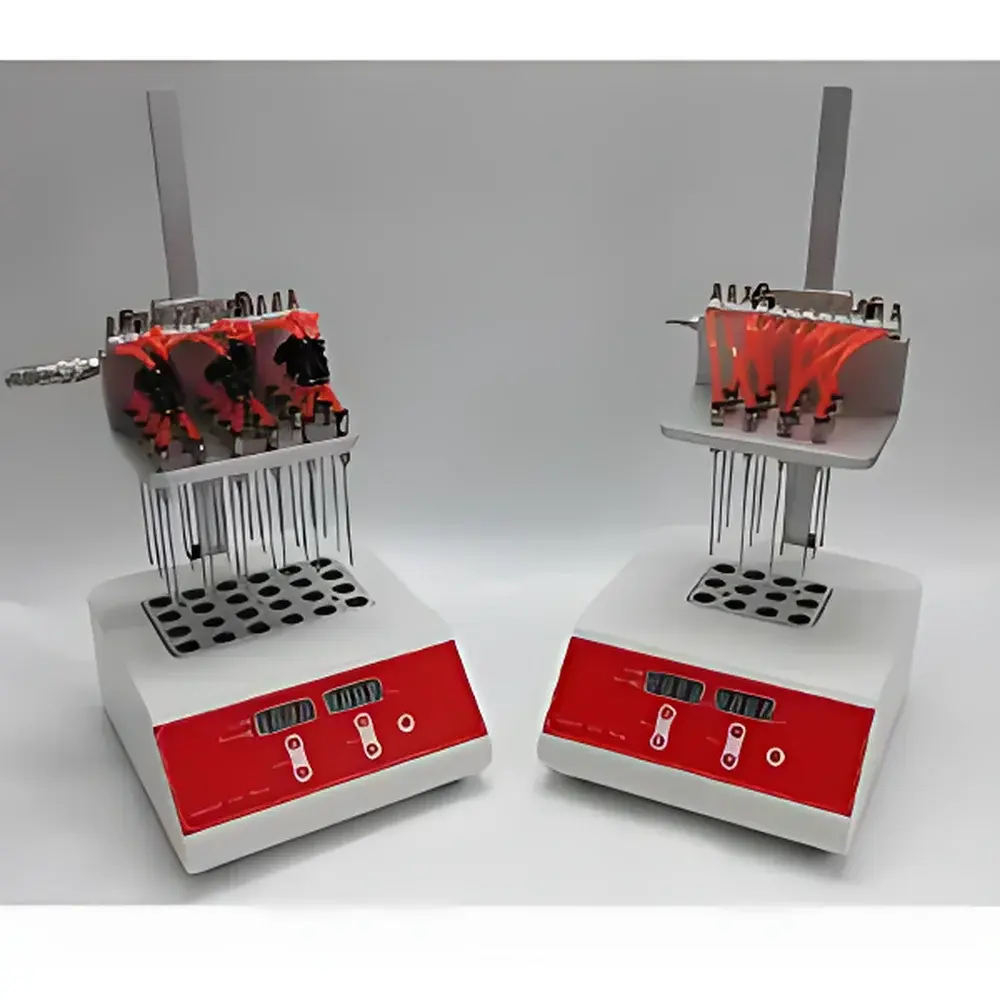
CM200-2 Dry-Block Adjustable Nitrogen Evaporator by Chengmeng Weiye
| Brand | Chengmeng Weiye |
|---|---|
| Origin | Beijing, China |
| Manufacturer Type | Direct Manufacturer |
| Model | CM200-2 |
| Heating Method | Dry-Block Heating |
| Temperature Range | Ambient +5°C to 150°C |
| Temperature Stability | ±0.5°C at 100°C |
| Temperature Accuracy | ±0.5°C (40–100°C), ±1°C (100–150°C) |
| Sample Capacity | 24 positions |
| Tube Diameter Compatibility | Up to 15 mm |
| Nitrogen Flow Rate | 0–10 L/min |
| Maximum Power Consumption | 400 W |
| Heating Block Material | Aluminum Alloy with Anodized Surface |
| Time Setting Range | 0–99 h 59 min |
| Safety Features | Over-Temperature Protection, Auto Fault Detection & Audible Alarm |
| Display | Dual LED Display (Real-Time Temperature + Countdown Timer) |
| Dimensions (W×D×H) | 280 × 240 × 500 mm |
| Weight | Approx. 8.2 kg |
Overview
The CM200-2 Dry-Block Adjustable Nitrogen Evaporator is a precision-engineered sample concentration system designed for high-throughput laboratories performing quantitative analysis in pharmaceutical development, clinical research, environmental testing, and forensic toxicology. Unlike water-bath or sand-bath evaporators, this instrument employs a thermostatically controlled aluminum heating block to deliver rapid, uniform thermal transfer—eliminating cross-contamination risks associated with liquid media. Nitrogen gas is delivered via individually adjustable stainless-steel needles positioned above each sample vial, facilitating solvent evaporation under inert atmosphere. This process prevents oxidation of thermolabile analytes (e.g., steroids, prostaglandins, pesticides) and ensures reproducible recovery rates essential for LC-MS/MS, GC-MS, and ELISA workflows. The system operates without vacuum pumps or condensers, reducing maintenance overhead while maintaining full compliance with ISO/IEC 17025 method validation requirements for sample preparation stages.
Key Features
- Dry-block heating architecture with anodized aluminum block—enabling fast ramp-up (≤30 min from 40°C to 150°C) and exceptional thermal homogeneity across all 24 positions.
- Independent gas flow control per channel using 24 precision needle valves—allowing selective nitrogen delivery and minimizing gas consumption during partial-load operation.
- Vertically adjustable gas manifold with standardized 150 mm stainless-steel needles—compatible with common tube formats including 10–15 mm OD vials, culture tubes, and microcentrifuge tubes.
- Integrated dual-function LED display showing real-time setpoint temperature and countdown timer (0–99 h 59 min)—supporting unattended overnight evaporation protocols.
- Over-temperature cutoff circuit with automatic shutdown and audible alarm—meeting IEC 61010-1 safety standards for laboratory electrical equipment.
- Modular design supporting interchangeable heating blocks (sold separately)—enabling adaptation to alternative tube geometries or specialized applications such as derivatization pre-concentration.
- Compact footprint (280 × 240 × 500 mm) and low-profile chassis—optimized for placement inside fume hoods when handling volatile or hazardous solvents (e.g., chloroform, hexane, acetonitrile).
Sample Compatibility & Compliance
The CM200-2 accommodates standard 15 mm outer-diameter test tubes, 13 × 100 mm culture tubes, and 1.5 mL microcentrifuge tubes without adapter modification. Its dry-heating configuration avoids immersion-related issues such as water ingress, mineral buildup, or inconsistent heat distribution—critical for GLP-compliant residue analysis per EPA Method 525.3 and FDA Bioanalytical Method Validation Guidance. All electrical components conform to CE marking requirements and meet RoHS Directive 2011/65/EU restrictions on hazardous substances. While not certified for Class I Div 1 hazardous locations, the unit is routinely deployed in ISO 14644-1 Class 7 cleanrooms when paired with external nitrogen generators meeting ASTM D6350 purity specifications (≥99.999% N₂).
Software & Data Management
The CM200-2 operates as a standalone hardware platform with no embedded firmware or network interface. However, its analog temperature feedback loop and digital timer output are compatible with external data loggers (e.g., Omega OM-DAQPRO-5300) for 21 CFR Part 11–compliant audit trails. Users may integrate the device into LIMS environments via RS-232 or USB-to-serial adapters using Modbus RTU protocol (custom driver available upon request). Temperature calibration records—including as-found/as-left data, reference standard traceability (NIST-traceable thermometer), and uncertainty budgets—are maintained per ISO/IEC 17025 Clause 6.4.1.
Applications
- Routine concentration of biological matrices (plasma, urine, tissue homogenates) prior to LC-MS quantification of small-molecule drugs.
- Preparative cleanup steps in multiresidue pesticide analysis (EN 15662:2018).
- Derivatization reaction quenching and reagent removal in amino acid profiling workflows.
- High-volume environmental water testing where EPA Method 8270D requires solvent exchange before GC-MS injection.
- Stability-indicating assays involving light- and oxygen-sensitive compounds such as retinoids or catecholamines.
FAQ
Can the CM200-2 be used with solvents other than methanol or acetonitrile?
Yes—the system supports any low-boiling-point organic solvent (bp < 150°C) provided appropriate ventilation and pressure-rated gas lines are used.
Is third-party calibration documentation available?
Calibration certificates issued by CNAS-accredited labs (with uncertainty values ≤ ±0.3°C at 100°C) can be supplied upon order confirmation.
What maintenance is required for long-term reliability?
Annual inspection of heating block emissivity, needle valve seat integrity, and thermal fuse functionality is recommended; no lubrication or consumables are required.
Does the unit support programmable multi-step temperature ramps?
No—this model implements single-setpoint control only; multi-stage protocols require external programmable controllers or manual intervention.
How does the dry-block design improve reproducibility versus water-bath nitrogen evaporators?
Elimination of convective turbulence and bath-level variability yields ±0.5°C inter-position uniformity—versus typical ±2.5°C variation observed in water-bath systems under identical load conditions.



