
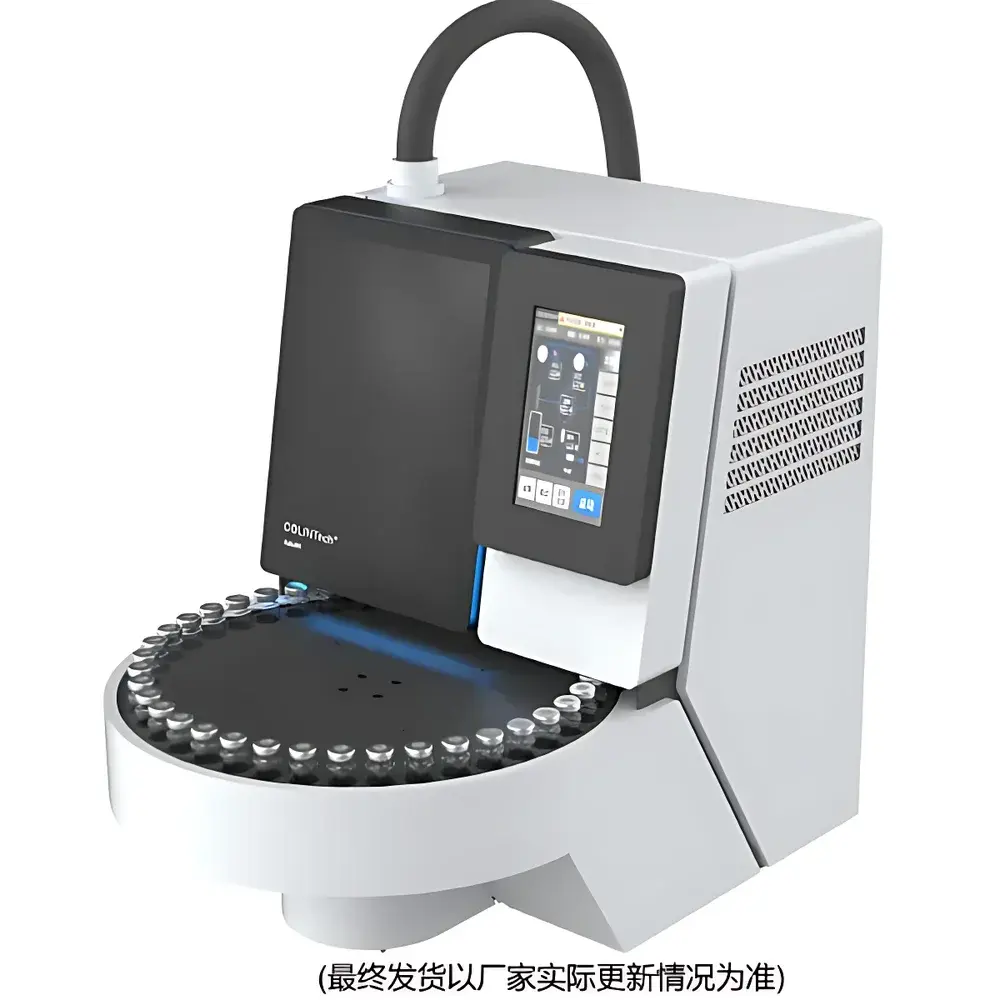
Colintech AutoHS® 40B Advanced Automated Headspace Sampler
| Brand | Colintech |
|---|---|
| Origin | Sichuan, China |
| Manufacturer Type | Original Equipment Manufacturer (OEM) |
| Instrument Type | Dynamic Headspace Sampler |
| Automation Level | Fully Automatic |
| Sample Vial Capacity | 40 positions |
| Vial Size | 20 mL |
| Oven Temperature Range | Ambient to 180 °C |
| Valve & Needle Temperature Range | 35–210 °C |
| Sampling Mechanism | Time-based quantitative injection (no fixed loop volume) |
| Method Storage | 10 user-defined methods |
| Electronic Pressure Control (EPC) | Yes |
| Compliance | Designed for ASTM D3699, ISO 11843-2, USP <467>, and EPA Method 502.2 / 524.2 workflows |
Overview
The Colintech AutoHS® 40B is a fully automated dynamic headspace sampler engineered for high-throughput, reproducible volatile organic compound (VOC) analysis in conjunction with gas chromatography (GC) or GC/MS systems. It operates on the principle of equilibrium and dynamic purge-and-trap extraction, enabling precise quantification of analytes partitioned from liquid or solid matrices into the vapor phase above the sample — the “headspace.” Unlike conventional static headspace systems, the AutoHS® 40B implements a proprietary dual-path static/dynamic compensation extraction architecture, which simultaneously maintains thermal equilibrium while actively purging the headspace with carrier gas at controlled flow rates. This design minimizes memory effects, eliminates carryover from high-concentration samples, and delivers superior sensitivity across both polar and non-polar compounds — critical for pharmaceutical residual solvent testing, environmental water analysis, food flavor profiling, and polymer leachables screening.
Key Features
- Fully automated operation with 40-position 20 mL vial carousel and 15 independently controllable heating zones, supporting overlapping thermal equilibration cycles to maximize instrument uptime.
- Dual-path extraction system integrating static equilibration with dynamic compensation purge, reducing dead volume to near-zero and eliminating residual contamination between runs.
- Time-based quantitative injection mode: precise control over injection duration (0.01–99.99 s resolution) enables flexible, method-tuned analyte transfer without mechanical loop replacement.
- Independent temperature control for vial oven (ambient to 180 °C), transfer line (up to 210 °C), and sampling needle (35–210 °C), ensuring complete volatilization and preventing condensation-induced bias.
- Integrated Electronic Pressure Control (EPC) module compatible with all major GC and GC/MS platforms — no external pressure regulators or manual calibration required.
- Intuitive graphical user interface with real-time status visualization, sequence editing, and on-screen method validation prompts; supports up to 10 stored methods with customizable run sequences.
- Optional vial agitation module available for enhanced mass transfer kinetics in heterogeneous or viscous samples (e.g., soil slurries, pharmaceutical suspensions).
Sample Compatibility & Compliance
The AutoHS® 40B accommodates standard 20 mL crimp-top headspace vials with silicone/PTFE septa and is validated for use with aqueous, alcoholic, oily, semi-solid, and solid-phase matrices including soils, polymers, tablets, and packaged foods. Its thermal and pressure control architecture meets the operational requirements of globally recognized analytical standards: USP for residual solvents in pharmaceuticals, ASTM D3699 for benzene in gasoline, ISO 11843-2 for detection limit estimation in headspace-GC, and EPA Methods 502.2 (VOCs in drinking water) and 524.2 (purge-and-trap GC/MS). The system supports GLP-compliant audit trails when paired with compliant LIMS or chromatography data systems (CDS), and its EPC functionality aligns with FDA 21 CFR Part 11 requirements for electronic record integrity when configured with appropriate software controls.
Software & Data Management
The embedded firmware provides full local control via a 7-inch capacitive touchscreen interface with multi-level password protection, method versioning, and automatic event logging (vial position, temperature ramp history, injection timing, pressure setpoints). Raw method parameters are exportable in CSV format for traceability. When interfaced with third-party CDS platforms (e.g., Thermo Chromeleon, Agilent OpenLab, Shimadzu GCsolution), the AutoHS® 40B communicates via industry-standard RS-232 or Ethernet protocols, enabling synchronized method triggering, status feedback, and error reporting. Sequence files can be imported/exported using ASCII-based protocol definitions, facilitating laboratory-wide method harmonization and cross-platform validation.
Applications
- Pharmaceutical quality control: Residual solvent quantification per ICH Q3C guidelines (e.g., acetone, dichloromethane, toluene in APIs and formulations).
- Environmental monitoring: VOC analysis in groundwater, wastewater, and soil extracts per EPA regulatory frameworks.
- Food & beverage safety: Ethanol, aldehydes, esters, and off-flavor compounds in dairy, wine, and infant formula.
- Materials science: Monomer release testing from adhesives, coatings, and medical device packaging.
- Forensic toxicology: Volatile substance identification in blood and tissue homogenates.
FAQ
Is the AutoHS® 40B compatible with third-party GC systems?
Yes — it features universal EPC and TTL-level trigger interfaces, certified for seamless integration with Agilent, Thermo Fisher, Shimadzu, PerkinElmer, and Bruker GC platforms.
Does the system support method validation per regulatory guidelines?
Yes — its stable thermal gradients, pressure-controlled sampling, and electronic audit trail capabilities support IQ/OQ/PQ documentation aligned with ISO/IEC 17025 and FDA CGMP expectations.
Can the instrument perform both static and dynamic headspace modes?
It operates primarily in dynamic compensation mode, but static equilibrium conditions are programmatically maintained during the initial incubation phase prior to purge initiation.
What maintenance is required for long-term reliability?
Routine maintenance includes septum replacement every 100 injections, annual calibration of temperature sensors and pressure transducers, and quarterly cleaning of the transfer line and needle assembly using certified GC-grade solvents.
Is remote monitoring or network connectivity supported?
Ethernet connectivity enables remote status viewing and sequence upload via HTTP-based web interface; full remote control requires integration with vendor-supported CDS middleware.
Related Products





